Equisetaceæ
Equisetaceæ
The Horse-Tail Tribe
- 合集
- 植物自然目
- 绘者
- Elizabeth Twining(伊丽莎白·特温宁)
- 年代
- 1868
- 图版号
- Order 152
- 原书页码
- p.152
- 授权
- CC BY-SA 4.0
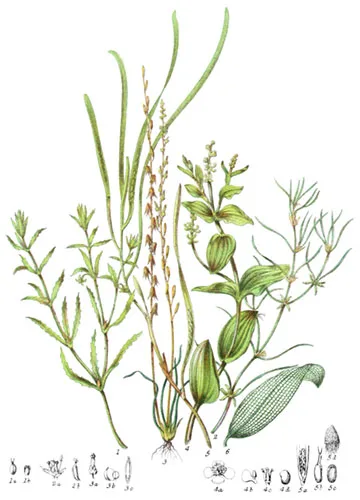
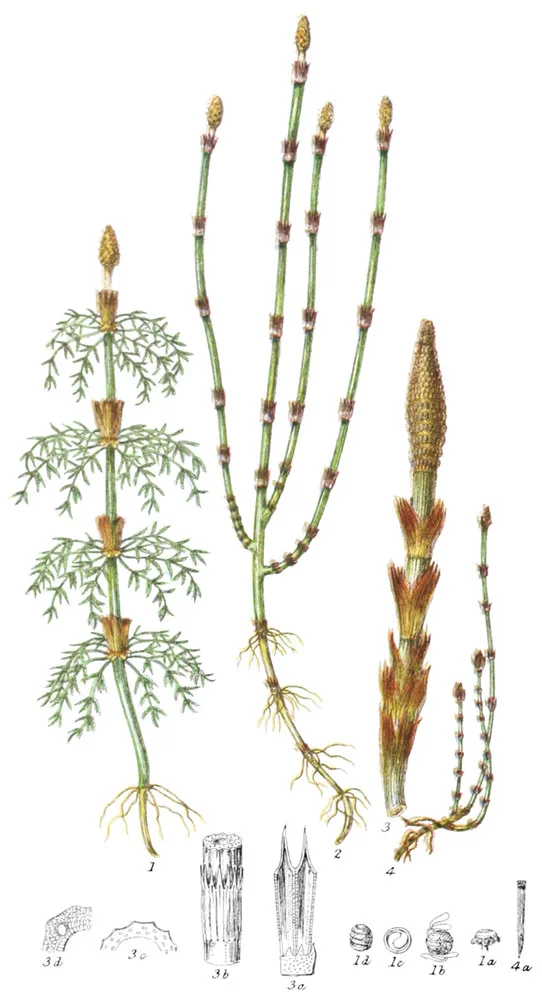
图中植物与部位
-
1.
Equisetum sylvaticum
, Wood Horse-tail England
- 1a. Disk, with Spores
- 1b. Spore, wrapped round by elater, magnified
- 1c. Spore, wrapped round by elater, magnified
- 1d. Spore, wrapped round by elater, magnified
- 2. Equisetum hyemale , Dutch Rush England
-
3.
Equisetum fluviatile
, Great Water Horse-tail England
- 3a. Sheath, magnified
- 3b. Stem, magnified
- 3c. Section, magnified
- 3d. Pores of Stem, magnified
-
4.
Equisetum variegatum
, Variegated Horse-tail England
- 4a. Unnamed*
关于本图版
这幅图版出自《植物自然目》(Natural Orders of plants),由伊丽莎白·特温宁绘制,1849 年出版。原书题作“Equisetaceæ”。原书为这一物种留下了成幅的彩色图像记录。
全编共收录 160 幅图版,本图是其中一幅,原书将其列为 Order 152,见第 152 页,版式为纵幅。此图由原件扫描修复而成,使用时请遵循页面标注的授权条款。
原书文字(英文 / 法文)
Key characteristics
Leafless branched herbaceous plants, with a hollow, striped, jointed stem, containing silex; the joints separable, and surrounded by a membranous sheath. The stem is composed chiefly of cellular tissue, but is strengthened externally with a layer of hard woody tubes. Pores are numerous on the stem, and small spiral vessels are abundant. The fructification is very simple, without corolla, consists only of spores on the edge of a round disk. The spores are wrapped round by four spiral elastic filaments, called elaters, terminating in dilate flat appendages.
These plants have affinity with Marchantiaceæ.
The stems contain silex, and are slightly astringent.
Select plants in this order
Not all plants listed are illustrated and not all plants illustrated are listed.
- Equisetum, the sole, representative of this small but remarkable Order, on the limits of flowerless plants, derived its name from the Greek for Horse-hair, but it is now generally called Horse-tail. The plants of this genus are very unlike all others to their whole construction, and in appearance; yet they have some points of resemblance to other Tribes. Their stems, containing a large portion of silex, connect them with Grasses, and the arrangement of the spores or round scales forms a link with Marchantiaceæ. Although of small size, and apparently not adapted to be of use to man or animals, the abundant quality of flinty particles contained in the outer part of the hollow stems renders them available for polishing wood and other materials. Thus, as in higher branches of creation, the humble and lowly contribute their alotted share of benefit to the more fully developed.
- Equisetum sylvaticum (1) is a rare British species, found chiefly by the side of rills in Wales. The slender branches are compound, and drooping gracefully from the joints of the stem, produce a very elegant effect. Above each joint is a finely notched sheath surrounding the stem, and small membranous sheaths enclose each branch. Various are the links perceptible between different plants which botanists have endeavoured to divide into Tribes, according to their structure. The general aspect of this delicate Equisetum, bearing a solitary cone of scales above a crown of leaves, is like a miniature resemblance of a Cycas.
- E. hyemale (2) is generally known as Dutch Rush, it grows plentifully on the dykes of Holland, and contains so much silex as to be of great use in polishing. To the Dutch it is invaluable for the constant cleaning required in their damp atmosphere. Sir Humphry Davy was the first chemist who detected the particles of flinty earth, arranged in lines, in the furrowed stem of this plant. Several other species are common in Holland, and may be seen in the month of April sending up their hollow stems, bearing cones, out of the stand, together with the early catkins of the creeping Willow.
- E. fluviatile (3) is the largest British species, the stem, with its whorles of fine branches, rising to the height of three or four feet in favourable watery situations; the branches are rough, with silex on the outside; above each ring is a notched sheath. The fertile stems are very short, destitute of branches, and appear in spring before the others.
- E. variegatum (4) is the smallest English species, the slender stems are all without branches, clothed only with membranous sheaths at the joints. It is to be found chiefly in sandy ground in Scotland and Ireland; the fibres of the root are woolly, as are those of many grasses which grow in similar sandy situations. It has been ascertained, by the use of the microscope, that the particles of silex are frequently arranged in groups, forming chains and curves like the jewels of a necklace; others are placed in simple straight lines, some of the particles not exceeding the 500th of an inch in diameter, yet having a regular axis of double refraction. It appears that these crystalline portions are essential parts of the plant, and assist in the functions of vegetable life. In the lower stem, starch is contained in considerable quantity, and in the autumn it may be observed in active motion, passing up one side and down the other, in E. fluviatile and similar large species.
- The fossil Lepidodendron forms a remarkable link between flowering and flowerless plants.
- Calamites is a giant relic of this Tribe in a former vegetation; smaller species of Equisetum succeeded it, nearly resembling the present plants.
Locations
This Tribe, composed of one genus, comprising many species, is dispersed in most parts of the world, in the Tropics, and in Temperate countries; chiefly rivers, ditches, and watery places.
Legend
- Equisetum sylvaticum, Wood Horse-tail. England.
- Disk, with Spores.
- Spore, wrapped round by elater, magnified.
- Spore, wrapped round by elater, magnified.
- Spore, wrapped round by elater, magnified.
- Equisetum hyemale, Dutch rush. England.
- Equisetum fluviatile, Great Water Horse-tail. England.
- Sheath, magnified.
- Stem, magnified.
- Section, magnified.
- Pores of Stem, magnified.
- Equisetum variegatum, Variegated Horse-tail. England.
本图涉及的植物
- Equisetum sylvaticum
- Equisetum hyemale
- Equisetum fluviatile
- Equisetum variegatum
属索引
- Equisetum