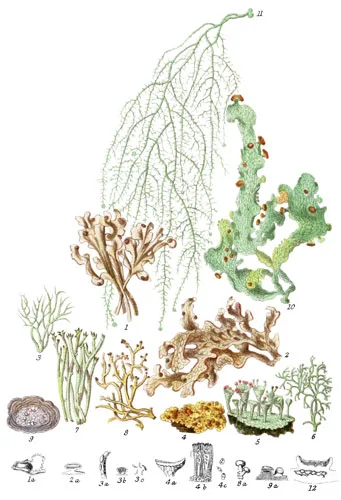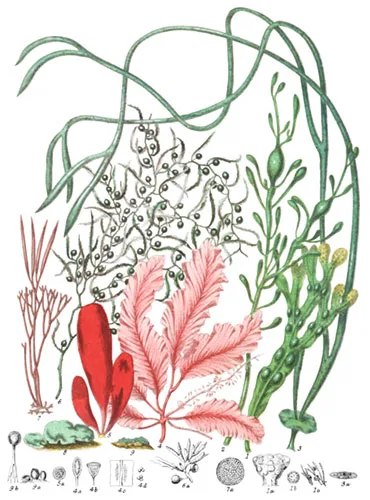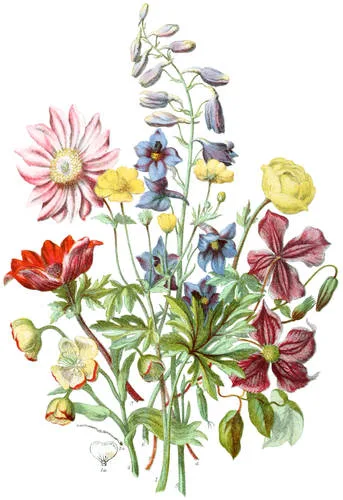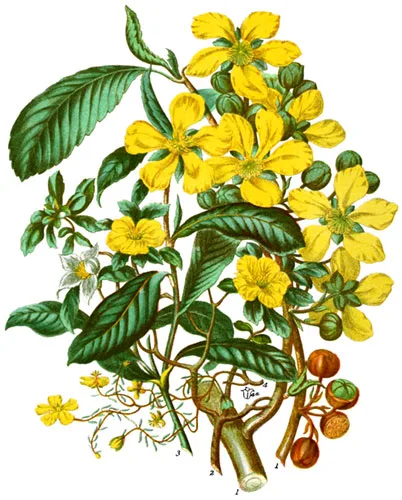
Fungaceæ
Fungaceæ
The Fungus Tribe
- 合集
- 植物自然目
- 绘者
- Elizabeth Twining(伊丽莎白·特温宁)
- 年代
- 1868
- 图版号
- Order 159
- 原书页码
- p.159
- 主色
- 橙
- 授权
- CC BY-SA 4.0
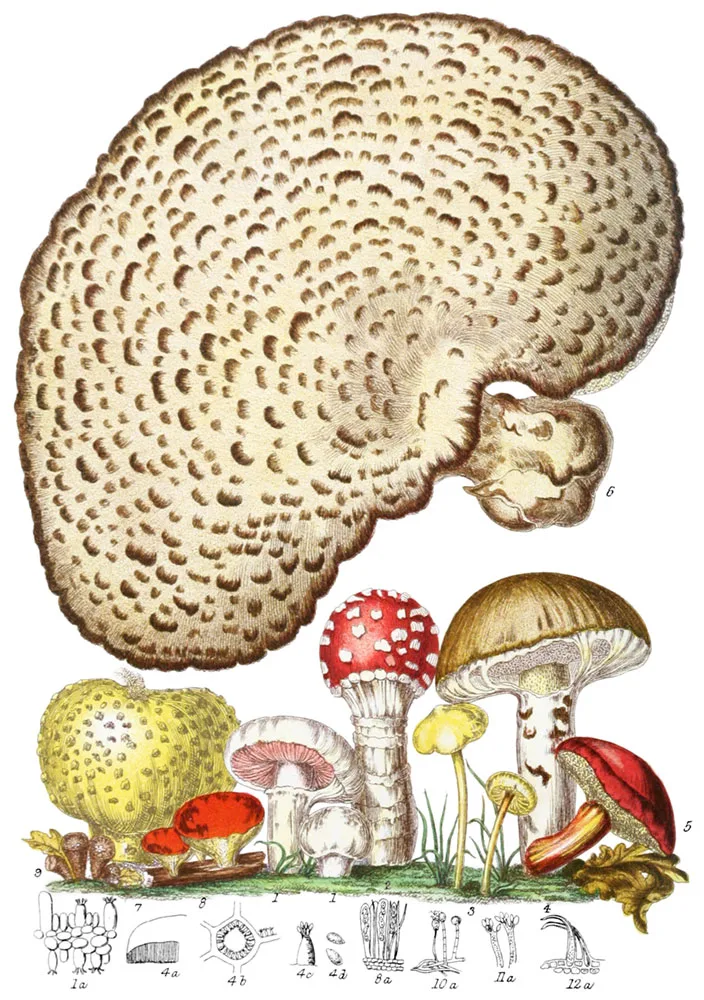
图中植物与部位
-
1.
Agaricus campestris
, Field Mushroom Fields, England
- 1a. Spores, magnified
- 2. Amanita mucaria , Poisonous Amanita Woods, England
- 3. Agaricus luteus , Yellow Agaric Grass, England
-
4.
Boletus subtomeatosus
, Downy Boletus Woods, England
- 4a. Section of cap
- 4b. Cell, with spores
- 4c. Spores
- 4d. Spores
- 5. Boletus sanguineus England
- 6. Polysporus squamosus Stem of trees, England
- 7. Scleroderma citrinum Roots of trees, England
-
8.
Peziza coccinea
England
- 8a. Spore cases and filaments
- 9. Cyathus striatus England
-
- 10a. Mucor mucedo , Mould
-
- 11a. Botrytis curta , Leaves
-
- 12a. Erineum juglandis
-
- bg.
关于本图版
《植物自然目》(Natural Orders of plants)由伊丽莎白·特温宁绘制,1849 年印行,本图即其中一幅。原书题作“Fungaceæ”。原书为这一物种留下了成幅的彩色图像记录。
该合集全编共 160 幅图版,此图为其中之一,图版编号 Order 159,对应原书第 159 页,版式为纵幅,整幅以橙为主调。图像自原件扫描修复,构图与设色未经改动,授权方式见页面下方。
原书文字(英文 / 法文)
Key characteristics
Plants composed of cellules, or filaments, or both, increasing in size inwardly, the outside not changing; growing chiefly on decayed animal or vegetable substances; of short duration. The fructification consists of spores attached externally and often in definite numbers to the cellular tissue, or placed on projections like stalks, or enclosed in membranous bags: other bodies appear to be similar to anthers. The most simple form of Fungus is composed of small jointed filaments, with cellules placed end to end, such as mould or mildew; spores are contained in each cell, or are collected in terminal joints. The spores germinate readily, and the young plants grow with excessive rapidity and force of development.
This Tibe has affinity with Lichens and Sea-weeds; but differs from the former in not containing germs full of green matter,—from the latter in possessing no spontaneous motion in th reproductive particles,—and from both in deriving nourishment from the substance on which they grow.
These plants contain abundant nitrogen, absorb oxygen, and exhale carbonic acid. Some are wholesome, others poisonous.
This lowly Tibe, approaching the verge of vegetable life, of extremely simple structure and fugitive existence, possesses nevertheless considerable interest, not only from the varied forms of the plants it comprises, but from the important part they perform in the transformation of vegetable matter. Many grow on dead or decaying animal or vegetable substances, which they speedily help to disintegrate, thus causing a rapid conversion to earth or mould, reducing what was become injurious to the living to a fresh source of support and sustenance for the future. In low damp situations, the islands of the Bay of Rio Janeiro, plants of all kinds spring forth, grow and decay, with wonderful rapidity; when a large tree is felled, the stem speedily becomes a fine earth, the process being hastened by the growth of countless fungi, which are developed as soon as decay commences.
In the simplest form of this Tribe, the species of mould (10)* and mildew are composed of cells placed end to end; some of the joints separate and reproduce fresh plants; in others, the spores accumulate in the cells, and are dispersed when they break. In the more perfect plants of this class, the masses of cellular tissue assume a determinate figure, the whole central portion being occupied by plates or cells, with spores attached.
Select plants in this order
Not all plants listed are illustrated and not all plants illustrated are listed.
- The most valuable of these plants as food is Agaricus campestris (1), the Mushroom; the gills are plates containing countless spores. Although this tribe is generally of a dull colour, yet some species are as bright as those of more highly developed plants.
- Amanita muscaria (2) adorns woods in autumn with its brilliant crimson cap.
- Agaricus xerampelinus is the most splendid species, of various tints of red and yellow, grows commonly in Italy, and was esteemed a delicacy by the ancient Romans.
- The cap of Boletus (4) is porous on the lower part, the cells being separable from the cap and each other, each fringed internally with spores.
- B. sanguineus (5) is not uncommon in woods.
- Polyporus has no central stem, and the tues are attached to the cap and to each other.
- P. squamosus (6) is one of our largest examples, growing on the stems of trees.
- P. tuberaster is an article of food in Italy.
- P. annosus is used in Sweden as a cure for the bite of snakes.
- P. formentarius is still made into tinder in poor countries.
- Scleroderma (7) is to be found about the roots of trees, the interior filled with spores collected into globules mixed with filaments, which escape by an opening at the top.
- The Puff-ball, Lycoperdon, a nearly similar genus, abounds in grassy places, in a variety of species.
- Bovista gigantea is the giant of the Tribe, sometimes more than two feet in diameter; the outer skin cracks, the inner one bursts at the top, and the small stalked spores are dispersed. The growth is wonderfully rapid; one was observed, during a damp night, to grow froma mere point to the size of a large gourd, at the rate of 66,000,000 of cells a minute.
- Peziza (8) is found chiefly on decayed wood, it spores contained in the hollow of its leathery cup.
- Amongst withered leaves on the ground may be seen the beautiful little Cyathus (9); within the cup are a few white capsules, fixed by a thread to the sides and base, full of minute spores.
- Nidularia crucibulum is a very neat species on old wood.
- Besides the eatable Mushrooms, others afford a delicious ingredient of cookery to refined palates; several more are valuable as nourishment to peasants in remote uncultivated districts. The most delicate are Morchella, the Morel; and Tuber cibarium, the Truffle, growing under the surface of the earth, black on the rough exterior, white within.
- Mylitta australis serves as food to natives and kangaroos.
- Botrytis (11)† is a magnified example of the minute kinds which are found on withering leaves.
- Erineum (12)‡ is scarcely more than a monstrous growth of the cells of the walnut leaf.
- Many singular experiments have been made on the rapid changes of colour in these plants, apparently not due to chemical action. Rhizomorpha has some luminous properties, which cause it to shed light in coal-mines and rocky caves in Saxony.
- Dutrochet found the greatest degree of vegetable heat to exist in Boletus.
Plants generally purify the air by absorbing carbonic acid, but they make vast compensation by decomposing decaying vegetable matter.
Locations
This Tribe, comprising infinite numbers, is dispersed over the whole world in indefinite geographical limits. Agaricus and Polyporus are most numerous in species.
Legend
- Agaricus campestris, Field Mushroom. Fields, England.
- Spores, magnified.
- Amanita muscaria, Poisonous Amanita. Woods, England.
- Agaricus luteus, Yellow Agaric. Grass, England.
- Boletus subtomeatosus, Downy Boletus. Woods, England.
- Section of cap.
- Cell, with spores.
- Spores.
- Spores.
- Boletus sanguineus. England.
- Polysporus squamosus. Stems of trees, England.
- Scleroderma citrinum. Roots of trees, England.
- Peziza coccinea. England.
- Spore cases and filaments.
- Cyathus striatus. England.
-
- Mucor mucedo, Mould.
-
- Botrytis curta. Leaves.
-
- Erineum juglandis.
本图涉及的植物
- Agaricus campestris
- Amanita muscaria
- Agaricus luteus
- Boletus subtomentosus
- Boletus sanguineus
- Polyporus squamosus
- Scleroderma citrinum
- Peziza coccinea
- Cyanthus striatus
- Mucor mucedo
- Botrytis curta
- Erineum juglandis
属索引
- Agaricus
- Amanita
- Boletus
- Botrytis
- Bovista
- Cyathus
- Erineum
- Lycoperdon
- Morchella
- Mucor
- Mylitta
- Nidularia
- Peziza
- Polyporus
- Rhizomorpha
- Scleroderma
- Tuber