Lamiaceæ
Lamiaceæ
The Dead-Nettle Tribe
- 合集
- 植物自然目
- 绘者
- Elizabeth Twining(伊丽莎白·特温宁)
- 年代
- 1868
- 图版号
- Order 102
- 原书页码
- p.102
- 主色
- 绿
- 授权
- CC BY-SA 4.0
图中植物与部位
-
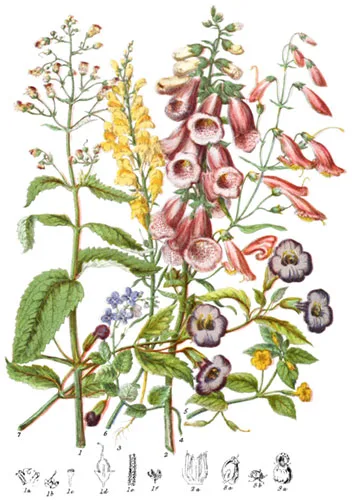
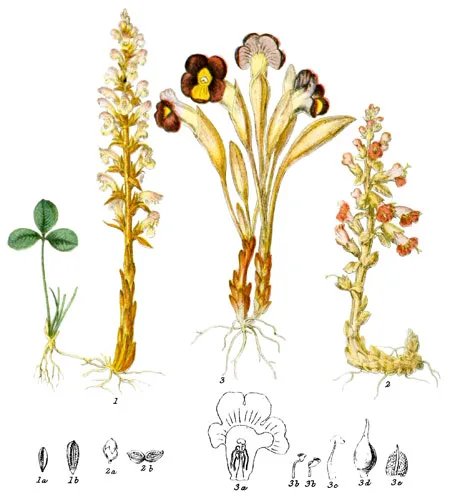
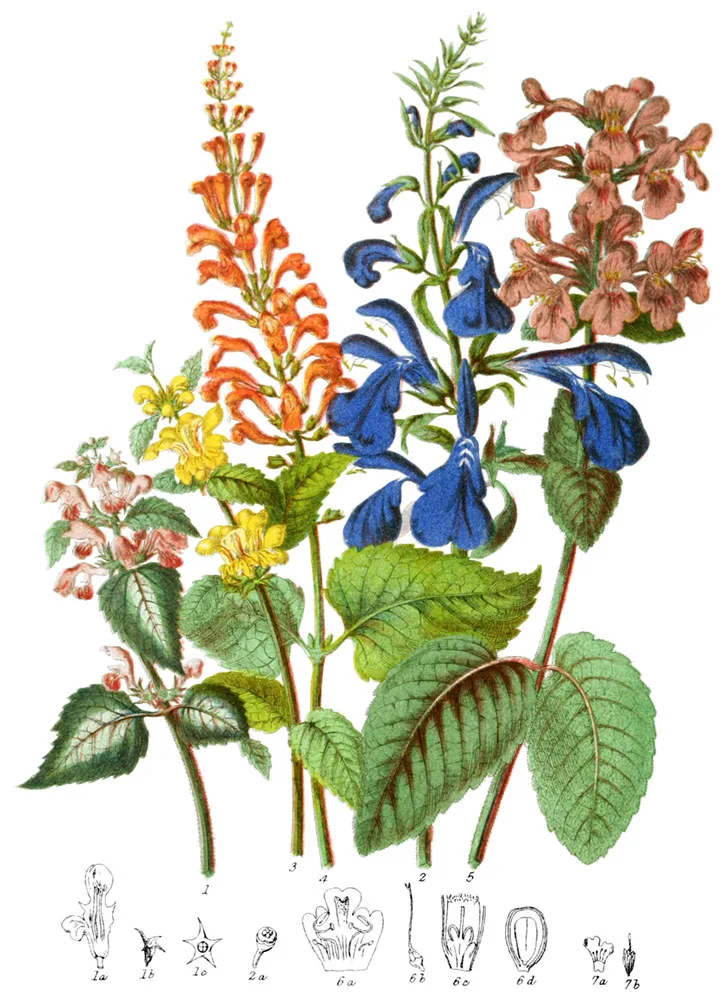
1.
Lamium maculatum
, Spotted Dead-Nettle England
- 1a. Flower opened
- 1b. Calyx
- 1c. Calyx and Ovary
-
2.
Salvia patens
, Spreading-flowered Salvia South America
- 2a. Ovary and Disk
- 3. Galeobdolon luteum , Yellow Weasle-Snout England
- 4. Scutellaria cordifolia , Heart-leaved Scutellaria Mexico
- 5. Betonica grandiflora Sibera
-
- 6a. Flower of Salvia
- 6b. Ovary and Pistil
- 6c. Section of Ovary
- 6d. Seed
-
- 7a. Flower of Lavendula
- 7b. Calyx and Pistil
关于本图版
《植物自然目》(Natural Orders of plants)由伊丽莎白·特温宁绘制,1849 年印行,本图即其中一幅。原书题作“Lamiaceæ”。原书为这一物种留下了成幅的彩色图像记录。
该合集全编共 160 幅图版,此图为其中之一,图版编号 Order 102,对应原书第 102 页,版式为纵幅,整幅以黄绿为主调。图像自原件扫描修复,构图与设色未经改动,授权方式见页面下方。
原书文字(英文 / 法文)
Key characteristics
Under-shrubs and herbaceous plants: the stems are four-cornered, with opposite branches. The leaves are opposite, divided or undivided, without stipules, covered with receptacles of aromatic oil. The flowers are nearly sessile, opposite, sometimes in circles around the stem, sometimes solitary. The calyx is tubular, below the ovary, two-lipped, the upper lib whole or bifid, overlapping the lower in the bud. The stamens are four, two long, two short, placed upon the corolla alternately with the lobes of the lower lip, the two upper sometimes wanting; the anthers are two-celled, or one-celled at the point. The ovary is four-lobed, seated on a fleshy disk; the single style proceeds from the base of the ovary, the stigma is acutely bifid. The fruit is one or four with small nuts, enclosed within the calyx, but uncovered. The seeds are erect, with little or no albumen.
This Tribe has close affinity with Verbenaceæ, but is distinguished from that and all other allied tribes by its four-lobed ovary.
A fragrant aromatic oil exists abundantly in the leaves of these plants. None are unwholesome.
Select plants in this order
Not all plants listed are illustrated and not all plants illustrated are listed.
- Lamium is a genus of very little beauty, and few or no aromatic properties, yet as it exhibits very distinctly the chief characters of this Order, it has been selected to give its name to the whole tribe.
- L. maculatum (1) is the prettiest of our native species; L. album, the white Dead-nettle, the most common.
- The only species thought worthy of a place in gardens is L. orvala of Italy, but even that is now rarely seen.
- Salvia ranks amongst the best of the tribe; it contains many herbs and under-shrubs, and is widely dispersed.
- S. verbenaca of our fields belongs to each great division of the globe. The leaves are usually covered with a fine network of veins, and pores of aromatic oil.
- S. officinalis of South Europe was formerly much used for its beneficial properties, and still retains a place in herb gardens, for cooking purposes.
- S. Sclarea is made into wine in some countries.
- S. patens (2) is now become a hardy inhabitant of our gardens, and is one of the most beautiful species.
- S. splendens is another fine specimen from Mexico, producing its bright red flowers late in the autumn.
- S. glutinosa is a tall plant, with pale yellow flowers, very abundant on mountains in Switzerland.
- S. patula, with white flowers, is Portuguese.
- Galeobdolon (3) inhabits shady places in Kent and a few other countries, but is not common; it grows also in moist woods on the Continent.
- Scutellaria cordifolia (4) is a brillaint example of a lowly genus; G. minor is a remarkably neat little plant, growing in marshy places in Wales and elsewhere; the calyx has a peculiar projection at the back, and closes when the flower falls.
- Betonica grandiflora (5) has the same character of a wide interval between the pairs of leaves, as our B. officinalis, which was once considered useful as a medicine, and in dyeing wool yellow.
- So numerous are the aromatic species in this tribe, it is impossible to describe them all. Many are of extensive value, and were amongst the earliest medicinal herbs used in our island; some were brought from the south by monks and missionaries.
- Rosemary grows by the sea on the south and west of France; by distillation, it yields a fragrant oil, and a substance resembling camphor is obtained from the leaves: the peculiarly fine flavour of Narbonne honey is supposed to be caused by the bees feeding on the flowers. The Welsh still consider it emblematical of repentance, and scatter it on graves.
- Melissa, Balm, affords honey to bees, and a pleasant tea, in former times much employed in fevers.
- One of the most fragrant of our native aromatic plants if Thymus Serpyllum, creeping over heaths and commons, becoming quite dwarf, like many others on chalk downs.
- T. vulgaris is the garden Thyme.
- T. capitellatus, the bracts covered with glands, is common in Portugal.
- Mentha piperita yields the medicinal Pepper-mint; M. viridis, the culinary Spear-mint, used also medicinally, both in the form of oil and water.
- M. Pulegium is the useful herb Penny-royal.
- But the most esteemed, probably, of European species, is Lavender, Lavandula vera, frequent in many parts of the Continent, particularly on the Lavendelberg, at Kreuznach, near the Rhine, and between the lakes of Neuchatel and Morat, in Switzerland. The fragrant volatile oil contains in the flowers (7)* is a chief ingredient in Eu de Cologne and perfumery of all kinds.
- L. Spica yields an oil used in procelain-painting.
- L. Stæchas, French Lavender, is a native of the Stechades, on the south coast of France.
- Basil, Savory, Marjoram, and several others, are valuable as domestic herbs.
- Horehound and Ground-Ivy are also of common use in country districts as remedies for coughs.
- A species of Ocymum affords eatable tubers in Madagascar, but this is a rare instance of the tribe.
- In Brazil many species have valuable medicinal qualities, and are used by the natives.
- Martius describes the famous Matico as Phlomis.
- The celebrated Patchouli of the East, used to stuff beds, is said to belong to this aromatic tribe.
Locations
Chiefly abundant in Temperate regions, between 40° and 50° of North latitude; growing in hot, dry situations, as well as in woods, hedges, and meadows; a few only in marshes. In the isles of the Mediterranean, they form about one-twentieth of the Flora. In the northern provinces of India, two hundred species have been discovered. To the north of Europe they diminish gradually, are rare in Lapland, and not found in Melville Isle.
Legend
- Lamium maculatum, Spotted Dead-Nettle. England.
- Flower opened.
- Calyx.
- Calyx and Ovary.
- Salvia patens, Spreading-flowered Salvia. South America.
- Ovary and Disk.
- Galeobdolon luteum, Yellow Weasle-Snout. England.
- Scutellaria cordifolia, Heart-leaved Scutellaria. Mexico.
- Betonica grandiflora. Siberia.
-
- Flower of Salvia.
- Ovary and Pistil.
- Section of Ovary.
- Seed.
-
- Flower of Lavandula.
- Calyx and Pistil.
十二观
- 实测花色 橙黄、蓝
- 纵幅 1.38∶1
- 含 7 个物种
- 15 处解剖图
- 1868 年刊
- Order 102
这不是词条,是一条看画的次序:先站定看整体,再看名字与形色、构图与刀工,然后问它几时开、从哪里来、经了谁的手;最后是中国诗文——同一朵花,中国古人是怎么看的。十二观读完,这幅图就打开了。
-
第一眼
论画以形似,见与儿童邻。
—— 宋·苏轼《书鄢陵王主簿所画折枝》
只求画得像,是小孩的眼光。苏轼不是不要形似,是说形似之后还有一层:神。这一幅是竖的:眼睛从下往上走,落点在上半部。先让整株立起来,再看细节。第二步凑近一寸:主线之外另有 15 处解剖小图——那是画家怕你看不清,替你把花剖开了。第三步,找绿色最重的一小块:整幅的明暗秩序,是从那里排开的。这一幅是斜势:上半的重心比下半偏右,画的是一株活物被风带着的样子,不是图解的直立。
-
名与实
此幅未见可靠的学名,只能以原书题名相称——早期图谱里这种情形并不少见。此幅既无通行中文名,学名也不可靠,只能以原书题名相称——图谱里总有几幅这样的图,只能靠画面本身说话。
-
形与色
就这一幅实测:花色占画面的 18.6%,叶色 16.7%,主相是橙黄、辅以蓝。这个比例与色相,是这一幅独有的。此图为一幅博物插画:一株植物被从山野或温室中取出,安置在纸的中央,根、茎、叶、花、果依次交代,务求可辨、可据、可传。此幅以绿为主,绿近嫩苔,是花萼与叶的主色。这一路颜色多来自叶、萼与枝,花只占很小一块——图谱的次序向来如此:先立植株,再点花色。颜色不是平涂的:最浅处近乎纸色,最深处在花瓣重叠的缝里。把这两处找到,画面的呼吸就出来了。
-
构图与呼吸
画幅高而窄,主株一路向上,上下留白多,是图谱中最常见的立轴式构图。(高宽比约 1.38∶1)另附 15 处局部解剖,主体与细部互为注脚。这一幅排得满:枝叶占到画面的 40%,重心近于正中——标本式的画法,图的是看得全。试着用拇指遮住空白处——画面立刻变闷;放开,它才重新“喘上气”。留白,是给主体让出的气口。
-
一刀一色
十九世纪后半叶,石版与彩色石印渐成主流:颜色可以直接印出,不再依赖手工,线条反倒退居其次。图像的“准确”提高了,手性却淡了。工艺留下的破绽比题跋更诚实:刻工不会撒谎,上色的人赶时间的时候会。
-
时序
图版多标花期,因花期是植物一年中最容易被辨认的十余日;其余月份,它只是一丛叶。图上所记的 1868 年是刊行之年,不是花期;真正的花藏在原书的采集记录里,通常比出版早一两年。图谱记的是十余日的盛况;剩下的三百多天,植物在长叶、结果、休眠——图只截了它最像自己的一刻。
-
故土
来源不一,或本地山野,或远洋引种。十九世纪的植物园与温室,是这些植物离开故土后的第一个住所。这类植物的旅程比图版本身更长:从一座山到另一座山,从一种语言换到另一种语言。
-
书与人
《植物自然目》(Natural Orders of plants)由伊丽莎白·特温宁绘,成于1849。此幅为其中Order 102,见原书第 102 页。图谱是集体工程:绘图、刻版、上色、编纂各有其人,署名的往往只有第一个。
-
诗境
朝饮木兰之坠露兮,夕餐秋菊之落英。
—— 战国·屈原《离骚》
中国文学里最早的一顿“花食”:露与英都可入口,草木与人从此不分彼此。把这一句放回画面:绿色的花冠就是诗句的落点——诗先写气,画后写形,两者在此处接上了。
-
文心
六法者何?一、气韵生动是也;二、骨法用笔是也;三、应物象形是也;四、随类赋彩是也;五、经营位置是也;六、传移模写是也。
—— 南齐·谢赫《古画品录》
一千五百年前,谢赫给了六条看画的标准:气韵、用笔、形似、设色、构图、临摹。前五条今天仍然管用——在这幅图版上一样样对过去,就是一次完整的读画。中国有《本草纲目》《植物名实图考》,欧洲有从《本草》插图到彩色石印的谱系;两条传统都相信:图能补文字的不足。记住这一句,下次在别处见到同类,它会自己浮上来——鉴赏力就是这样一句一句攒出来的。
-
花语
博物画的象征不在花语,而在“记录”本身:它相信一株植物值得被准确画下,这份信念是科学时代最朴素的道德。在图谱里,它首先是一个物种,其次才是一种象征——这个次序值得记住。
-
带走一双眼睛
把这三件事带走:先整体后细节;先线后色;先看画再翻书。任何一张老图版,都可以用这三条读。1868 年的那朵花早已化作尘土,它留在纸上的样子,却比任何一株活着的同类都长寿。
本图涉及的植物
- Lamium maculatum
- Salvia patens
- Galeobdolon luteum
- Scutellaria cordifolia
- Betonica grandiflora
- Salvia
- Lavandula
属索引
- Betonica
- Galeobdolon
- Lamium
- Lavandula
- Melissa
- Mentha
- Ocymum
- Phlomis
- Salvia
- Scutellaria
- Thymus