Loasaceæ
Loasaceæ
The Loasa Tribe
- 合集
- 植物自然目
- 绘者
- Elizabeth Twining(伊丽莎白·特温宁)
- 年代
- 1868
- 图版号
- Order 60
- 原书页码
- p.60
- 主色
- 黄
- 授权
- CC BY-SA 4.0
图中植物与部位
-
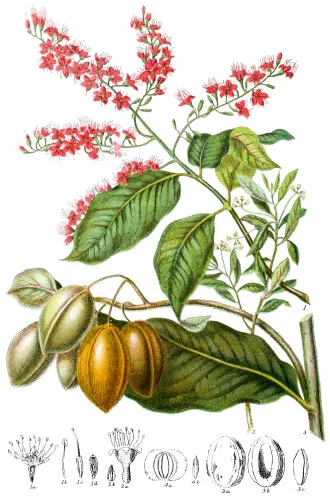
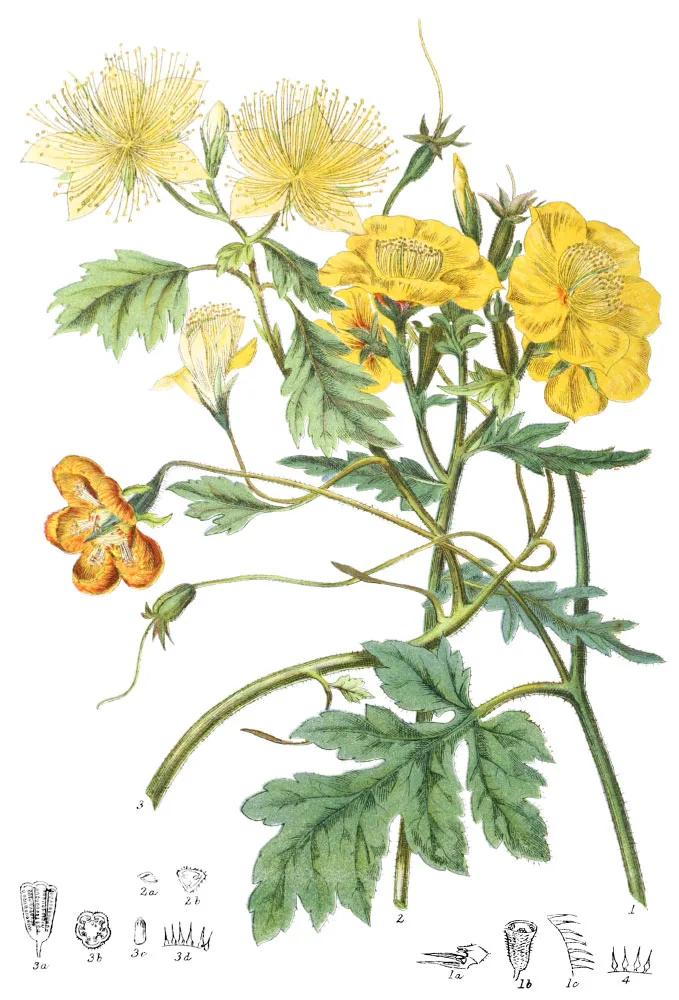
1.
Loasa grandiflora
, Large-flowered Loasa Caraccas
- 1a. Hooded Petal and Filaments
- 1b. Section of Seed-vessel
- 1c. Stinging hairs magnified
-
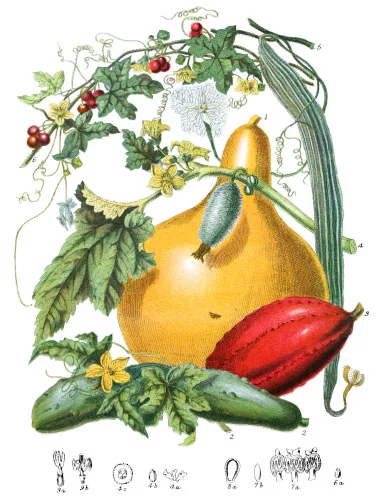
2.
Bartonia aurea
, Golden-flowered Bartonia California
- 2a. Seed magnified
- 2b. Section of Seed-vessel
-
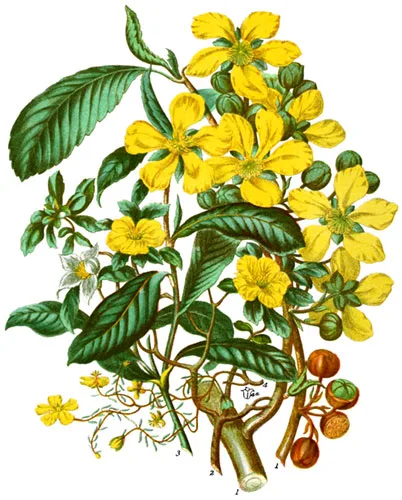
3.
Microsperma bartonoides
Mexico
- 3a. Long section of Seed-vessel
- 3b. Cross section
- 3c. Seed magnified
- 3d. Hairs magnified
- 4. Magnified hairs of Loasa nitida
关于本图版
本图选自伊丽莎白·特温宁的《植物自然目》(Natural Orders of plants),原书 1849 年出版。原书题作“Loasaceæ”。原书为这一物种留下了成幅的彩色图像记录。
该合集全编共 160 幅图版,此图为其中之一,图版编号 Order 60,对应原书第 60 页,版式为纵幅,设色以橙为基调。图像自原件扫描修复,构图与设色未经改动,授权方式见页面下方。
原书文字(英文 / 法文)
Key characteristics
Herbaceous plants, often climbing, for the most part clothed with stinging or pricking hairs, secreting an acrid juice at their base. The leaves are opposite or alternate, without stipules, usually more or less divided at their edges; the flower-stalks are terminal, or on side branches, or grow from the base of the leaf-stalks, each bearing one flower. The tube of the calyx is adherent to the ovary, four or five-parted at the top, and persistent. The petals are five or ten, in two rows, smaller than the outer. The stamens are numerous, in several rows, arising from within the petals, either distinct or adhering in bundles before reach petal, within the hollow part of which they lie when the flower first expands. The filaments are awl-shaped, unequal, the outer ones frequently destitute of anthers. The ovary is one-celled, included in the tube of the calyx. The style is single, stigma one or several, united or free at the top. The fruit is a capsule, succulent or dry, crowned with the persistent calyx, one-celled, three, five, or seven-valved, with projections to which the seeds are attached: the seeds contain fleshy albumen, and are many, as in Loasa, or few as in Klaprothia and Mentzelia.
The stinging hairs of these plants form a solitary link with the Nettle tribe, although their construction is in some points different: in habit there exists an affinity with the Gourd tribe.
The chief property is an acrid fluid, which is instilled into wounds by the singular mechanism of the stinging hairs.
Select plants in this order
Not all plants listed are illustrated and not all plants illustrated are listed.
- The different species of Loasa bear bright yellow flowers, of very curious structure, the the extreme pungency of the stings renders them disagreeable plants in a garden or green-house.
- Loasa grandiflora (1) is the most beautiful at present introduced here; the leaves of all are more or less covered with stinging hairs, those of L. Placei are extremely beset with them on each surface.
- L. volubilis is a twining species from Chile, not sufficiently hardy to bear the open air of this climate.
- The Pumaysanca of Brazil is a medicine prepared from L. punicea.
- The Spaniards in South America call Loasa ortiga, from its stinging like the Nettle.
- Bartonia, so named after Dr. Barton, a botanist of Philadelphia, was first brought to England, from the shores of Missouri; the two species from thence bear white flowers, and are sweet-scented, expanding chiefly towards the night.
- Bartonia aurea (2) has been since introduced from California, and is now become a hardy annual plant in English gardens, and is much admired for the brilliant golden flowers, although the foliage is rough.
- B. albescens of Chile has small, pale flowers, and a white, shining stem.
- Microsperma bartonoides (3) bears abundant elegant flowers, of exceedingly pure, pale yellow, the numerous slender stamens giving it a very graceful appearance; after the fall of the petals, the flower-stalks elongate.
- Mentzelia, a genus of which the capsules contain only a few seeds, was named after Mentzel, a Prussian botanist and physician to the Elector of Brandenburg; they are curious plats, with yellow flowers, like the others of this tribe.
Locations
All the plants of this Tribe are natives of the Tropical or Temperate regions of North and South America.
Legend
- Loasa grandiflora, Large-flowered Loasa. Caraccas.
- Hooded Petal and Filaments.
- Section of Seed-vessel.
- Stinging hairs magnified.
- Bartonia aurea, Golden-flowered Bartonia. California.
- Seed magnified.
- Section of Seed-vessel.
- Microsperma bartonoides. Mexico.
- Long section of Seed-vessel.
- Cross section.
- Seed magnified.
- Hairs magnified.
- Magnified hairs of Loasa nitida.
本图涉及的植物
- Loasa grandiflora
- Bartonia aurea
- Microsperma bartonoides
- Loasa nitida
属索引
- Bartonia
- Klaprothia
- Loasa
- Mentzelia
- Microsperma