Lythraceæ
Lythraceæ
The Loosestrife Tribe
- 合集
- 植物自然目
- 绘者
- Elizabeth Twining(伊丽莎白·特温宁)
- 年代
- 1868
- 图版号
- Order 54
- 原书页码
- p.54
- 授权
- CC BY-SA 4.0
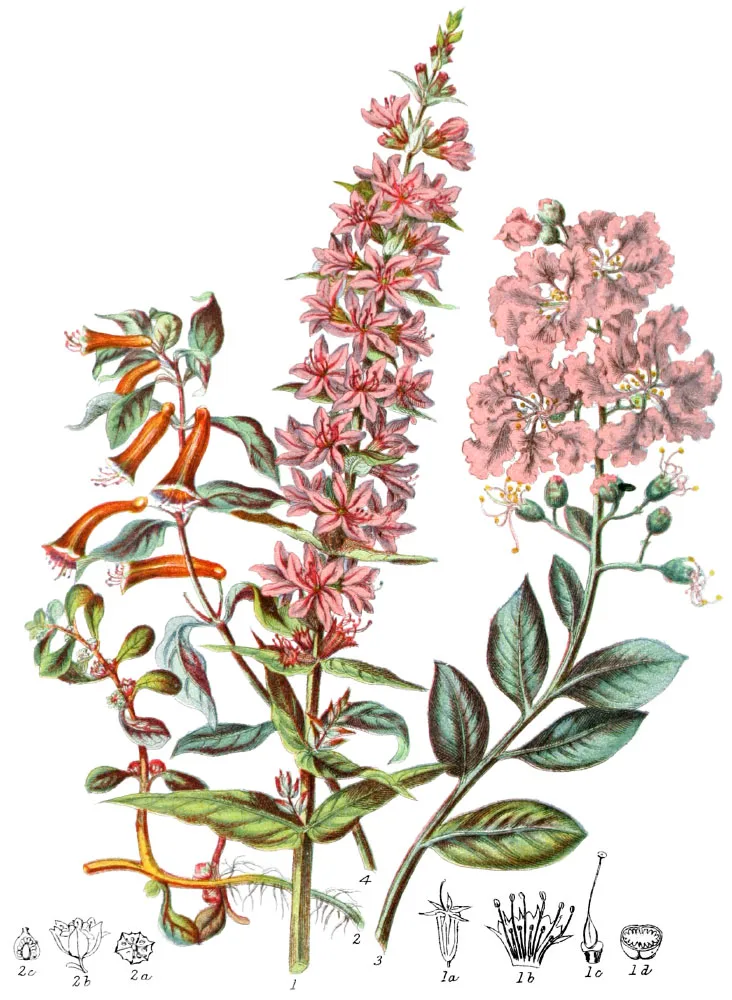
图中植物与部位
-
1.
Lythrum Salicaria
, Purple Loosestrife River Banks, England
- 1a. Calyx and Pistil
- 1b. Calyx and Stamens
- 1c. Pistil
- 1d. Section of Seed-vessel
-
2.
Peplis Portula
, Water Purslane England
- 2a. Flower
- 2b. Flower, magnified
- 2c. Section of Seed-vessel
- 3. Lagerstrœmia indica , Indian Lagerstrœmia East Indies
- 4. Cuphea tubiflora , Tubular-flowered Cuphea South America
关于本图版
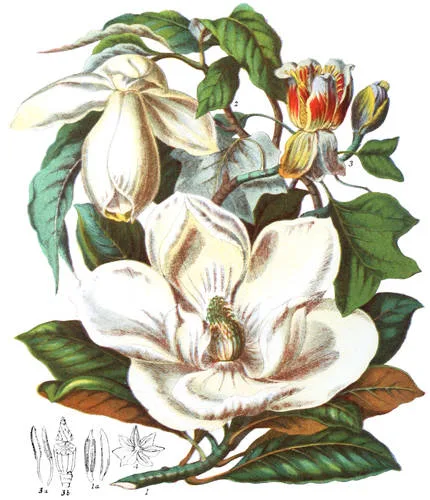
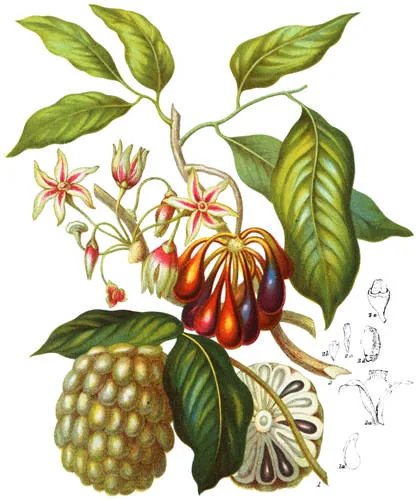
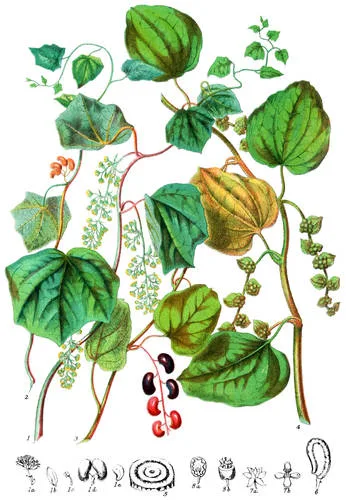
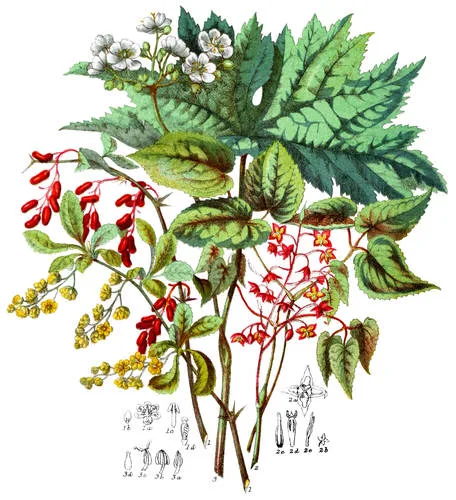
此图原刊于《植物自然目》(Natural Orders of plants),绘者为伊丽莎白·特温宁,成书于 1849 年。原书题作“Lythraceæ”。这是该物种在早期博物学出版物中的图像记录之一。
全编共收录 160 幅图版,本图是其中一幅,原书将其列为 Order 54,见第 54 页,版式为纵幅。此图由原件扫描修复而成,使用时请遵循页面标注的授权条款。
原书文字(英文 / 法文)
Key characteristics
Almost all herbaceous plants, a few only shrubs. The branches are frequently quadrangular. Leaves opposite, seldom alternate, entire, without either stipules or glands, sometimes with glandular dots. Flowers solitary, or in clusters, regular, or irregular, growing from the base of the leaf-stalk, or in terminal spikes or racemes as the upper leaves diminish. The calyx is tubular, ribbed and plaited, often oblique; some of the lobes are in many cases longer than the rest. The petals are inserted between the outer lobes of the calyx, very soon falling off, sometimes wanting. The stamens are fixed in the tube of the calyx, below the petals, to which they are either equal in number, or twice, or even four times as many; the anthers are two-celled opening longitudinally. The style is slender; the stigma usually capitate. The capsule is membranous, covered by the calyx, gaping when ripe, containing numerous small seeds.
This order has most affinity with the Saxifrage tribe.
Select plants in this order
Not all plants listed are illustrated and not all plants illustrated are listed.
- Lythrum Salicaria (1) is esteemed one of the most elegant of British plants; it grows frequently on the banks of rivers and streams, the tall spikes of bright purple flowers rising to the height of four or five feet; in dry situations, the plant becomes more downy and of shorter stature. The whole plant has astringent properties, which have rendered it useful in medicine and in tanning.
- Lythrum hyssopifolium is not so common a species, being found only in a few places in England, and is of smaller growth and less beautiful aspect.
- Peplis Portula (2) grows generally in watery places, on heaths, on sandy soils, with a prostrate stem, creeping within the bell-shaped plaited calyx.
- Lagerstrœmia (3) was so named by Linnæus, after Lagerstrœm of Gottenberg, who obtained many rare plants from the East. It forms, with a few other plants, a division of this tribe distinguished by having the seeds winged. All the species are fine shrubs of the East Indies, China, and South America.
- Lagerstrœmia reginæ is a very beautiful evergreen shrub, bearing long panicles of rose-coloured flowers, which deepen in hue during the day till they become purple by evening; the bark and leaves are considered medicinal, and the seeds are narcotic.
- Cuphea (4) is a genus of South America; several species are now cultivated in English gardens as ornamental flowers.
- Cuphea Balsamona is found to be a valuable remedy in the intermittent fevers of Brazil.
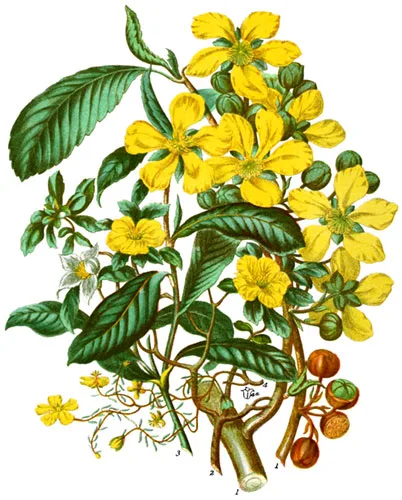
- Heimia salicifolia, a Mexican plant, is remarkable for having yellow flowers in the midst of this usually purple-flowered tribe.
- Lawsonia inermis, the Hinna of Egypt, yields an orange dye, employed by the women of Oriental countries to stain their fingers and feet; it is also used for dyeing morocco leather, and various other purposes. In India, it is much cultivated north of the Jumna river.
- The bright red flowers of Grislea tomentosa yield a dye to the natives of India.
- The wood of Physocalymma floribunda is of a fine rose colour, and forms the favourite Rosewood of Germany and Portugal.
- The leaves of Ammannia vesicatoria are so extremely acrid as to be used for blisters in India.
- Pemphis acidula inhabits exclusively the coasts of tropical Asia; where the leaves are said to be cooked and eaten by the inhabitatnts.
Locations
This Tribe is dispersed in various countries. Lythrum, like many other plants which grow in watery situations, extends over a wide range of the globe, being found in Europe, America, Asia, and Australia. L. Cashmerianum inhabits the shores of the Lake of Cashmere. L. Salicaria is found in New Holland, although at present no other species of this tribe has been discovered there. Grislea belongs to India, China, and South America; Ammannia to the hot countries of both hemispheres. Rotala, Pemphis, and Ameletia are spread over the peninsula of India and the islands of the Indian Ocean. Lagerstrœmia and its allies are all natives of India or South America.
Legend
- Lythrum Salicaria, Purple Loosestrife. River banks, England.
- Calyx and Pistil.
- Calyx and Stamens.
- Pistil.
- Section of Seed-vessel.
- Peplis Portula, Water Purslane. England.
- Flower.
- Flower, magnified.
- Section of Seed-vessel.
- Lagerstrœmia indica. Indian Lagerstrœmia. East Indies.
- Cuphea tubiflora, Tubular-flowered Cuphea. South America.
本图涉及的植物
- Lythrum salicaria
- Peplis Portula
- Lagerstræmia indica
- Cuphea tubiflora
属索引
- Ameletia
- Ammannia
- Cuphea
- Grislea
- Heimia
- Lagerstrœmia
- Lawsonia
- Lythrum
- Pemphis
- Peplis
- Physocalymma
- Rotala