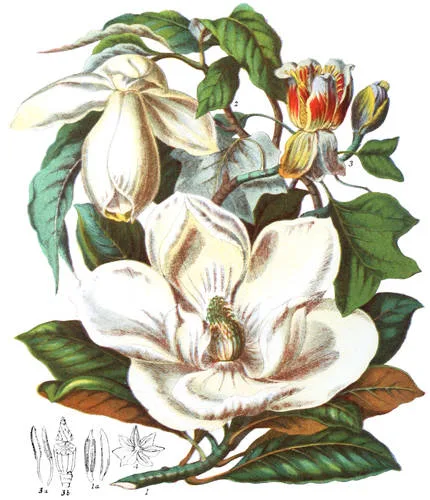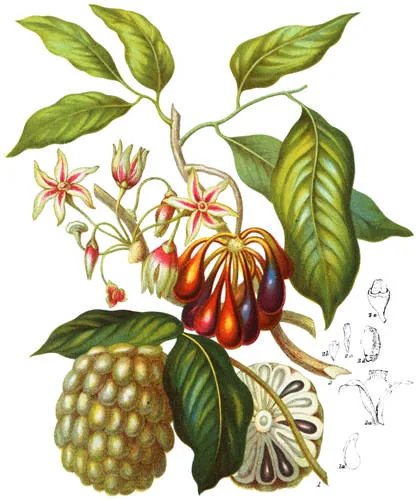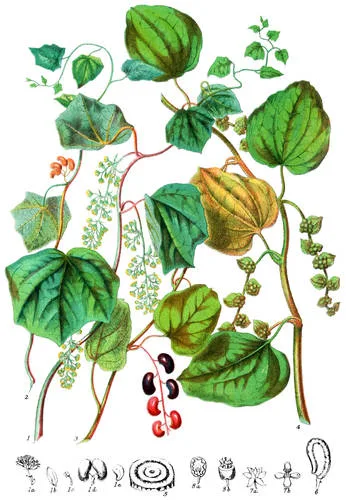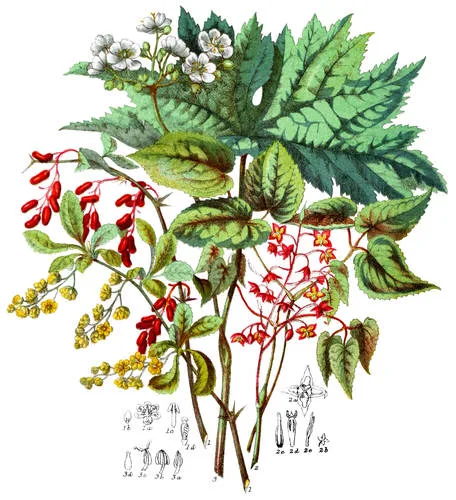
Malvaceæ
Malvaceæ
The Mallow Tribe
- 合集
- 植物自然目
- 绘者
- Elizabeth Twining(伊丽莎白·特温宁)
- 年代
- 1868
- 图版号
- Order 23
- 原书页码
- p.23
- 主色
- 红
- 授权
- CC BY-SA 4.0
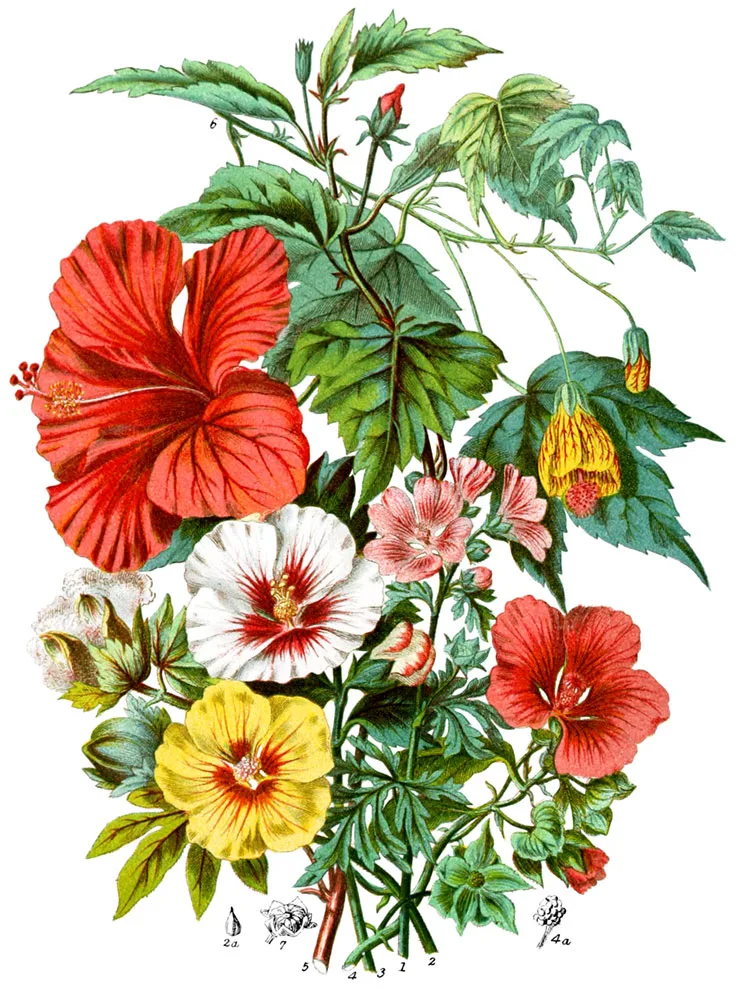
图中植物与部位
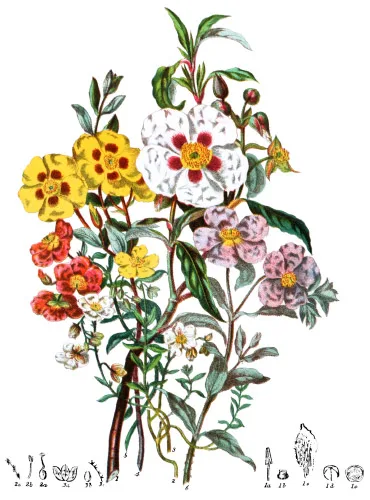
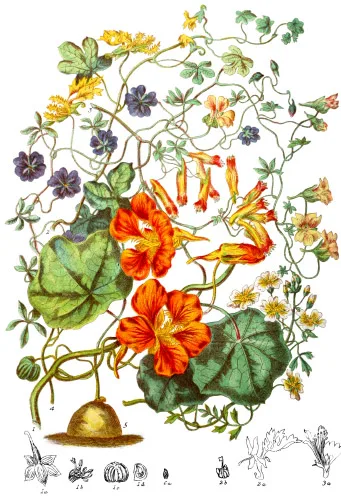
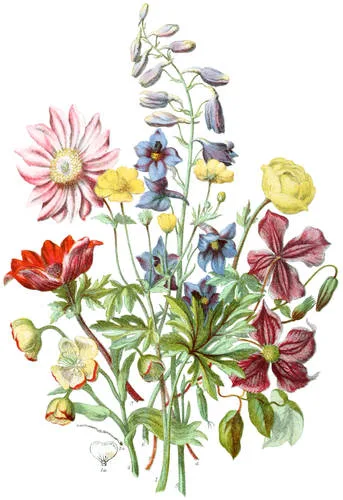
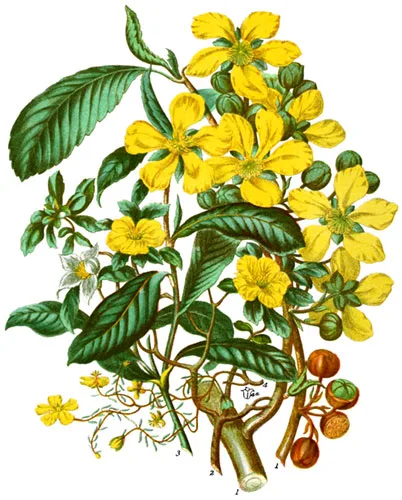
- 1. Malva moschata , Musk Mallow England
-
2.
Gossypium hrbaceum
, Common Cotton East Indies
- 2a. Seed
- 3. Hibiscus syriacus , Althea frutex Syria
-
4.
Malope trifida
, Trifid-leaved Malope Barbary
- 4a. Fruit of distinct carpels crowded into a heap
- 5. Hibiscus Rosa-sinensis , Chinese Hibiscus China
- 6. Abutilon striatum , Striated Abutilon Brazil
- 7. Fruit of Malva sylvestris , Common Mallow
关于本图版
《植物自然目》(Natural Orders of plants)由伊丽莎白·特温宁绘制,1849 年印行,本图即其中一幅。原书题作“Malvaceæ”。此类图版是当时记录物种形态的主要方式。
该合集全编共 160 幅图版,此图为其中之一,图版编号 Order 23,对应原书第 23 页,版式为纵幅,设色以红为基调。图像自原件扫描修复,构图与设色未经改动,授权方式见页面下方。
原书文字(英文 / 法文)
Key characteristics
Trees, shrubs, and herbaceous plants. The leaves are alternate, more or less divided, and have stipules at the base of their stalks. The flowers grow generally from the base of the leaf-stalks, and are often surrounded by an involucre of various forms. The sepals of the calyx are five, very seldom three, or four, in a greater or less degree united at the base. The petals are of the same number as the sepals, twisted in the bud, either distinct or adhering to the tube formed by the stamens. The stamens are numerous, all perfect, the filaments united together by the base of the pistil; the anthers are one-celled, bursting transversely. The ovary is formed by the union of several carpels or seed-vessels around a centre, from which arise an equal number of styles, either united or distinct, with variable stigmas. The fruit is either a capsule, as in Hibiscus, or a berry, as in Achania; the seed-vessels are united, as in Malva; or distinct, but crowded into a heap, as in Malope: each contains one or more seeds, which are sometimes hairy, as those of Gossypium.
The united stamens of Malva connect this Order with Geraniaceæ; the twisted petals and mucilaginous properties with Flax; and the arrangement of the carpels of Malope has an affinity with the crowfoots.
The uniform character of the whole Order is to abound in mucilage, and to be destitute of all the unwholesome properties. It is remarkable for the beauty of the flowers, for the toughness of the fibres, which in many species yield a strong cordage, and a thread used for weaving into coarse linen, for the downy cotton in the seed-vessels of the species, for the softening mucilage prepared from the seeds and roots of the others, and for various useful properties.
Select plants in this order
Not all plants listed are illustrated and not all plants illustrated are listed.
- Malva moschata (1) is the prettiest of the British species of this tribe; it was named from a slight scent it possesses of musk.
- Malva sylvestris is well known as one of our commonest way-side flowers, and is a good example of one species being very widely dispersed beyond the usual limits of the tribe; this and the British M. rotundifolia are frequently seen on the plains of India. M. crispa, of the West Indies, yields from the bark a very tenacious fibre for cordage.
- Gossypium, the cotton plant, is the most extensively useful of this or perhaps any tribe; there is scarcely any other plant that has proved of so much service to man, or has called forth so high a degree of skill in manufacture, or enterprise in commerce. It appears to have been first cultivated and woven into cloth in India, but is now spread over an extensive range of the globe on each side of the equator; from the south shores of Europe to the Cape of Good Hope; from China to Arabia and Syria; one species is peculiar to Peru; several are cultivated in the West Indies, Mexico, and the United States. In the equinoctial regions of America, cotton grows at an elevation of 9000 feet.
- Gossypium herbaceum (2) and its varieties are the kinds most generally cultivated in India; the capsule contains about five seeds, covered with a short grey down, lying in the mass of white cotton. One of these varieties produces the delicate cotton from which the beautiful Dacca muslin is fabricated. G. herbaceum is the only kind grown in the south of Europe.
- Hibiscus Rosa-sinensis (5) is a splendid example of the beauty of the flowers of this tribe; the petals are, like some others, astringent; the juice is used by the Chinese to blacken their eye-brows and the leather of their slippers.
- H. cannabinus is employed in India as a substitute for hemp and flax; the seeds yield an useful oil.
- H. trionum, with its inflated membranous calyx, is known in gardens as the Bladder Ketmia.
- Althea frutex (3) is a hardy shrub, flowering abundantly in shrubberies, even in the Parks of London.
- A. palustris inhabits the marshes of our southern coast, and is also found plentifully in France, where a syrup under the name guimauve is obtained from the abundant mucilage of the roots, and is esteemed as a cure for coughs.
- A. rosea, the Hollyhock, affords a similar kind of syrup in Greece; its leaves yield a yellow dye.
- Abelmoschus esculentus is an excellent ingredient for soup in the East.
- The seeds of A. moschatus are cordial, and mixed with coffee by Arabians.
- Urena and Pavonia are both medicinal plants of Brazil.
- Abutilon, Sida, and a few other genera, compose a division of this tribe without an involucre to the flower.
- Abuliton striatum (6) is a highly ornamental shrub, producing its elegant bell-shaped flowers on long drooping stalks during several months.
- Sida lancelolata is intensely bitter, and is thought valuable in medicine.
- S. micrantha has extremely straight light stems, which serve well for rocket-sticks.
Locations
The plants of this Tribe are found in great abundance in the Tropics: plentifully in the hottest countries of the Temperate regions, gradually diminishing towards the north. In the British Isles there are only six species; in Sweden they form but a small portion of the Flora; in Lapland they seem to be altogether unknown.
Legend
- Malva moschata, Musk Mallow. England.
- Gossypium herbaceum, Common Cotton. East Indies.
- Seed.
- Hibiscus syriacus, Althea frutex. Syria.
- Malope trifida, Trifid-leaved Malope. Barbary.
- Fruit of distinct carpels crowded into a heap.
- Hibiscus Rosa-sinensis, Chinese Hibiscus. China.
- Abutilon striatum, Striated Abutilon. Brazil.
- Fruit of Malva sylvestris, Common Mallow.
十二观
一幅图版,分十二个角度来读:名物、形色、刀笔、构图、时序、故土、谱系、花语、诗境、典故、观法、余韵。前七观是它的来历,后五观是它的余味。
-
名物考
原书题作「Malvaceæ」,编为Order 23(原书第 23 页)。此幅未见可靠的学名,只能以原书题名相称——这类情形在早期图谱中并不少见。此幅既无通行中文名,学名也不可靠,只能以原书题名相称——图谱里总有几幅这样的图,只能靠画面本身说话。
-
形与色
此图为一幅博物插画:一株植物被从山野或温室中取出,安置在纸的中央,根、茎、叶、花、果依次交代,务求可辨、可据、可传。按色相归档,此幅属红一路,红近胭脂,最经得起手工叠色。上色时画家通常先铺一层淡底,再在瓣基与背光处加深——颜色的层次,是这样一层层叠出来的。画幅高而窄,形与色的关系因此看得格外清楚:先读轮廓,再读色层,最后才看笔触。
-
刀笔与色层
十九世纪后半叶,石版与彩色石印渐成主流:颜色可以直接印出,不再依赖手工,线条反倒退居其次。图像的“准确”提高了,手性却淡了。此幅的线条与色块,可以拿放大镜看:线若连续不断,是刻的;色若溢出轮廓半毫米,是手涂的。工艺留下的破绽,比题跋更诚实。
-
构图与留白
画幅高而窄,主株一路向上,上下留白多,是图谱中最常见的立轴式构图。(画幅高宽比约 1.35∶1)另附 9 处局部解剖,主株与细部互为注脚。
-
时序
图版多标花期,因花期是植物一年中最容易被辨认的十余日;其余月份,它只是一丛叶。图上所记的 1868 年是刊行之年,不是花期;真正的花期藏在原书的采集记录里,比出版早一两年。
-
故土
来源不一,或本地山野,或远洋引种。十九世纪的植物园与温室,是这些植物离开故土后的第一个住所。同一部图谱里,同类往往排在一起;把几幅并看,差别比单看一幅清楚得多。
-
谱系
《植物自然目》(Natural Orders of plants)由伊丽莎白·特温宁绘,成于1849。此幅为其中Order 23,见原书第 23 页。图版今属公有领域,可自由取用;但纸上那层手工上色,仍是两百年前某一个人的手。
-
花语与象征
博物画的象征不在花语,而在“记录”本身:它相信一株植物值得被准确画下,这份信念是科学时代最朴素的道德。此幅偏红,在花语里总要再加重一分情绪。花语是后人添上去的,花本身并不知道;但这层“不知道”,正是它最动人的地方。
-
诗境
朝饮木兰之坠露兮,夕餐秋菊之落英。
—— 战国·屈原《离骚》
中国文学里最早的一顿“花食”:露与英都可入口,草木与人从此不分彼此。诗以气行,画以形立;两种“看”叠在一起,才是看画的意思。
-
典与谱
中国有《本草纲目》《植物名实图考》,欧洲有从《本草》插图到彩色石印的谱系;两条传统都相信:图能补文字的不足。中国的花谱重品第与品格,欧洲的植物志重形态与命名;此图站在后一条线上,却也经得起前一种眼光——毕竟看花的人,两样都要。典籍能补画面之不足,也会遮住画面:先看画,再翻书,顺序不要倒。
-
观法
看画幅的边缘:一株植物被截断在何处,往往透露它被观看的方式——是标本,是园艺,还是野地。别忘了看题名与编号:它们不是画面的一部分,却是这幅图进入知识体系的入口。
-
余韵
1868 年的那朵花早已化作尘土,它留在纸上的样子,却比任何一株活着的同类都长寿。
本图涉及的植物
- Malva moschata
- Gossypium herbaceum
- Hibiscus syriacus
- Malope trifida
- Hibiscus Rosa-sensis
- Abutilon striatum
属索引
- Abelmoschus
- Abutilon
- Achania
- Althea
- Gossypium
- Hibiscus
- Malope
- Malva
- Pavonia
- Sida
- Urena