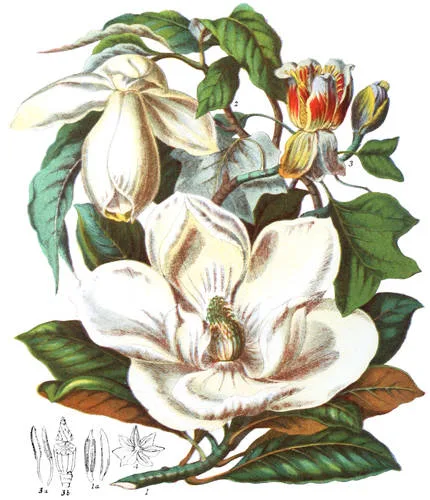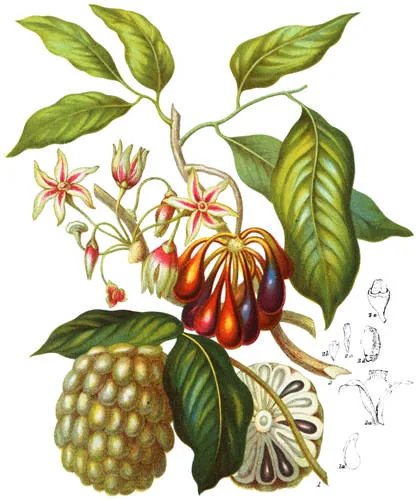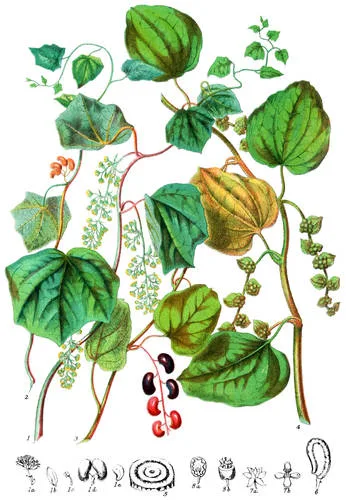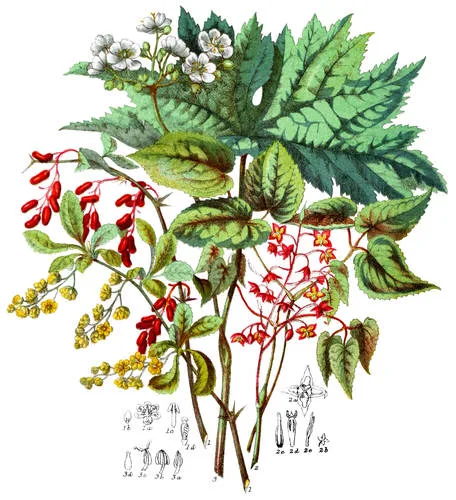
Marcgraviaceæ
Marcgraviaceæ
The Marcgravia Tribe
- 合集
- 植物自然目
- 绘者
- Elizabeth Twining(伊丽莎白·特温宁)
- 年代
- 1868
- 图版号
- Order 36
- 原书页码
- p.36
- 主色
- 绿
- 授权
- CC BY-SA 4.0
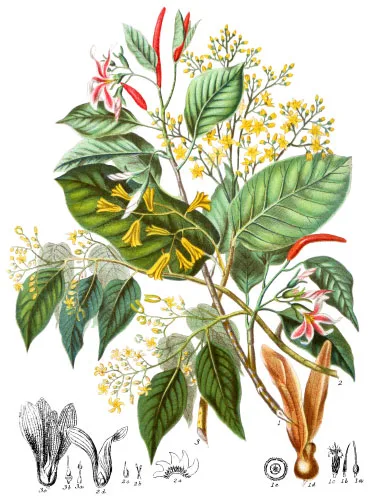
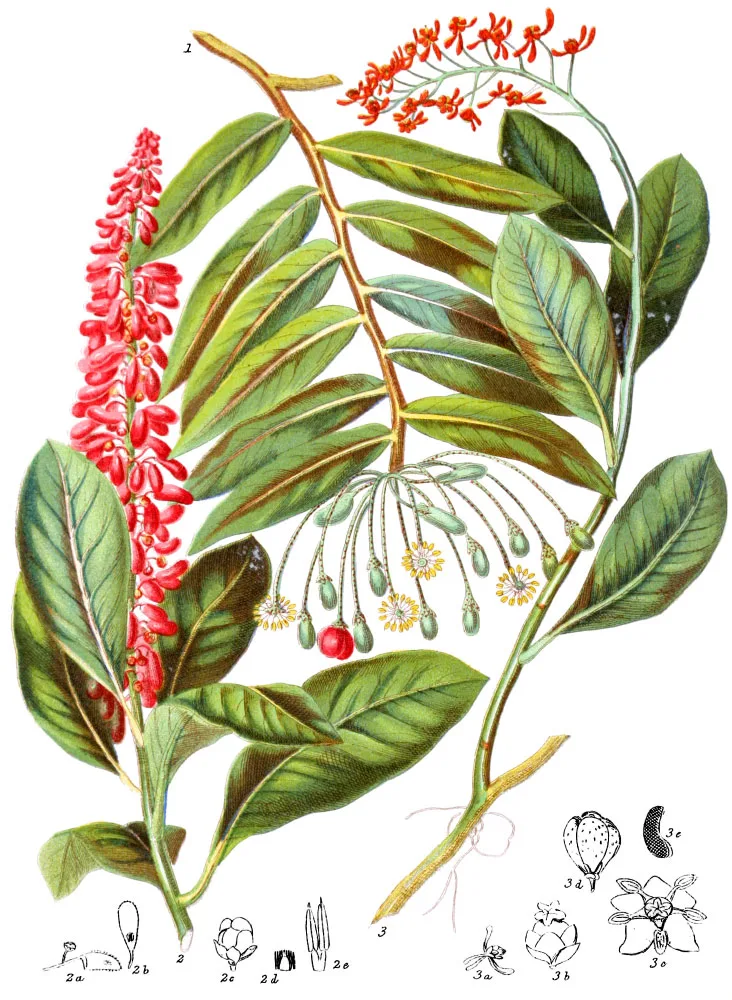
图中植物与部位
- 1. Marcgravia umbellata West Indies
-
2.
Norantea japurensis
South America
- 2a. Flower and Bract
- 2b. Bract
- 2c. Bud, magnified
- 2d. Pistil and Stamen
- 2e. Stamen
-
3.
Ruyschia corallina
South America
- 3a. Flower and Bract
- 3b. Calyx and Pistil
- 3c. Flower, magnified
- 3d. Capsule
- 3e. Seed
关于本图版
这幅图版出自《植物自然目》(Natural Orders of plants),由伊丽莎白·特温宁绘制,1849 年出版。原书题作“Marcgraviaceæ”。这是该物种在早期博物学出版物中的图像记录之一。
全编共收录 160 幅图版,本图是其中一幅,原书将其列为 Order 36,见第 36 页,版式为纵幅,整幅以黄绿为主调。此图由原件扫描修复而成,使用时请遵循页面标注的授权条款。
原书文字(英文 / 法文)
Key characteristics
Trees and shrubs, some of which are climbing, parasitical, and sending out rootlets from the knots of the branches, or base of the leaf-stalks. The leaves are alternate, simple, entire at the edges, tough and leathery, without stipules. The flowers are regular, growing on branching stalks, or in umbels, or in terminal spikes; usually having bracts, which are sometimes hooded, or hollow bags. The sepals of the calyx are from two to seven, generally leathery; the corolla is attached to the base of the ovary; in Marcgravia it is composed of one petal, hollow, cup-shaped; sometimes it is formed of five small petals as in Norantea. The stamens are either of definite or indefinite number, inserted either on the receptacle or on a membrane at the base of the ovary; the filaments are dilated at the base; the anthers are attached by the base, long, many-celled, surmounted by a single style with a simple or capitate stigma; the ovules are numerous, attached to the projections of the central column. The fruit is at present imperfectly known, supposed to be generally succulent, but sometimes a capsule, leathery, and consisting of several valves which separate slightly, the partitions from the middle of each valve not reaching to the central column, the fruit becomes one-celled. The seeds are very small, numerous, imbedded in pulp, oblong, blunt at each end, straight or incurved, the outer skin hard and netted, with the scar at the side, without albumen.
This Order appears to have affinity with Hypericaceæ, but is still more closely allied to Clusiaceæ: the hooded bracts form a kind of link with the pitcher-plants.
Select plants in this order
Not all plants listed are illustrated and not all plants illustrated are listed.
- Marcgravia (1) was so named in memory of Marcgraf, a German botanist, who made a voyage to Brazil in 1648. It is a sub-parasitical shrub, creeping over the stems of tall trees, with drooping divided branches terminated by umbels of flowers; the corolla is of one petal, which is conical, falling off soon; the stamens then become spreading; the sepals are six, the two outermost largest. The round germen has no style, but is crowned by the radiant stigma; the small shining seeds are enclosed in a succulent fruit full of soft red pulp. In the woods of Jamaica it is frequent, assuming various aspects during the different periods of growth; the hollow bracts being the most remarkable feature. The stem, root, and leaves are said to be employed medicinally in the West Indies.
- M. cuneifolia has hooded bracts on three flower-stalks, like Norantea, the two other flower-stalks have none: it has also five petals instead of one hollow petal.
- Norantea (2) is supposed to be called after its native name in Guiana, where it was discovered by Aublet, a French traveller of the last century.
- N. japurensis (2) is a parasitical shrub growing on the trees of the primæval forests on the shores of the River Japure; the membranous hollow bracts contain pellucid water; this species was found flowering in the month of January, others were in flower in June, from which it seems probable the plants flower twice in the year, as frequently occurs in the vegetation of the Tropics.
- N. paraensis is of nearly similar aspect with the rest, but the petals and calyx are purple, the bracts scarlet.
- N. adamantinum has small green flowers, on long stalks.
- Ruyschia records the name of a celebrated Dutch botanist. Several species of the genus abound in South America; it is in some instances a tree, in others a shrub.
- R. corallina (3) is a paraside, sending out aerial roots from the joints of the stem, climbing on lofty trees in the hot, damp forests on the sandy shores of rivers in Brazil, and everywhere near the coast of the Pacific, in the tropical region of South America, extending to about twenty degrees of latitude north and south of the equator. It flowers in January, and at that time bears much resemblance to an orchideous plant.
- R. amazonica, of the shores of the Amazon River, has yellow petals with red bracts, and flowers in August.
- R. Spixiana was discovered by the Bavarian botanist Spix, in the interior of the province of Para, in the course of the Amazon, bearing its curious flowers abundantly in August.
The modifications both of form and colour of the bracts of the plants of this tribe are very singular; in several instances, they have the appearance of the spur or nectary of some flowers, in others they are of a size and colour as to acquire the aspect of an actual flower, which is of comparative insignificance itself.
Locations
Equinoctial America is the region inhabited by this Tribe.
Legend
- Marcgravia umbellata. West Indies.
- Calyx.*
- Ovary.*
- Norantea japurensis. South America.
- Flower and Bract.
- Bract.
- Bud, magnified.
- Pistil and Stamen.
- Stamen.
- Ruyschia corallina. South America.
- Flower and Bract.
- Calyx and Pistil.
- Flower, magnified.
- Capsule.
- Seed.
本图涉及的植物
- Marcgravia umbellata
- Norantea japurensis
- Ruyschia corallina
属索引
- Marcgraavia
- Norantea
- Ruyschia