Meliaceæ
Meliaceæ
The Bead-Tree Tribe
- 合集
- 植物自然目
- 绘者
- Elizabeth Twining(伊丽莎白·特温宁)
- 年代
- 1868
- 图版号
- Order 40
- 原书页码
- p.40
- 授权
- CC BY-SA 4.0
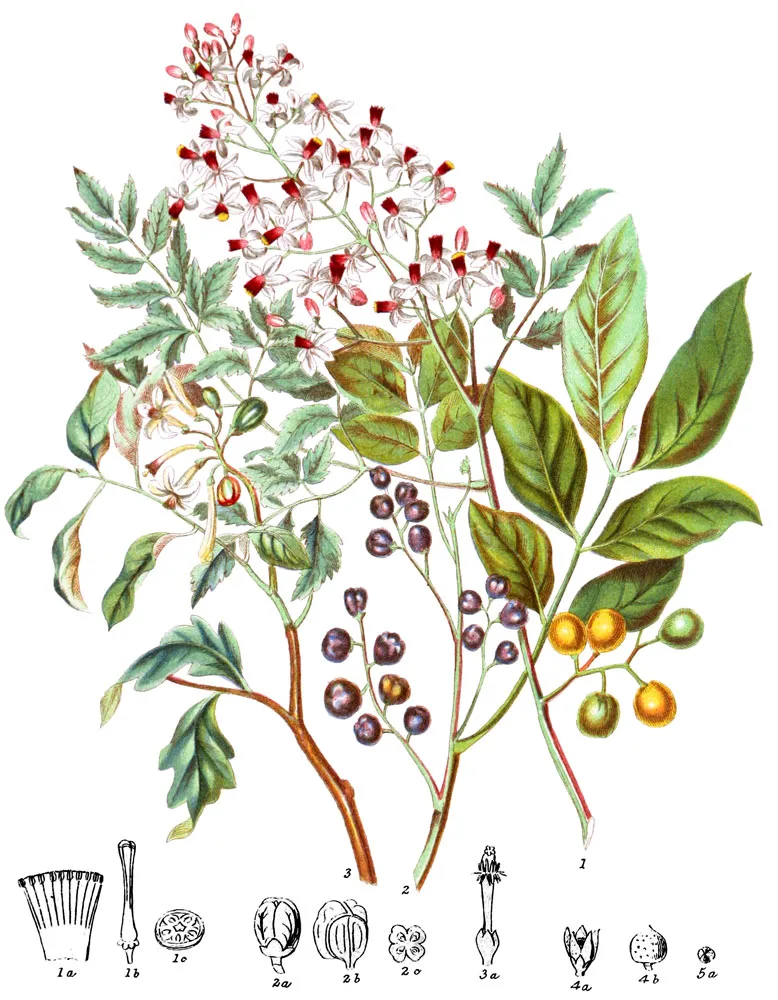
图中植物与部位
-
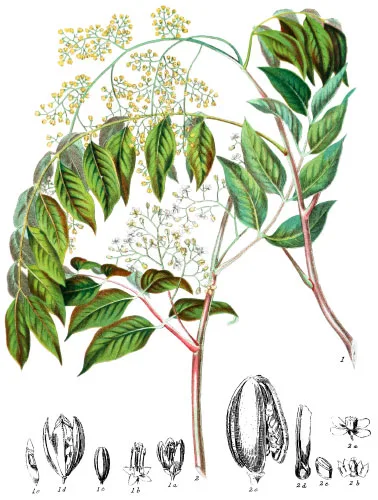
1.
Melia Azedarach
, Bead-Tree Syria and South Europe
- 1a. Stamens
- 1b. Pistil
- 1c. Section of Fruit
-
2.
Guarea tuberculata
, Tuberculated Guarea South America
- 2a. Fruit
- 2b. Section
- 2c. Section of Ovary
-
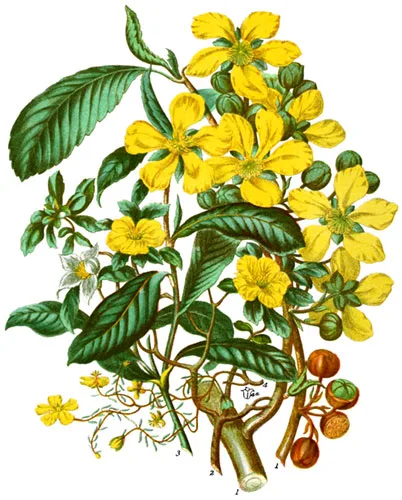
3.
Turræa lobata
, Various-leaved Turræe East Indies
- 3a. Stamens and Pistil
-
- 4a. Ekebergia senegalensis, Flower
- 4b. Fruit
-
- 5a. Seed of Ekebergia indica
关于本图版
本图选自伊丽莎白·特温宁的《植物自然目》(Natural Orders of plants),原书 1849 年出版。原书题作“Meliaceæ”。此类图版是当时记录物种形态的主要方式。
该合集全编共 160 幅图版,此图为其中之一,图版编号 Order 40,对应原书第 40 页,版式为纵幅。图像自原件扫描修复,构图与设色未经改动,授权方式见页面下方。
原书文字(英文 / 法文)
Key characteristics
Trees and shrubs, the leaves of which are alternate, occasionally nearly opposite, simple or pinnate, without stipules. The flowers are sometimes imperfect in pistils and stamens; the sepals of the calyx are three, four, or five, partly united; the petals are the same number, attached below the ovary, conniving or cohering at the base. The stamens are twice as many ase the petals, the filaments cohering and forming a long tube, the anthers seated within the orifice of the tube, which is slightly expanded and notched. The disk is often very large, surrounding the ovary like a cup; the ovary is single, having usually as many cells as the number of petals; the style is single; the stigmas are distinct or combined. The fruit is a berry, or a drupe, or a dry capsule, often one-celled; the seeds are without wings; those of Melia and others contain a fleshy albumen; Those of Trichilia and a few more have none.
These trees have relation to the Soap-tree and Mahogany tribes.
Bitter, astringent, and tonic properties exist throughout the Tribe; a few species are poisonous.
Select plants in this order
Not all plants listed are illustrated and not all plants illustrated are listed.
- Melia Azedarach (1) was not known to the ancients, but is now abundant in the countries of Europe, Asia, and Africa bounding in the Mediterranean; it is a tree attaining the height of forty feet in the south of France and Italy; the foliage is graceful, and the flowers abundant and elegant; the tubular crown formed by the stamens is the peculiar character. The pulp of the fruit is poisonous, although some birds eat it without injurious effects. This is one of the few fruits, besides the Olive, which contain oil in the pulp instead of the seed, the usual receptable of it; in the East it is used for burning in laps, and for other domestic purposes. The ribbed seed is hard, and serves as beads for rosaries, on which account it is often planted in the court of a monastery, this use giving the name to the tribe: the root is bitter and nauseous, and is said to be employed medicinally in North America.
- M. Azadirachta, the Margosa, or Nym-tree of the East Indies, attains considerable dimensions, the branches stretching horizontally to a great distance; when planted around religious edifices, these trees form a valuable shade, and are of very striking effect. The bitter juice obtained from the stem and bark is one of the common medicines of the Hindoo doctors; the pulp of the fruit yields oil like that of the former species, and is supposed to have properties rendering it medicinal. The leaves are used generally in India for poultices.
- Guarea (2), so called from the Cuban name, contains in the wood and bark a bitter resinous substance with the odour of musk; that of C. grandifolia is highly fragrant and valued as a perfume; in general, the wood is unfit for casks, as it has the property of imparting an extreme bitterness to the liquor contained in them.
- Trichilia has also a powerful scent of musk; T. speciosa yields a fragrant oil used as a remedy in rhuematism.
- T. Catigoa imparts a bright yellow colour to leather.
- Turræa (3), named after a botanist in Pauda, is a genus belonging to the Islands of India.
- A few eatable fruits are found in this Tribe.
- The Langsat, much esteemed in the Indian Archipelago for the cooling qualities of its watery pulp, is a species of Lansium, and the fruit, called by the natives Ayer Ayer, belongs to the same genus.
- Milnea edulis, of Silhet, is another plant affording eatable fruit.
- The aromatic roots of Sandoricum indicum are said to possess medicinal properties.
- The bark of Carapa guianensis is an esteemed fever remedy in Guiana; the oil of the fruit preserves iron from rust.
- C. guineensis yields the useful Kundah oil, which, though bitter and acrid, burns well in lamps.
- An odour of garlic occuring in Dysoxylon and Hartighsea is a connecting link with a few species of Cedrela in the Mahogany tribe; the Javanese use the fruit as garlic.
Locations
The plants of this Tribe are found in almost all parts of the world; most abundantly in Asia and America; Hartighsea exists in New Zealand; Melia Azedarach extends as far north as lat. 40°; beyond the Tropics the species are rare.
Legend
- Melia Azedarach, Bead-Tree. Syria and South Europe.
- Stamens.
- Pistil.
- Section of Fruit.
- Guarea tuberculata, Tuberculated Guarea. South America.
- Fruit.
- Section.
- Section of Ovary.
- Turræa lobata, Various-leaved Turræa. East Indies.
- Stamens and Pistil.
-
- Ekebergia senegalensis, Flower.
- Fruit.
-
- Seed of Ekebergia indica.
本图涉及的植物
- Melia Azedarach
- Guarea tuberculata
- Turræa glabra
- Ekebergia indica
- Ekebergia senegalensis
属索引
- Carapa
- Dysoxylon
- Ekebergia
- Guarea
- Hartighsea
- Lasium
- Melia
- Milnea
- Trichilia
- Turræa