Myrtaceæ
Myrtaceæ
The Myrtle Tribe
- 合集
- 植物自然目
- 绘者
- Elizabeth Twining(伊丽莎白·特温宁)
- 年代
- 1868
- 图版号
- Order 57
- 原书页码
- p.57
- 主色
- 橙
- 授权
- CC BY-SA 4.0
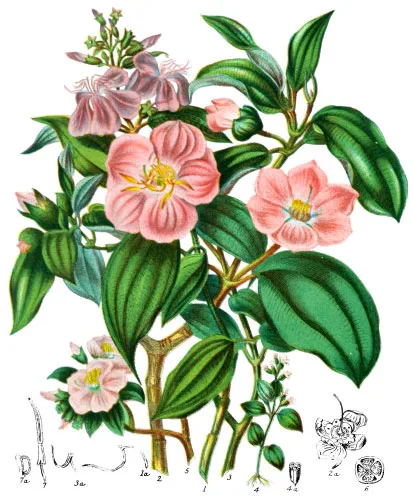
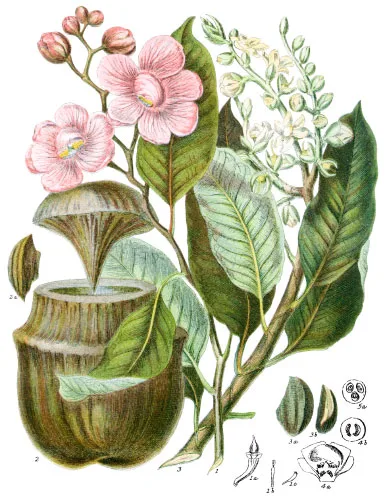
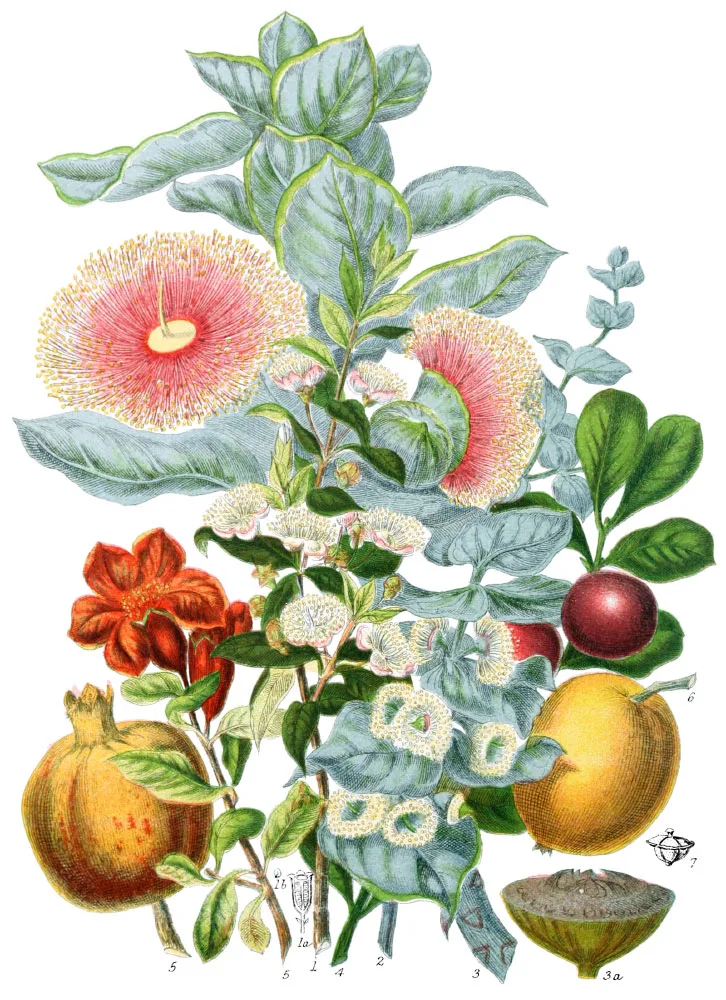
图中植物与部位
-
1.
Myrtus communis
, Common Myrtle Persia and S. Europe
- 1a. Section of Ovary
- 1b. Seed
- 2. Eucalyptus pulverulenta , Powdery Gum-tree New Holland
-
3.
Eucalyptus macroearpa
Swan River
- 3a. Seed-vessel
- 4. Psidium Cattleyanum , Purple Guava South America
- 5. Punica Granatum , Pomegranate S. Europe
- 6. Eugenia Malaccensis , Malay Rose-apple East Indies
- 7. Leptospermum scoparium , New Zealand Tea Plant New Zealand
关于本图版
本图选自伊丽莎白·特温宁的《植物自然目》(Natural Orders of plants),原书 1849 年出版。原书题作“Myrtaceæ”。此类图版是当时记录物种形态的主要方式。
该合集全编共 160 幅图版,此图为其中之一,图版编号 Order 57,对应原书第 57 页,版式为纵幅,整幅以橙为主调。图像自原件扫描修复,构图与设色未经改动,授权方式见页面下方。
原书文字(英文 / 法文)
Key characteristics
Trees and shrubs, no herbaceous plants. Leaves opposite, entire, usually having transparent dots, and a vein running parallel with the margin. The flowers are various in form, but grow usually from the base of the leafstalk; they are red, white, occasionally yellow, never blue. The calyx is adherent, four or five cleft at the top, sometimes cohering together at the points, and falling off like a cap, as in Eucalyptus. The petals are equal in number to the divisions of the calyx. Stamens either twice as many as the petals, or numerous, rarely of the same number; the filaments are distinct, or connected in several sets, curved inwards before flowering; the anthers are ovate, two-celled, opening lengthwise. The ovary is from one to six celled, the style simple. The fruit is either dry or fleshy, entire or gaping; the seeds are usually of indefinite number, and variable in form.
This is one of the most clearly defined of the natural orders of plants, and very easily recognized. The opposite leaves without stipules, with a smooth edge and marginal vein being sure indications of it. It is closely connected with Rosaceæ, Melastomaceæ, and others, but is obviously distinguishable from all. Nearly all are highly aromatic, from an oil contained in the pores of the leavs. Some curious transformations of petals and sepals occur in this tribe.
Select plants in this order
Not all plants listed are illustrated and not all plants illustrated are listed.
- Myrtus (1) was known to and named by the ancient Greeks, and retains the same derivation in all European languages. It was a celebrated plant in Athens, employed as a symbol of honour in victory, and of justice for judges, and dedicated to Venus on account of its beauty and aromatic fragrance. The berries were added to wine, used in cookery, and in medicine for their astringent properties. The buds are still eaten as pepper in Tuscany, and the bark is used for tanning. It was long ago brought to England, and now flourishes in the southern counties in great luxuriance, particularly on the coast, the air of the sea being remarkably favourable to it, as was observed anciently in Greece.
- M. tomentosa yields eatable berries on the Neilgherries.
- M. nummularia is the smallest plant of this tribe, spreading over the ground in the Falkland Isles.
- Eucalyptus pulverulenta (2) and E. macrocarpa (3) are examples of the Gum trees of Australia, where they rank amongst the loftiest timber trees; the stems of some species rising in a straight column to the height of 150 feet before branching; the foliage is of a singular grey hue, the same on both surface, forming a striking contrast with the bright glossy leaves of the European Myrtle. The flowers have no petals; the united calyx, being separated from the top of the cup by the force of the expanding stamens, falls off like a cap. A valuable kind of Tannin is prepared from the bark of several species, and is said to be much more powerful than that of Oak.
- E. resinifera of New South Wales yields an efficacious gum resin.
- E. mannifera exudes a sweet substance resembling Manna, in the dry season.
- E. robusta has cavities in the stem containing a fine red gum. Another species furnishes a copious juice which ferments like beer, and is considered a refreshing beverage by the inhabitants of Tasmania.
- The different kinds of Psidium, or Guava, afford a pleasnt fruit in the West Indies, that of P. Cattleyanum (4) is esteemed the best flavoured.
- The dark curled-grained wood of P. montanum is much valued for its ornamental uses.
- Punica is said by Pliny to have been so named from having been found growing abundantly on the shores of Carthage. It was early celebrated for the medicinal properties of the fruit in Persia, where it forms extensive woods. In Europe it is still employed medicinally; the fruit is considered delicious in the East.
- Eugenia was named after Prince Eugene of Savoy, a great patron of botany.
- E. Malaccensis (6) is much cultivated in the Malay Isles for the sake of its agreeable fruit, which has the fragrance of a rose; several species bearing eatable fruit grow in South America; Allspice is the dried fruit of E. Pimento.
- Leptospermum scoparium abounds on the shores of many parts of Australia and New Zealand, where it was found by Captain Cook; th eleaves, having a pleasant bitter flavour, were used by his crew as tea. The seed-vesel is of a remarkable vase shape (7).
- Nearly all species of Metrosideros are evergreen shrubs of Australia, where the hard wood is of much value.
- M. buxifolia, the aki of New Zealand, is a rambling shrub climbing by means of its side rootlets to the top of the highest forest trees in the Bay of Islands.
- Cajeput oil, valued for its stimulant properties, is distilled from the leaves of Melaleuca Cayaputi of the Moluccas.
- The dried flower-buds of Caryophyllus aromaticus are the spice Cloves.
Locations
The plants of this Tribe are dispersed in Tropical and other hot countries; a great number are natives of the East Indies and South America; in Chile, they grow to the height of 2000 feet on the Andes; at the Equator, the region of Myrtaceæ ascends to upwards of 5000 feet; many genera are peculiar to Australia and South Sea Isles. Sonneratia and Careya belong exclusively to India and its islands. Psidium and Eugenia are natives equally of Asia and America. Metrosideros augustifolia and a very few others are found in Africa; M. lucida extends as far south as Lord Auckland’s Isles. Myrtus is a widely dispersed genus, found at the Straits of Magellan, in Peru, and on the mountains of India. M. communis is the most northern species, having become naturalized in South Europe.
Legend
- Myrtus communis, Common Myrtle. Persia and S. Europe.
- Section of Ovary.
- Seed.
- Eucalyptus pulverulenta, Powdery Gum-tree. New Holland.
- Eucalyptus macroearpa. Swan River.
- Seed-vessel.
- Psidium Cattleyanum, Purple Guava. South America.
- Punica Granatum, Pomegranate. S. Europe.
- Eugenia Malaccensis, Malay Rose-apple. East Indies.
- Leptospermum scoparium, New Zealand Tea Plant. New Zealand.
十二观
- 实测花色 橙黄、黄绿
- 纵幅 1.38∶1
- 含 7 个物种
- 10 处解剖图
- 1868 年刊
- Order 57
这不是词条,是一条看画的次序:先站定看整体,再看名字与形色、构图与刀工,然后问它几时开、从哪里来、经了谁的手;最后是中国诗文——同一朵花,中国古人是怎么看的。十二观读完,这幅图就打开了。
-
第一眼
六法者何?一、气韵生动是也;二、骨法用笔是也;三、应物象形是也;四、随类赋彩是也;五、经营位置是也;六、传移模写是也。
—— 南齐·谢赫《古画品录》
一千五百年前的六条标准:气韵、用笔、形似、设色、构图、临摹。你在这幅图上一样样对过去,就是一次完整的读画。这一幅是竖的:眼睛从下往上走,落点在上半部。先让整株立起来,再看细节。第二步凑近一寸:主线之外另有 10 处解剖小图——那是画家怕你看不清,替你把花剖开了。第三步,找橙色最重的一小块:整幅的明暗秩序,是从那里排开的。
-
名与实
没有学名可依,就看题名:题名里往往藏着产地、赠者或一句形容。此幅既无通行中文名,学名也不可靠,只能以原书题名相称——图谱里总有几幅这样的图,只能靠画面本身说话。
-
形与色
就这一幅实测:花色占画面的 19.6%,叶色 13.6%,主相是橙黄、辅以黄绿。这个比例与色相,是这一幅独有的。此图为一幅博物插画:一株植物被从山野或温室中取出,安置在纸的中央,根、茎、叶、花、果依次交代,务求可辨、可据、可传。此幅属橙一路,橙如琥珀,暖而不燥。上色时先铺一层淡底,再在瓣基与背光处加深——层次是这样一层层叠出来的。画幅高而窄,形与色的关系因此看得格外清楚:先读轮廓,再读色层,最后才看笔触。
-
构图与呼吸
画幅高而窄,主株一路向上,上下留白多,是图谱中最常见的立轴式构图。(高宽比约 1.38∶1)另附 10 处局部解剖,主体与细部互为注脚。这一幅排得满:枝叶占到画面的 57%,重心近于正中——标本式的画法,图的是看得全。试着用拇指遮住空白处——画面立刻变闷;放开,它才重新“喘上气”。留白,是给主体让出的气口。
-
一刀一色
十九世纪后半叶,石版与彩色石印渐成主流:颜色可以直接印出,不再依赖手工,线条反倒退居其次。图像的“准确”提高了,手性却淡了。拿放大镜(或手机微距)看三处:花瓣边缘、叶脉、题名。线若连续不断,是刻的;色若越过轮廓半毫米,是手涂的。
-
时序
图版多标花期,因花期是植物一年中最容易被辨认的十余日;其余月份,它只是一丛叶。图上所记的 1868 年是刊行之年,不是花期;真正的花藏在原书的采集记录里,通常比出版早一两年。同一株植物,春天与秋天看起来像两种东西;图谱选花期,是因为那时它最不容易认错。
-
故土
来源不一,或本地山野,或远洋引种。十九世纪的植物园与温室,是这些植物离开故土后的第一个住所。十九世纪的苗圃主是这场植物迁徙的中转站:谁家先开花,谁家就有生意。
-
书与人
《植物自然目》(Natural Orders of plants)由伊丽莎白·特温宁绘,成于1849。此幅为其中Order 57,见原书第 57 页。一本书的“作者”常常是主编;真正决定这幅图好不好看的,是没留下名字的刻工与上色人。
-
诗境
朝饮木兰之坠露兮,夕餐秋菊之落英。
—— 战国·屈原《离骚》
中国文学里最早的一顿“花食”:露与英都可入口,草木与人从此不分彼此。诗以气行,画以形立;两种“看”叠在一起,才是看画的意思。
-
文心
六法者何?一、气韵生动是也;二、骨法用笔是也;三、应物象形是也;四、随类赋彩是也;五、经营位置是也;六、传移模写是也。
—— 南齐·谢赫《古画品录》
一千五百年前,谢赫给了六条看画的标准:气韵、用笔、形似、设色、构图、临摹。前五条今天仍然管用——在这幅图版上一样样对过去,就是一次完整的读画。中国有《本草纲目》《植物名实图考》,欧洲有从《本草》插图到彩色石印的谱系;两条传统都相信:图能补文字的不足。读古文不必求全解,先认下这一句:它把“看花”换成了“看人”,你再看这幅图,眼里就多了一层。
-
花语
博物画的象征不在花语,而在“记录”本身:它相信一株植物值得被准确画下,这份信念是科学时代最朴素的道德。此幅偏橙,在花语里总要再加重一分情绪。象征会随世道改口:同一株植物,在一个世纪里可以说完全相反的话。
-
带走一双眼睛
鉴赏力不是知识,是习惯:每次多看一眼,十年之后你看什么都和别人不一样。二百年后,这株植物的后代或许仍在某处活着;而纸上这一株,永远停在 1868 年的那个季节。
本图涉及的植物
- Myrtus communis
- Eucalyptus pulverulenta
- Eucalyptus marcocarpa
- Psidium Cattleyanum
- Punica granatum
- Eugenia Malaccensis
- Leptospermum scoparium
属索引
- Careya
- Caryophyllus
- Eucalyptus
- Eugenia
- Leptospermum
- Melaleuca
- Metrosideros
- Myrtus
- Psidium
- Punica
- Sonneratia