Pandanaceæ
Pandanaceæ
The Screw-Pine Tribe
- 合集
- 植物自然目
- 绘者
- Elizabeth Twining(伊丽莎白·特温宁)
- 年代
- 1868
- 图版号
- Order 146
- 原书页码
- p.146
- 主色
- 绿
- 授权
- CC BY-SA 4.0
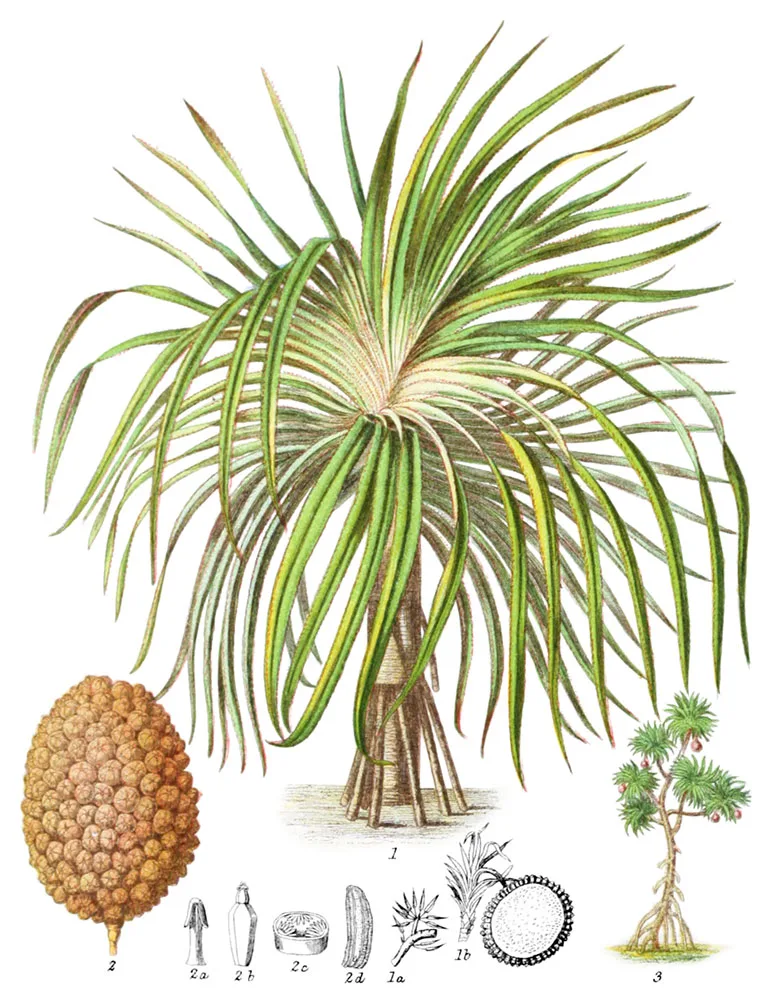
图中植物与部位
-
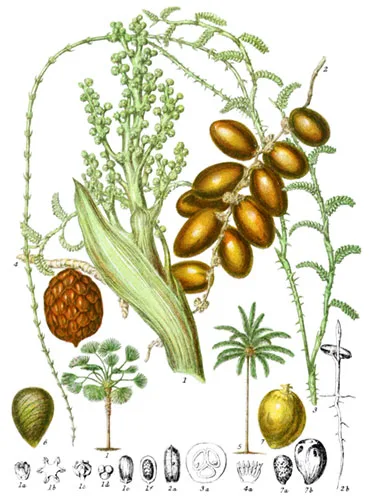
1.
Pandanus spiralis
, Spiral leaved Screw-pine New South Wales
- 1a. Stamen flowers
- 1b. Section of fruit
-
2.
Freycinetia imbricata
, Fruit Indian Isles
- 2a. Stamen
- 2b. Ovary
- 2c. Section of ovary
- 2d. Unnamed*
- 3. Branching Pandanus, with fruit Asia
关于本图版
《植物自然目》(Natural Orders of plants)由伊丽莎白·特温宁绘制,1849 年印行,本图即其中一幅。原书题作“Pandanaceæ”。这是该物种在早期博物学出版物中的图像记录之一。
该合集全编共 160 幅图版,此图为其中之一,图版编号 Order 146,对应原书第 146 页,版式为纵幅,整幅以黄绿为主调。图像自原件扫描修复,构图与设色未经改动,授权方式见页面下方。
原书文字(英文 / 法文)
Key characteristics
Trees and shrubs, sometimes upright and sending down aerial roots to the ground, sometimes having climbing or prostrate stems. The leaves are laid over one another in three rows spirally; they are long and narrow, clasping at their base, usually spiny at the edges; sometimes pinnated or fan-shaped. The leaves or spathes on the spadix are smaller, often coloured. The stamens and pistils are separate or united; the flowers have no corolla, sometimes a calyx, occasionally a few scales cover the spadix. The stamens are numerous, the filaments bearing single anthers with two or four cells. The ovaries are usually in clusters, each ovary having a stigma. The fruit is either a fibrous drupe with one seed, or a berry with many cells and many seeds in each, containing fleshy albumen.
This Tribe forms a link with Palms and Arums.
Some of the plants have eatable fruit and fibrous leaves.
Select plants in this order
Not all plants listed are illustrated and not all plants illustrated are listed.
- Pandanus is said to be derived from the Malay name, Pandang, signifying worthy of admiration. The different species grow throughout the isles of the Indian Ocean most abundantly, wherever the atmosphere is sufficiently moist, for even the dry sandy plains afford a favourable soil if near the damp saline air of the sea. They are generally found on level ground, and from thence ascending to the region of tree-ferns. Some have a straight columnar stem, as in P. spiralis (1), attaining twenty feet in its native country; others are slender, and bend gracefully, with forked branches terminating in tufts of leaves in spiral rows (3). The most peculiar characteristic of these trees is their power of emitting roots from the upright stem to the height of fifteen feet from the ground; they are provided at points with a cellular substance which protects them till they reach the ground, when they penetrate the earth, and are of twofold advantage to the tree—absorbing nourishment for its use, and preserving it in a firm upright position against the rough winds from the ocean. The tough soft portion of the roots serves as cork; the fibres are of various uses to the natives of Tahiti; the mats manufactured from them, and stained with different colours, are occasionally to be seen in museums in this country. In the East Indies the strong coarse bags for transportation of coffee are made from the fibres of the leaf, which are of very durable texture in most of the species. The young leaf-buds are by some Asiatics eaten and esteemed, like those of Palms; and the fruit, although not of a pleasant flavour, forms part of their food in times of scarcity; the seeds are also considered eatable.
- The flowers of P. odoratissimus are highly fragrant, yielding one of the richest Eastern perfumes: for the sake of this scent the trees are much cultivated in Java. The women of the islands of the South Pacific Ocean strew the pollen of the anthers over their hair.
- P. candelabrum, the chandelier-tree of Guinea and St. Thomas’s, has forked branches, with spiral traces of former leaves, presenting a very remarkable appearance.
- P. utilis, of the Isle of Bourbon, is of less size; the smallest species is the dwarf Screw-pine of the Mauritius, P. humilis. The sharp spines of the edges of the leaves, and along the under side of the mid-rib, render it suitable to protect fields, for which purpose it is very frequently planted in India.
- Although Screw-pines flourish most on the shores or flat districts of islands, they will thrive likewise on mountains; some have been found at 4000 feet elevation on the Himalaya.
- Freycinetia Bauerii is the Grass-tree of Norfolk Isle, one of the most striking examples of is luxuriant vegetation; scrambling prostrate on the ground, or climbing round the trunks of trees. the branches are crowned with the drooping crests of long, slender, graceul leaves, from the centre of which come forth clusters of flowers, producing fruit four inches long, filled with a red pulp within the drupes which form the exterior.
- The fruit of F. imbricata† is nearly similar.
- Some species of Freycinetia are of considerable size; all belong to the isles of the Indian Arhicpelago.
- The leaves of Cyclanthus, Carludovica, and Nipa, are fan-shaped or pinnate, and the flowers have a calyx.
- The juice of Nipa is obtained by bruising the spadix of the flowers, and when fermented is considered a pleasant kind of Palm-wine in Java.
- The seeds of Freycinetia and Pandanus contain crystals, conspicuous without the aid of a microscope.
- A fossilized fruit of Pandanus has been found in the Oolite of Charmouth in Devonshire.
Locations
This Tribe inhabits the islands of the Indian Ocean, and most of the Tropical isles of the Eastern hemisphere. Cyclanthus belongs exclusively to South America.
Legend
- Pandanus spiralis, Spiral leaved Screw-pine. New South Wales.
- Stamen flowers.
- Section of fruit.
- Freycinetia imbricata, Fruit. Indian Isles.
- Stamen.
- Ovary.
- Section of Ovary.
- Branching Pandanus, with fruit. Asia.
本图涉及的植物
- Pandanus spiralis
- Freycinetia imbricata
属索引
- Carludovica
- Cyclanthus
- Freycinetia
- Nipa
- Pandanus