Piperaceæ
Piperaceæ
The Pepper Tribe
- 合集
- 植物自然目
- 绘者
- Elizabeth Twining(伊丽莎白·特温宁)
- 年代
- 1868
- 图版号
- Order 126
- 原书页码
- p.126
- 主色
- 绿
- 授权
- CC BY-SA 4.0
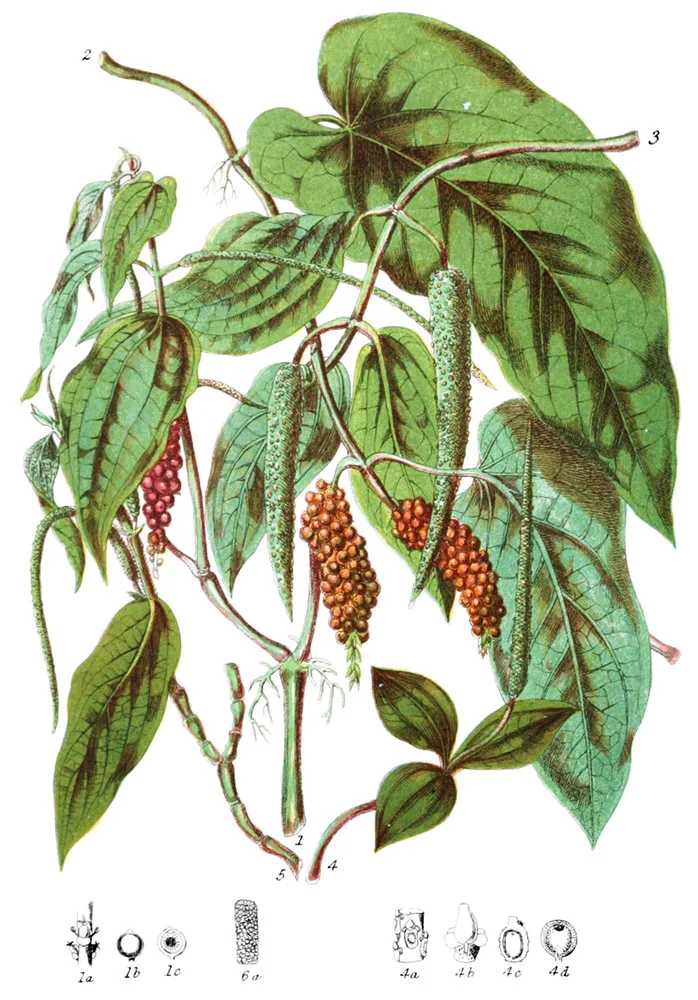
图中植物与部位
-
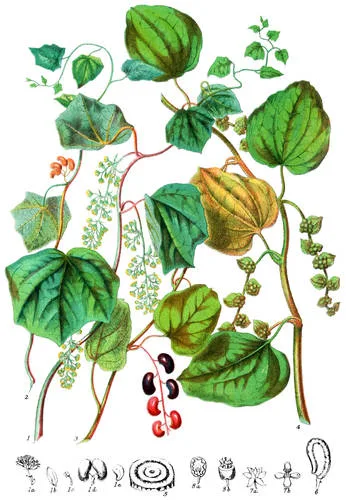
1.
Piper nigrum
, Common Pepper East Indies
- 1a. Flowers
- 1b. Fruit
- 1c. Section of Fruit
- 2. Piper Betle , Betel East Indies
- 3. Piper ribesioides South America
-
4.
Peperomia aricarinata
South America
- 4a. Spike, magnified
- 4b. Flower, magnified
- 4c. Section of Ovary
- 4d. Section of Fruit
- 5. Artanthe elongata , Matico Peru
-
- 6a. Chavica Roxburghii , Long Pepper, Flower spike
关于本图版
此图原刊于《植物自然目》(Natural Orders of plants),绘者为伊丽莎白·特温宁,成书于 1849 年。原书题作“Piperaceæ”。这是该物种在早期博物学出版物中的图像记录之一。
全编共收录 160 幅图版,本图是其中一幅,原书将其列为 Order 126,见第 126 页,版式为纵幅,设色以绿为基调。此图由原件扫描修复而成,使用时请遵循页面标注的授权条款。
原书文字(英文 / 法文)
Key characteristics
Shrubs and herbaceous plants, with jointed stems, sometimes of a climbing habit. The leaves are opposite, or in whorls, or alternate from one of the pair remaining undeveloped; sometimes having one or two stipules at their base. The flowrs are usually without stalks, in spikes at the ends of the branches, or from the base of the leaf-stalk, or opposite to it, usually without sepals or corolla, having a bract only. The stamens are two, or more, placed on one side, or around the ovary. The anthers are one or two-celled, the connecting portion being often fleshy. The ovary is free, simple, one-celled, containing one ovule. The stigma is shored, simple, rather oblique. The fruit is fleshy, one-celled one-seeded, remaining closed. The embryo lies at the top of the seed, outside the albumen.
This Tribe has affinity with Urticaceæ, and some parts of the structure connect it with Araceæ amongst Monocotyledonous plants.
Pungent aromatic propertie exist in the resin and ethereal oil of these plants.
Select plants in this order
Not all plants listed are illustrated and not all plants illustrated are listed.
- Piper is apparently derived from Pipul, the name of the long pepper in Bengal.
- P. nigrum (1) is the species most known and used in this country, and is imported largely from the East, where it is cultivated extensively. The fruit is the valuable part, with the outer skin left, being called black Pepper: when rubbed off it becomes white Pepper. Its pungent quality does not exist in the essential oil, as is usual in other spices, neither does it rise by boiling in water. The plants generally contain a white crystallizable substance, piperine, which, as well as the oil and the resin, are extremely beneficial in intermittent fever, said to equal Quinine. Both as a medicine and condiment Pepper is of much value. In the East Indies and Cochin-China it grows wild, but it is planted in fields in Java and Sumatra, poles being fixed for the young trees to climb over. After the ribe berries are gathered in September, the plants are cut down; in about three years they again bear a crop of fruit.
- P. Betle (2) is an important species in Southern Asia, its leaves serving to wrap round slices of the Areca-palm nut, which forms the constant stimulant of the languid natives of hot regions in Asia, and is still more indispensable throughout the East, than even Tobacco in the western countries of the world.
- P. trioicum is an extremely pungent species: several others ar eknown in conservatories, but are not cultivated for use.
- Long pepper is the spike of pistil flowers of Chavica Roxburghii, in an unripe state, dried; the root and stem are sliced and prepared for medicinal uses.
- C. majuscula of Java has an useful bark.
- Peperomia is a genus lately separated from the true Pepper, but without any material distinction.
- P. pellucida is eaten as a salad when in a young state, in the West Indies.
- P. aricarinata (4) is usually to be seen in collectionsof these plants in the conservatories of our botanic gardens.
- Artanthe elongata (5) is of high repute in Peru, known as Matico, and possessing powerful astringent properties.
- A. crocata yields a yellow dye in Java.
- Among the nacotic plants of this Tribe Macropiper methysticum is much celebrated in Ava, the valuable qualities existing in the large rugged root.
- The fruit of Cubeba officinalis and other species is known as Cubebs in the bazaars of India.
- Acrocarpidium hispidulum is a bitter medicinal plant of the West Indies.
- Coccobryon capense elongs to South Africa, and is of considerable use.
- Various other species are employed in their respective countries for various purposes, but none are to be compared with Pepper for extensive dispersion and value.
Locations
This Tribe is limited to the hottest regions of the world; it abounds in tropical America and the islands of the Indian Archipelago, in low damp valleys, and on the shores of rivers. It is rare in equinoctial Africa, but more frequent at the Cape of Good Hope.
Legend
- Piper nigrum, Common Pepper. East Indies.
- Flowers.
- Fruit.
- Section of Fruit.
- Piper Betle, Betel. East Indies.
- Piper ribesioides. South America.
- Peperomia aricarinata.* South America.
- Spike, magnified.
- Flower, magnified.
- Section of Ovary.
- Section of Fruit.
- Artanthe elongata, Matico. Peru.
-
- Chavica Roxburghii, Long Pepper. Flower Spike.
本图涉及的植物
- Piper nigrum
- Piper Betle
- Piper ribesioides
- Piperomia aracarinata
- Aranthe elongata
- Chavica Roxburghii
属索引
- Acrocarpidium
- Artanthe
- Chavica
- Coccobyron
- Cubeba
- Macropiper
- Peperomia
- Piper