Plantaginaceæ
Plantaginaceæ
The Rib-Wort Tribe
- 合集
- 植物自然目
- 绘者
- Elizabeth Twining(伊丽莎白·特温宁)
- 年代
- 1868
- 图版号
- Order 109
- 原书页码
- p.109
- 授权
- CC BY-SA 4.0
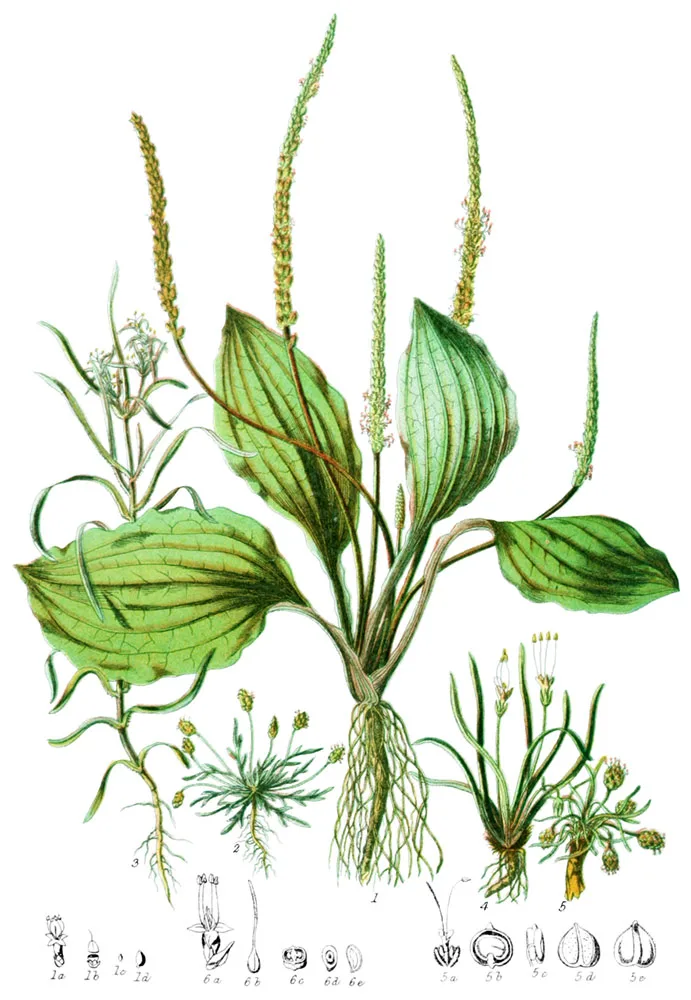
图中植物与部位
-
1.
Plantago major
, Greater Plantain England
- 1a. Flower
- 1b. Seed-vessel
- 1c. Seed
- 1d. Seed magnified
- 2. Plantago coronopus , Star of the Earth England
- 3. Plantago squarrosa , Leafy-spiked Plantain Egypt
- 4. Littorella lacustris , Plantain Shore-weed England
-
5.
Bourgueria nubicola
Bolivia
- 5a. Flower, magnified
- 5b. Section of Seed
- 5c. Stamen
- 5d. Seed-vessel
- 5e. Bract
-
- 6a. Flower of P. lanceolata
- 6b. Ovary and Pistil
- 6c. Section of Ovary
- 6d. Seed
- 6e. Seed-vessel
关于本图版
这幅图版出自《植物自然目》(Natural Orders of plants),由伊丽莎白·特温宁绘制,1849 年出版。原书题作“Plantaginaceæ”。原书为这一物种留下了成幅的彩色图像记录。
全编共收录 160 幅图版,本图是其中一幅,原书将其列为 Order 109,见第 109 页,版式为纵幅。此图由原件扫描修复而成,使用时请遵循页面标注的授权条款。
原书文字(英文 / 法文)
Key characteristics
Herbaceous plants, a few of which are shrubby, usually stemless. The leaves grow in tufts on the ground, and are opposite or alternate in the species having a stem, flat and ribbed, or tapering and fleshy. The flowers grow in spikes, or solitary, as in Littorella; the calyx is four-parted, persistent. The corolla is of one petal, membranous, fixed below the ovary, four-parted at the top, persistent. The stamens are four, inserted into the corolla alternate with its segments. The filaments are thread-like, soft, bent inwards in the bud; the anthers are two-celled. The ovary is composed of a single carpel, without a disk, two-celled, sometimes four-celled by the angles of the central plate; the style is single, slender; the stigma hairy, simple, rarely partly bifid. The capsule is membranous, opening transversely, bearing the seeds on a loose central column. The seeds are many, two, or single, and contain fleshy albumen.
These plants have some affinity with Plumbaginaceæ.
The herbage is slightly astringent, the seeds mucilaginous.
Select plants in this order
Not all plants listed are illustrated and not all plants illustrated are listed.
- Plantago is a genus of plants of peculiar aspect, in some points forming a kind of link with the grasses.
- P. major (1) is one of our most frequent species, growing by the wayside almost everywhere throughout the country; it is equally common in all parts of Europe, and has been observed in Japan. The numerous small seeds are the favourite food of birds, and the leaves have still a reputation among peasants for healing slight wounds. A variety called Rose-plantain is thought sufficiently pretty to be admitted into the flower-garden.
- P. coronopus (2) is often too abundant on lawns, spreading over it to the exclusion of the fine tufted grasses; the name of Star of the Earth expresses its form, as the leafs and stalks lie close pressed on the ground. In former times, when vegetable food was not so choice and varied as at present, the leaves were eaten as salad, but they have an unpleasant flavour. This is one of our native plants which an English traveller will recognise at Funchal in Madeira.
- P. radicata of Portugal is of similar character, but much larger.
- P. lanceolata, the Rib-grass of the pastures, is not esteemed here, but is said to afford good fodder for the cattle on the Swiss Alps.
- P. maritima is of varied growth, according to the locality; it may be found with thick fleshy leaves on rocks bordering the Solway Frith and other salt situations, thus confirming to the general rule that fleshy-leaved plants thrive chiefly near the sea; for when growing in situations removed from the influence of saline air or soil, as by the side of small rivers in the Craven district of Yorkshire, the leaves are flat, and scarcely more fleshy than those of other species.
- P. squarrosa (3) is an example of the few species which have leaves on the stem, not all proceeding from the root; a large supply of potash is yielded from the ashes.
- P. cynops is shrubby, grows in the south of Europe, and is supposed to be referred to by Pliny.
- In Madeira is found P. arborescens.
- P. remotiflora, P. amplexicaulis, and P. penicillata, form part of the vegetation of the mountains of Scinde and Beloochistan at an elevation of 5000 feet.
- The remote Auckland Isles are the abode of a species much resembling the British P. media, which has been named P. Aucklandica.
- The largest known species is P. maxima, the flower-stalks measuring thirty inches in height.
- Littorella (4) is a delicate little plant, growing in watery sandy places; like some Plantains, the flowers have extremely long stamens, curved inwards in the bud, then erect, afterwards becoming flaccid and drooping. The pistil and stamens are in separate flowers. It is the only species known, and is found on the margins of ponds or lakes.
- Bougueria (5) was named by Decaisne after its discoverer, who accompanied Condamine on a journey in Peru. It is a genus intermediate between Plantago and Littorella, having the habit of growth of the former, and a capsule nearly resembling that of the latter. Bouger found it growing in the fissues of the porphyritic rocks of the mountains that rise above the city of Potosi, at an elevation of 14,000 feet. The root is thick and large in proportion to the plant; the linear leaves are somewhat fleshy, adn when young are covered with white hairs. Perfect an imperfect flowers exist on the same spike; the capsule contains one seed, and remains closed.
- Althought Plantago is a lowly genus, it has been observed in almost every country, in Morocco and at the Cape of Good Hope, in India, Japan, Kamtchatka, Patagonia, and the Andes. The mucilaginous seeds are of some utility.
- Those of P. arenaria are said to be employed in the dressing of muslin.
Locations
This Tribe is scattered over the whole world, in various localities; most abundant in cool or Temperate climates.
Legend
- Plantago major, Greater Plantain. England.
- Flower.
- Seed-vessel.
- Seed.
- Seed magnified.
- Plantago coronopus, Star of the Earth. England.
- Plantago squarrosa, Leafy-spiked Plantain. Egypt.
- Littorella lacustris, Plantain Shore-weed. England.
- Bougueria nubicola. Bolivia.
- Flower, magnified.
- Section of Seed.
- Stamen.
- Seed-vessel.
- Bract.
-
- Flower of P. lanceolata.
- Ovary and Pistil.
- Section of Ovary.
- Seed.
- Seed-vessel.
本图涉及的植物
- Plantago major
- Plantago coronopus
- Plantago squarrosa
- Littorella lacustris
- Bougueria nubicola
属索引
- Bougueria
- Littorella
- Plantago