Portulaceæ
Portulaceæ
The Purslane Tribe
- 合集
- 植物自然目
- 绘者
- Elizabeth Twining(伊丽莎白·特温宁)
- 年代
- 1868
- 图版号
- Order 64
- 原书页码
- p.64
- 授权
- CC BY-SA 4.0
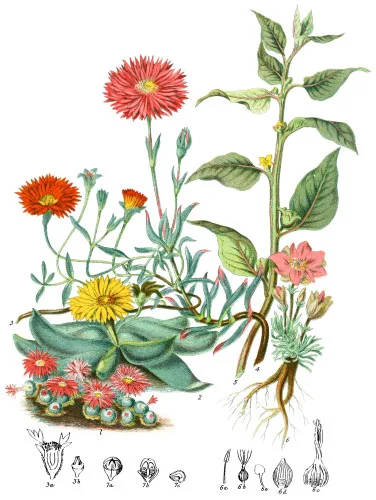
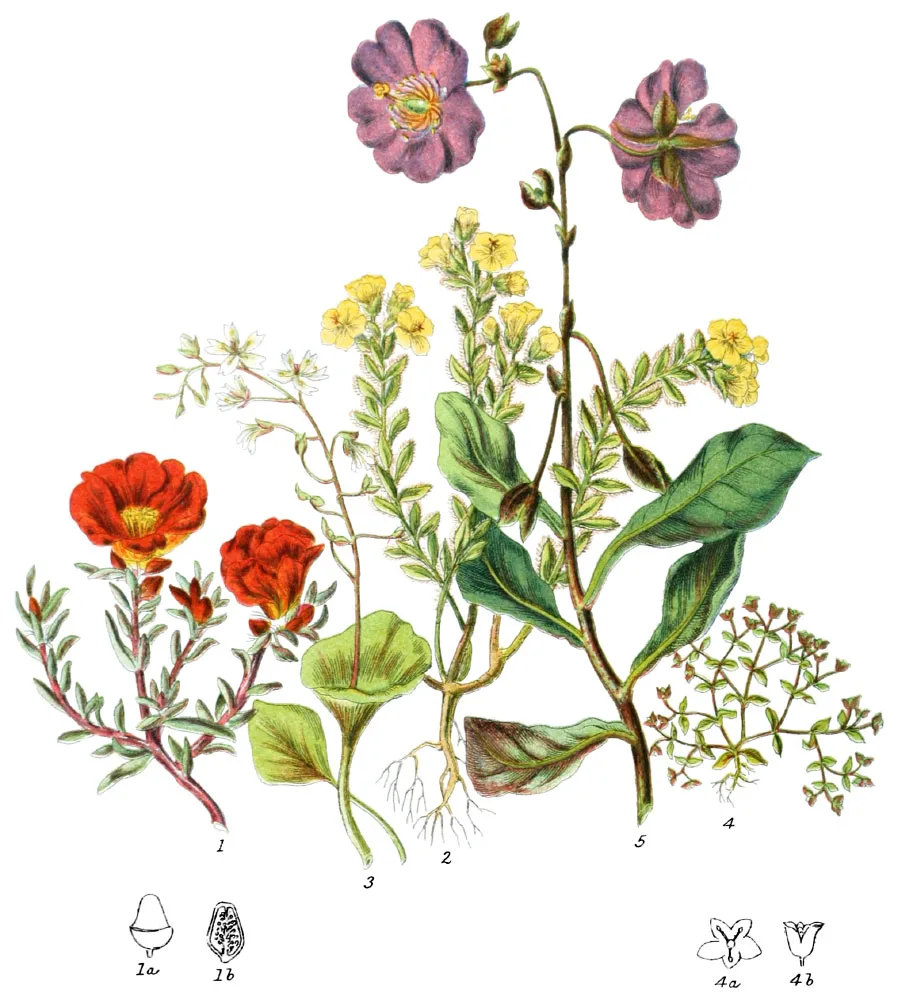
图中植物与部位
-
1.
Portulaca Gilliesii
, Gillies’s Portulaca Mendoza
- 1a. Seed-vessel
- 1b. Section
- 2. Portulaca hirsutissima , Hairy Portulaca Brazil
- 3. Claytonia perfoliata , Small-flowered Claytonia North America
-
4.
Montia fontana
, Blinks England
- 4a. Flower
- 4b. Calyx
- 5. Calandrinia grandiflora , Great-flowered Calandrinia Chile
关于本图版
本图选自伊丽莎白·特温宁的《植物自然目》(Natural Orders of plants),原书 1849 年出版。原书题作“Portulaceæ”。这是该物种在早期博物学出版物中的图像记录之一。
该合集全编共 160 幅图版,此图为其中之一,图版编号 Order 64,对应原书第 64 页,版式为纵幅。图像自原件扫描修复,构图与设色未经改动,授权方式见页面下方。
原书文字(英文 / 法文)
Key characteristics
Shrubs or herbs of a succulent, fleshy nature, the leaves of which are alternate, seldom opposite, entire at the edges, without stipules, often having tufts of hairs at their base. The flowers are either terminal, or grow from the base of the leaves, generally expanding in sunshine, and of short duration. The calyx is composed of two sepals, united at their base; the petals are generally five, either distinct, or cohering in a short tube; the stamens are inserted with the petals irregularly into the base of the calyx, or attached to the base of the ovary; they vary in number, all contain pollen, the filaments are distinct, the anthers have two cells opening lengthwise. The ovary is composed of three carpels, forming one cell, either free or partially adherent; the style is single or absent; the stigmas are several, much divided; the capsule is one-celled, opening either transversely, or by valves, occasionally one-seeded and closed. The seeds are numerous if the fruit opens, attached to a central plate, with farinaceous albumen.
This Order has most affinity with Mesembryaceæ* in appearance and habit.
Insipidity of taste and want of smell are the general characteristics of these harmless plants.
Select plants in this order
Not all plants listed are illustrated and not all plants illustrated are listed.
- Portulaca was known to the ancient Greeks, and valued by them for its cooling and wholesome qualities.
- P. oleracea is a native of the southern countries of Europe, where it is still cultivated, and employed for salads and other culinary purposes; it is but little used now in England, and, accirding to an old author, was never in great estimation, “for being of a very cold nature, it is unfit to be eaten except in the heat of summer.”
- P. sativa is a nearly similar species introduced from South America; both are extremely succulent in the leaves and stalks; the flowers are small and yellow, placed in the midst of a tuft of leaves.
- P. Gilliesii (1) was brought to England from Mendoza in 1827, and is one of the bright-coloured flowers of the tribe.
- P. hirsutissima (2) is an exception to the usual smooth character of these plants, being clothed with long yellowish hairs; it is a native of meadows in the province of Minas Novas, in Brazil.
- P. grandiflora adorns the sandy valleys of the province of San Paulo with its brilliant purple flowers.
- P. paniculata grows on the maritime rocks of St. Dmingo and Martinique, and is thought to possess medicinal properties.
- Claytonia perfoliata (3) is hardy little plant, spreading widely in a garden where it is once cultivated, flourishing in a poor soil, and appearing early in spring. In some places it is boiled and eaten like spinage.
- C. tuberosa affords food in its tuberous roots to the poor peasants of Siberia.
- C. virginica is a pretty little species, occasionally seen in flower-gardens, the petals delicately streaked with red, withering before they fall off.
- Montia was so named after a professor of botany, at Bologna, in the beginning of the last century; the species are all small, inconspicuous plants.
- M. fontana (4) is the only British species, growing usually in a gravelly soil by the side of streamlets; it seldom rises above three inches in height, but is much branched and spreading: of the succulent nature of this tribe it partakes only slightly: the seed-vessel is of one cell, with three valves folded in at the margins, and not opening transversely, as in Portulaca. This little plant forms part of the scanty flora of Iceland.
- M. rivularis is a native of Germany and of Labrador, generally found on the banks of streams.
- Calandrinia was so called after a Genoese botanist; C. grandiflora (5), and other species, belong to South America: all have beautiful flowers, very ornamental, though of short duration, flourishing best in hot dry situations.
- C. arenaria expands its bright rose-coloured blossoms on the sandy plains of Valparaiso.
- Talinum is a genus of the same succulent nature and appearance.
- T. patens is used as an esculent herb by the Brazilians, in the same manner as Purslane.
Locations
South America and South Africa are the chief countries of this tribe; a very few have at present been discovered in New Holland; one species belongs to Guinea; Montia is the only British species.
Legend
- Portulaca Gilliesii, Gillies’s Portulaca. Mendoza.
- Seed-vessel.
- Section.
- Portulaca hirsutissima, Hairy Portulaca. Brazil.
- Claytonia perfoliata, Small-flowered Claytonia. North America.
- Montia fontana. Blinks. England.
- Flower.
- Calyx.
- Calandrinia grandiflora, Great-flowered Calandrinia. Chile.
本图涉及的植物
- Portulaca Gilliesii
- Portulaca hirsutissima
- Claytonia perfoliata
- Montia fontana
- Calandrinia grandiflora
属索引
- Calandrinia
- Claytonia
- Montia
- Portulacca