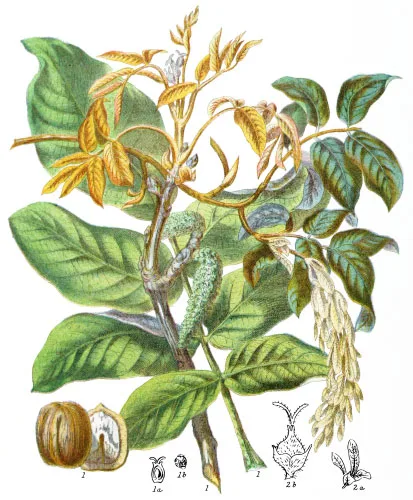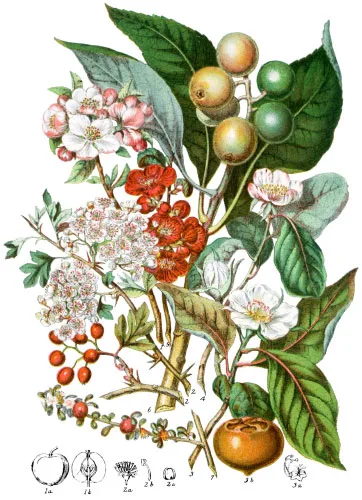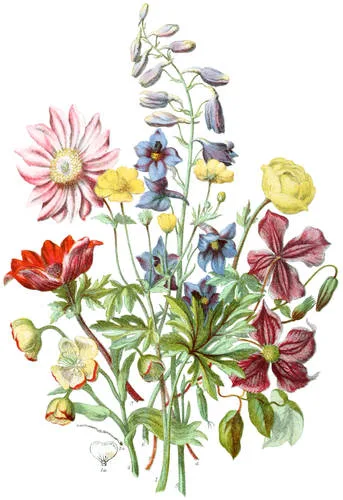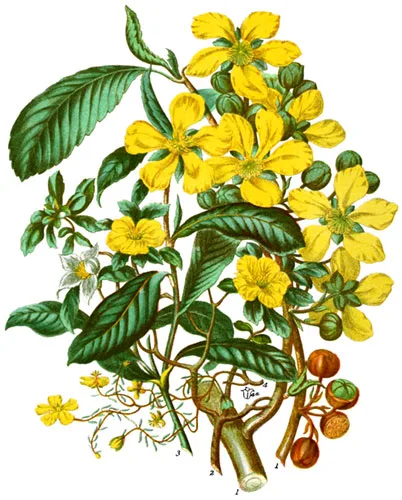
Rosaceæ
Rosaceæ
The Rose Tribe
- 合集
- 植物自然目
- 绘者
- Elizabeth Twining(伊丽莎白·特温宁)
- 年代
- 1868
- 图版号
- Order 51
- 原书页码
- p.51
- 主色
- 橙
- 授权
- CC BY-SA 4.0
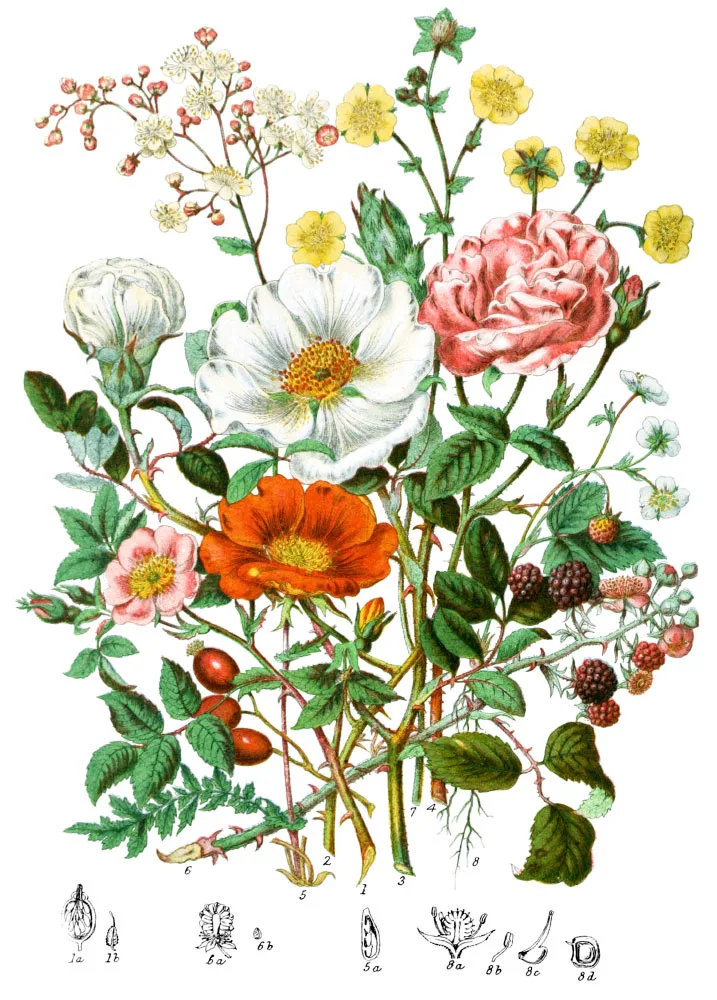
图中植物与部位
-
1.
Rosa canina
, Dog or Hep Rose Britain
- 1a. Section of Fruit
- 1b. Seed
- 2. Rosa punicea , Scarlet Briar Rose Austria
- 3. Rosa bracteata , the Macartney Rose China
- 4. Rosa gallica , Officinal Rose S. Europe
-
5.
Spirea filipendula
, Drop-wort Chalk Downs, England
- 5a. Unnamed*
-
6.
Rubus fruticosus
, Bramble or Blackberry Britain
- 6a. Section of Fruit
- 6b. Seed
- 7. Sieversia elata , Tall Sieversia Himalayas
-
8.
Fragaria vesca
, Wood Strawberry Britain
- 8a. Section of Fruit
- 8b. Stamen
- 8c. Carpel
- 8d. Achenia, with its seed
关于本图版
《植物自然目》(Natural Orders of plants)由伊丽莎白·特温宁绘制,1849 年印行,本图即其中一幅。原书题作“Rosaceæ”。此类图版是当时记录物种形态的主要方式。
该合集全编共 160 幅图版,此图为其中之一,图版编号 Order 51,对应原书第 51 页,版式为纵幅,画面以橙红为主色。图像自原件扫描修复,构图与设色未经改动,授权方式见页面下方。
原书文字(英文 / 法文)
Key characteristics
Shrubs and herbaceous plants. The leaves ar esimple or compound, alternate, often having a pair of stipules at their base, occasionally dotted. The flowers vary in form and size, and are variously arranged, occasionally imperfect. The calyx is three, four, or five-lobed, with a disk either lining the tube or surrounding the orifice; the fifth lobe placed next to the stem. In the true Roses the calyx tube becomes fleshy and covers the fruit; in Potentilla and others it remains herbaceous, and the fruit is a mass of Achenia. The stamens are of definite number, or many, arising from the calyx, curved inwards in the bud; the anthers are two-celled, bursing lengthwise; occasionally one-celled, bursting transversely. The ovaries are above the calyx, solitary or several, one-celled, sometimes cohering. The styles are many or single, stigmas compound or simple. The fruit is various, containing a one-seeded nut, or seeds; the seeds have no albume.
This tribe has close affinity with the Apple and Almond tribes; but the fruit clearly distinguishes each.
Astringent tonic juices and wholesome fruits are the characteristics of these plants.
Select plants in this order
Not all plants listed are illustrated and not all plants illustrated are listed.
- Rosa, the Rose, has the same name in all languages,a nd from time immemorial has been considered pre-eminent for beauty of form and colour, and fragrant scent. Various species abound in Europe and Asia, and countless varieties have ben produced by cultivation: in a wild state the flower has only five petals, but they are readily multiplied. Those which adorn our hedges are either pink or white; in Austria and the north of Italy, as well as near Cortona and elsewhere, a yellow Rose is abundant. Rose-bushes are liable to the attacks of an insect, which punctures the bark and causes the growth of rose-galls and mossy tufts on the stalks.
- R. canina (1) is a beatiful ornamentof hedgerows in June; the astringent fruit is used medicinally; in Germany it is made into a conserve, and eaten with roast meat.
- R. rubiginosa, Sweet-briar or Eglantine, grows on gravel or chalk soil here and on the Continent, and for its delightful fragrance is admitted into every garen.
- R. bracteata (3) is the finest of white Roses, with glossy foliage, and simple flower of extremely delicate perfume; it was brought from China by Lord Macartney, and is become acclimatized in this country.
- The petals of R. gallica (4) are not so highly scented as those of some other species, but they have astringent tonic properties, and are employed as medicine.
- The celebrated Attar of Roses of the East is extracted from the petals of R. moschata and R. damascena.
- No native Rose exists on the plains of India, but on the Himalayas several species are found; one of the most beautiful is R. Lyelli, with double white flowers; some climb to the tops of lofty trees, adorning them with their elegant branches.
- Rubus futicosus (6) is the well-known Bramble, common in many countries in rough places and hedges; the Blackberry is the most abundant at least of our native fruits, although not much esteemed; it is a native also of Cashmere.
- R. idæus, the Raspberry, grows in woods and hedges in the north of England; the fruit is of good flavour, but it has been much improved by cultivation, particularly in Holland.
- The leaves of R. arcticus are used in the most northern countries as tea.
- The fruit of R. chamæmorus and others, is thought to possess medicinal properties; the root of R. villosa is used in North America.
- Fragaria affords one of the most wholesome and agreeable fruits.
- F. vesca (8) and F. elatior are the two British species; from these many varieties have been raised, as well as from F. Virginiana, the Scarlet Strawberry, imported from North America more than two centuries ago.
- F. rubicola affords a grateful fruit to the natives of the Himalayas.
- The dried roots of Spirea filipendula (5) afford a mealy substitute for bread to the poor Laplanders.
- S. Ulmaria is one of the most graceful of British plants, very plentiful in moist meadows, by the side of ditches and streams in Kent and in the Midland counties, or wherever the damp valleys afford a suitable locality, as in Westmoreland. The flowers have an aromatic scent, and it wll deserves the title of “Queen of the Meadow.”
- Dryas is one of this tribe which advances farthest to the north, being found within the Arctic regions; it grows on hills in the Craven district of Yorkshire, and in the Scotch Highlands; the seeds being tipped with the long feathery styles, have a signular appearance in autumn.
- Agrimonia yields a yellow dye, once used for nankeen; A. Nepalensis represents the genus on the Himalayas.
- Poterium and Sanguisorba have heads of small flowers without petals; both are occasionally cultivated for fodder, and known as Burnet.
- The roots of Gillenia trifoliata are employed as Ipecacuanha in the United States.
- Brayera anthelmintica possesses extremely powerful properties.
- In the Feroe Isles, Tormentilla root is used for tanning.
- Sieversia is dispersed on the Swiss Alps, in Kamtschatka and Melville Isle.
- S. elata (7) belongs to the mountains of Asia.
- Quillaia saponaria contains a saponaceous secretion in the bark, which makes it useful as soap in South America.
Locations
This Tribe inhavits chiefly the Temperate or cold climates of the northern hemisphere; a few species are natives of high land within the Tropics; several belong to the Himalayas; a few only to South America. Rubus Jamaicensis is the only example in the West Indies. The apetalous plants represent the Tribe at the Cape of Good Hope.
Legend
- Rosa canina, Dog or Hep Rose. Britain.
- Section of Fruit.
- Seed.
- Rosa punicea, Scarlet Briar Rose. Austria.
- Rosa bracteata, the Macartney Rose. China.
- Rosa gallica, Officinal Rose. S. Europe.
- Spirea filipendula, Drop-wort. Chalk Downs, England.
- Rubus fruticosus, Bramble or Blackberry. Britain.
- Section of Fruit.
- Seed.
- Sieversia elata, Tall Sieversia. Himalayas.
- Fragaria vesca, Wood Strawberry. Britain.
- Section of Fruit.
- Stamen.
- Carpel.
- Achenia, with its Seed.
十二观
- 实测花色 橙黄、红
- 纵幅 1.39∶1
- 含 8 个物种
- 17 处解剖图
- 1868 年刊
- Order 51
这不是词条,是一条看画的次序:先站定看整体,再看名字与形色、构图与刀工,然后问它几时开、从哪里来、经了谁的手;最后是中国诗文——同一朵花,中国古人是怎么看的。十二观读完,这幅图就打开了。
-
第一眼
江馆清秋,晨起看竹,烟光日影露气,皆浮动于疏枝密叶之间。
—— 清·郑板桥《题画竹》
郑板桥说他画竹,是先看见“烟光日影露气”在枝叶间浮动,才动手。看画时找这一层空气,比记住花的名字更要紧。这一幅是竖的:眼睛从下往上走,落点在上半部。先让整株立起来,再看细节。第二步凑近一寸:主线之外另有 17 处解剖小图——那是画家怕你看不清,替你把花剖开了。第三步,找橙色最重的一小块:整幅的明暗秩序,是从那里排开的。
-
名与实
此幅未见可靠的学名,只能以原书题名相称——早期图谱里这种情形并不少见。此幅既无通行中文名,学名也不可靠,只能以原书题名相称——图谱里总有几幅这样的图,只能靠画面本身说话。
-
形与色
就这一幅实测:花色占画面的 16.6%,叶色 13.7%,主相是橙黄、辅以红。这个比例与色相,是这一幅独有的。蔷薇属多为灌木或蔓生藤本,羽状复叶,小叶三至七枚,边缘有细锯齿;花单生或簇生,重瓣者瓣缘起伏如绉纱,开时层层向内收束,露出中心一点黄蕊。此幅属橙一路,橙如琥珀,暖而不燥。上色时先铺一层淡底,再在瓣基与背光处加深——层次是这样一层层叠出来的。主株之外另有 17 处解剖小图,正可与这段形制对读:整株定其貌,细部定其名。
-
构图与呼吸
画幅高而窄,主株一路向上,上下留白多,是图谱中最常见的立轴式构图。(高宽比约 1.39∶1)另附 17 处局部解剖,主体与细部互为注脚。这一幅排得满:枝叶占到画面的 40%,重心近于正中——标本式的画法,图的是看得全。老图谱爱把主株摆在偏中线的位置,左右留得不一样多:这一点偏心,正是画面活起来的原因。
-
一刀一色
十九世纪后半叶,石版与彩色石印渐成主流:颜色可以直接印出,不再依赖手工,线条反倒退居其次。图像的“准确”提高了,手性却淡了。拿放大镜(或手机微距)看三处:花瓣边缘、叶脉、题名。线若连续不断,是刻的;色若越过轮廓半毫米,是手涂的。
-
时序
春末夏初,五月最盛。图版多题“开花时”,正是园中第一茬花;四季开者别有月季,不在这一季里。图上所记的 1868 年是刊行之年,不是花期;真正的花藏在原书的采集记录里,通常比出版早一两年。要判断一幅图的季节,不必看题跋:看叶的老嫩、花与果是否同在枝上,也就八九不离十了。
-
故土
北半球温带广布。中国自汉代已有蔷薇、月季之记载,十九世纪欧洲蔷薇与中国月季杂交,才有了今日花店里那些四季不断的品种。今天再看,图上的产地已是一百多年前的产地;植物会迁徙,地方也会改名字。
-
书与人
《植物自然目》(Natural Orders of plants)由伊丽莎白·特温宁绘,成于1849。此幅为其中Order 51,见原书第 51 页。一本书的“作者”常常是主编;真正决定这幅图好不好看的,是没留下名字的刻工与上色人。
-
诗境
低头久立向蔷薇,爱似零陵香惹衣。
—— 唐·薛涛《春郊游眺寄孙处士二首》
“低头久立向蔷薇”——把这一句放回画面:橙色的花冠就是诗句的落点——诗先写气,画后写形,两者在此处接上了。
-
文心
插花不可太繁,亦不可太瘦。多不过二种三种,高低疏密,如画苑布置方妙。
—— 明·袁宏道《瓶史·宜称》
袁宏道论插花只有一条标准:像画。枝条的高低疏密都要照画理来安排,花才不是一把塞进瓶里的植物。相传汉武帝上林苑已植蔷薇;宋以后花谱以“宝相”“十姊妹”称其重瓣之品,清《广群芳谱》更把蔷薇、玫瑰、月季分列为三。记住这一句,下次在别处见到同类,它会自己浮上来——鉴赏力就是这样一句一句攒出来的。
-
花语
西方以玫瑰为爱与缄默之征——“sub rosa”即“在玫瑰之下”,意为守口如瓶;中国诗文里的蔷薇却多与“柔蔓依人”相连,是缠绵,不是热烈。此幅偏橙,在花语里总要再加重一分情绪。花语是后人添上去的,花本身并不知道;但这层“不知道”,正是它最动人的地方。
-
带走一双眼睛
把这三件事带走:先整体后细节;先线后色;先看画再翻书。任何一张老图版,都可以用这三条读。二百年后,这株植物的后代或许仍在某处活着;而纸上这一株,永远停在 1868 年的那个季节。
本图涉及的植物
- Rosa canina
- Rosa punicea
- Rosa bracteata
- Rosa gallica
- Spirea filipendula
- Rubus futicosus
- Sieversia elata
- Fragaria vesca
属索引
- Agrimonia
- Brayera
- Dryas
- Fragaria
- Gillenia
- Poterium
- Quillaia
- Rosa
- Rubus
- Sanguisorba
- Sieversia
- Spirea
- Tormentilla