Rutaceæ
Rutaceæ
The Rue Tribe
- 合集
- 植物自然目
- 绘者
- Elizabeth Twining(伊丽莎白·特温宁)
- 年代
- 1868
- 图版号
- Order 44
- 原书页码
- p.44
- 主色
- 绿
- 授权
- CC BY-SA 4.0
图中植物与部位
-
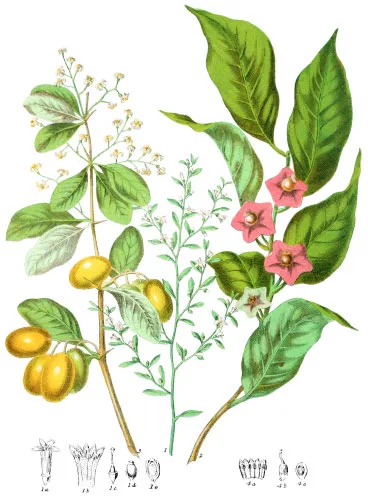
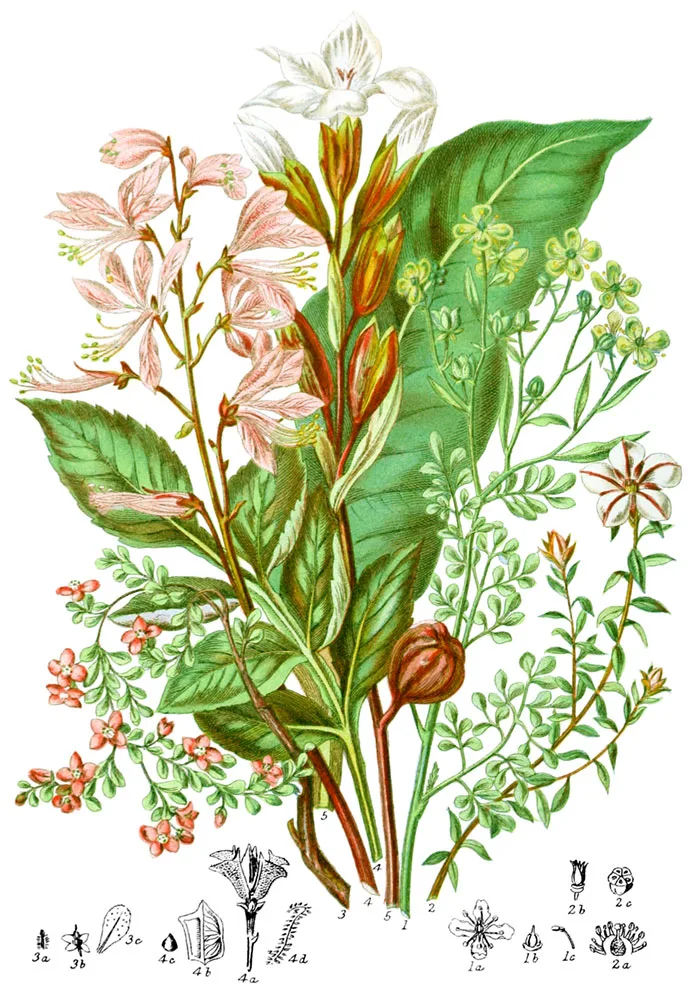
1.
Ruta graveolens
, Common Rue South Europe
- 1a. Flower
- 1b. Ovary and Pistil
- 1c. Stamen
-
2.
Adenendra uniflora
, One-flowered Adenandra Cape of Good Hope
- 2a. Pistil, Stamens, and Nectaries
- 2b. Seed-vessel
- 2c. Section
-
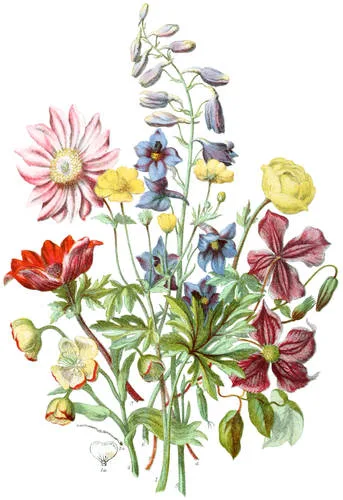
3.
Boronia crenulata
, Notched-leaved Boronia Australia
- 3a. Stamen
- 3b. Pistil and Nectaries
- 3c. Leaf, magnified
-
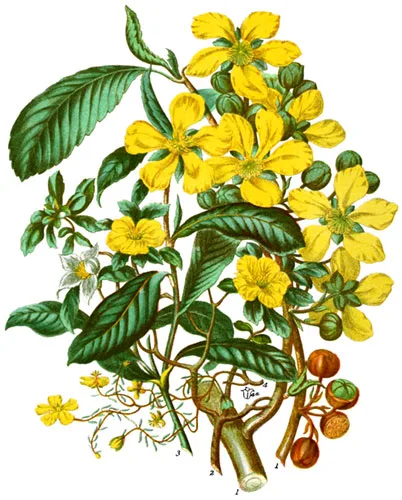
4.
Dictamnus Fraxinella
, Red Fraxinella Germany
- 4a. Seed-vessels
- 4b. Carpel, open
- 4c. Seed
- 4d. Glandular hairs, magnified
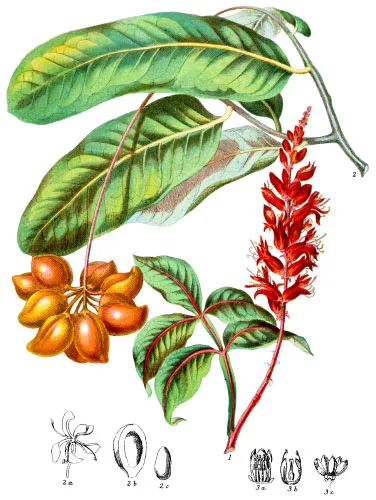
- 5. Erythrochiton Brasiliensis , Brazilian Erythrochiton Brazil
关于本图版
本图选自伊丽莎白·特温宁的《植物自然目》(Natural Orders of plants),原书 1849 年出版。原书题作“Rutaceæ”。原书为这一物种留下了成幅的彩色图像记录。
该合集全编共 160 幅图版,此图为其中之一,图版编号 Order 44,对应原书第 44 页,版式为纵幅,整幅以绿为主调。图像自原件扫描修复,构图与设色未经改动,授权方式见页面下方。
原书文字(英文 / 法文)
Key characteristics
Trees and shrubs, and some herbaceous plants: the leaves are opposite or alternate, simple or pinnate, covered with minute pellucid dots, without stipules. The flowers are on terminal stalks, or grow from the base of the leaf-stalks, are perfect, regular or irregular; the calyx has either four or five division; the petals are either as many as the divisions of the calyx and distinct, or combined into a monopetalous corolla, or occasionally absent. The stamens are equal in number to the petals, or twice or thrice as many, usually growing from the base of the ovary, placed outside the disk which surrounds it; either free or united with the base of the petals. The fruit consists of several carpels cohering firmly, or more or less distinct; the seeds two or solitary; those of Ruta and its immediate allies contain albumen; those of Diosma and its allies have none.
The abundant oily receptacles of these plants connect them with the Orange tribe, but the dry separable fruit forms an obvious distinction.
An essential oil of powerful odour, and extreme bitterness, are the prevailing properties of the Rue tribe.
Select plants in this order
Not all plants listed are illustrated and not all plants illustrated are listed.
- The derivation of Ruta is unknown, but the name is nearly the same in all languages.
- Ruta graveolens (1) is a herb of ancient fame and repute for its medicinal qualities; in the time of Hippocrates it was highly esteemed; for many ages it was supposed to prevent contagion, and was called the herb of grace; in the days of Shakspeare it was considered emblematical of repentance, probably owing to its bitterness. The leaves have an exceedingly unpleasant odour, and an acrid taste; the petals vary from four to five. For medicinal use it is now, like many other European plants, superseded by foreign species: none possess any beauty of flower, except R. albiflora of the mountains of Nepal, employed by the natives medicinally.
- R. montana, a Spanish plant, is so excessively acrid that is blisters the hands of those who gather it through the thickest gloves.
- Adenandra uniflora (2) was amongst the first plants brought from the Cape; the anthers are glandular, and between each is a stalked nectary; in many respects it closely resembles Diosma, a genus of plants called by the natives Bucku, partaking of the strong disagreeable scent peculiar to many of those tribe, but said to be thought agreeable by the Hottentots.
- Boronia crenulata (3) is one of the numerous species which abound in New Holland, of pleasing aspect, but little value for useful purposes.
- Dictamnus Fraxinella (4), a native of Germany, was early introduced to English gardens, and admired for its grateful aromatic odour, derived from the numerous glands containing volatile oil, especially on the flower-stalks; the root was formerly thought valuable as a medicine: this species is also a native of the Altai mountains.
- D. Himalayanus belongs to the Himalayas.
- Erythrochiton Brasiliensis was found by Martius in Brazil, consequently requires the protection of a hothouse in this climate.
- Several plants of this tribe are valuable for their febrifugal bark; Ticorea febrifuga is one of the most powerful remedies in the intermittent fevers of Brazil.
- The bark of Esenbeckia febrifuga is said to rival that of Cinchona, and is supposed to afford the medicines so much esteemed by the Brazilian miners.
- Hortia has nearly similar properties.
- A species of Galipea yields the famous bark known to the Spanish missionaries in Guiana for its beneficial effect in the most malignant fevers.
- The leaves of some plants in this tribe are made by infusion to supply both medicine and beverage; those of Ticorea jasminiflora are used for the former, those of Correa alba for a kind of tea by the colonists in New Holland.
- The leaves of Haplophyllum tuberculatum are employed by the women in Egypt to form a wash for their hair.
Locations
It may be remarked of this tribe, as of several others so widely dispersed, that the species on the limits of its geographical distribution in cool climates, possess only slightly developed properties, and are of comparatively little value to man; whilst those plants which are natives of the hot regions have powerful properties, rendering them extremely valuable to the inhabitants of the countries where they grow.
This Tribe is dispersed in every quarter of the globe; some species extend over the southern portion of the Temperate zone, Ruta and Dictamnus advance into the south of Europe. Diosma and its immediate allies abound at the Cape of Good Hope; Boronia, Correa, and others, are natives of Australia; Cusparia and several more inhabit the equinoctial regions of America.
Legend
- Ruta graveolens, Common Rue. South Europe.
- Flower.
- Ovary and Pistil.
- Stamen.
- Adenandra uniflora, One-flowered Adenandra. Cape of Good Hope.
- Pistil, Stamens, and Nectaries.
- Seed-vessel.
- Section.
- Boronia crenulata, Notched-leaved Boronia. Australia.
- Stamen.
- Pistil and Nectaries.
- Leaf, magnified.
- Dictamnus Fraxinella, Red Fraxinella. Germany.
- Seed-vessels.
- Carpel, open.
- Seed.
- Glandular hairs, magnified.
- Erythrochiton Brasiliensis, Brazilian Erythrochiton. Brazil.
本图涉及的植物
- Ruta graveolens
- Adenandra uniflora
- Boronia crenulata
- Dictamnus Fraxinella
- Erthrochiton Brasiliensis
属索引
- Adenandra
- Borronia
- Correa
- Cusparia
- Dictamnus
- Erythrochiton
- Esenbeckia
- Galipea
- Haplophyllum
- Hortia
- Ruta
- Ticorea