Santalaceæ
Santalaceæ
The Sandal-Wood Tribe
- 合集
- 植物自然目
- 绘者
- Elizabeth Twining(伊丽莎白·特温宁)
- 年代
- 1868
- 图版号
- Order 120
- 原书页码
- p.120
- 授权
- CC BY-SA 4.0
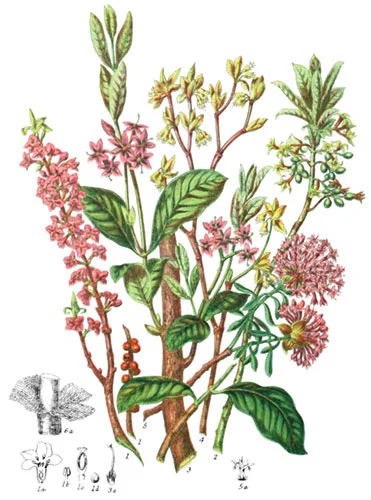
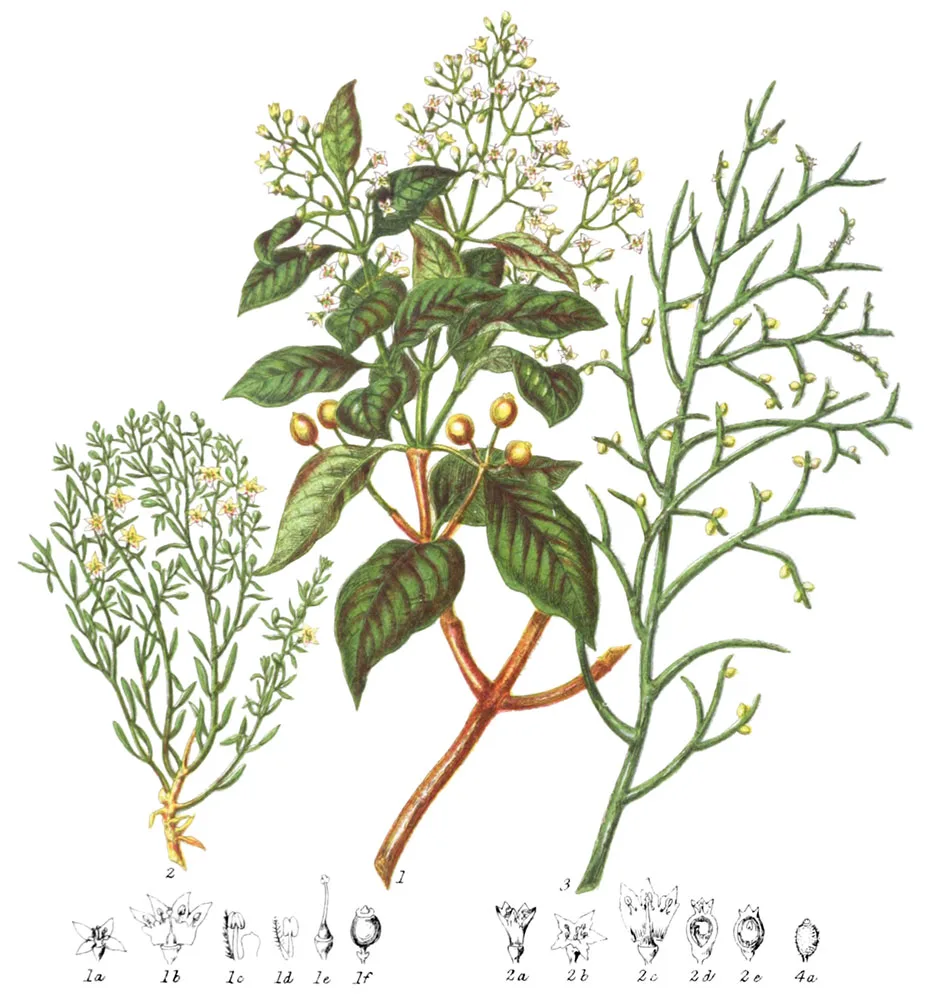
图中植物与部位
-
1.
Satalum album
, Sandal-wood Malabar
- 1a. Flower
- 1b. Opened
- 1c. Stamen Scale and Plume
- 1d. Stamen and Plume
- 1e. Ovary and Pistil
- 1f. Fruit
-
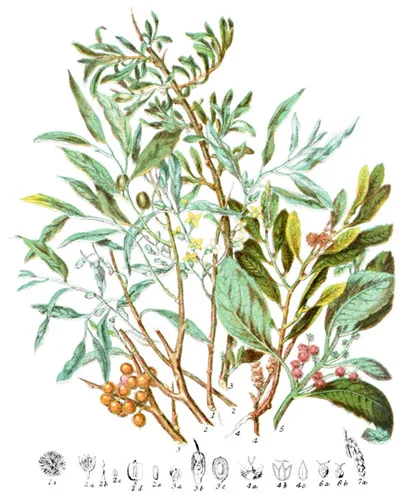
2.
Thesium linophyllum
, Flax-leaved Thesium Chalk soil, England
- 2a. Bud
- 2b. Flower
- 2c. Flower opened
- 2d. Section of Ovary
- 2e. Section of Fruit
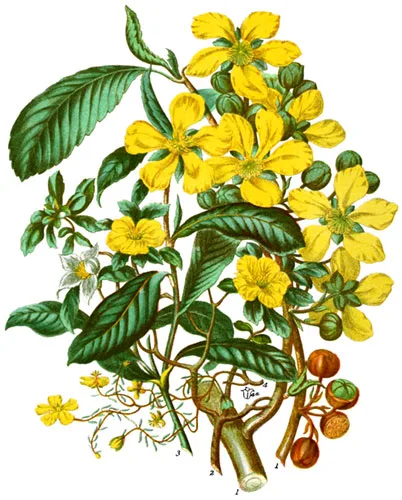
- 3. Leptomeria Billardieri Tasmania
-
- 4a. Fruit of Leptomeria acida
关于本图版
这幅图版出自《植物自然目》(Natural Orders of plants),由伊丽莎白·特温宁绘制,1849 年出版。原书题作“Santalaceæ”。此类图版是当时记录物种形态的主要方式。
全编共收录 160 幅图版,本图是其中一幅,原书将其列为 Order 120,见第 120 页,版式为纵幅。此图由原件扫描修复而成,使用时请遵循页面标注的授权条款。
原书文字(英文 / 法文)
Key characteristics
Trees, shrubs, and herbaceous plants; the leaves are alternate or opposite, undivided, sometimes minute and resembling stipules. The flowers are in spikes, seldom in umbels, solitary, small. The calyx is above the ovary, four of five cleft, half-coloured. The stamens are four or five, opposite the segments of the calyx, and inserted into their bases; a kind of plume is attached to the filament. The ovary is one-celled, with from one to four ovules fixed to a central plate, usually near the top; the style is single, the stigma often lobed. The fruit is one-seeded, hard and dry, or drupaceous; the seed contains fleshy albumen.
This Tribe has some affinity with Thymelaceæ and Elæagnaceæ, but is distinguished by the inferior ovary and the copious albumen of the seed.
Acid and astringent properties prevail in some of these plants.
Select plants in this order
Not all plants listed are illustrated and not all plants illustrated are listed.
- Santalum, which gives its name to this small Tribe, is derived from the Persian.
- S. album (1) is the famous sandal-wood of Malabar; it is an evergreen shrub, seldom more than ten feet in height, but the wood is extremely fragrant, and is much esteemed in India, where it is said to be impervious to insects. The small musical instruments, boxes, and other articles made of sandal-wood, are now generally known in this country, being favourite examples of the ingenuity of the native workmen of India. The Brahmis consider it one of their sacred trees, and employ the dust of the wood in compounding the pigment with which they paint the mysterious mark on the forehead of their god Vishnoo. The oil used in religious ceremonies and at funerals is extracted from the wood or its shavings. When the trees become old, the central part of the wood acquires a yellowish tinge, and then also it attains the highest degree of fragrance. Not only in Malabar, but in all the islands of the Indian Ocean, the sandal-wood is frequent, and it is exported from the coast to Bengal and China, though seldom brought to Europe. The native doctors value its soothing, cooling qualities.
- S. myrtifolium, a less useful species, grows chiefly on the Circar mountains.
- The species most common on the Sandwich Islands are S. Freycinetianum and S. paniculatum.
- Thesium is a genus of no beauty of colour or development, yet it is remarkably neat in form and structure of flower; all the species are stringent in the juice.
- The calyx of T. linophyllum (2) is white within, and spreading until the seed ripens, when it closes over it. At the base of the stamens is a small tuft of hairs, not so large and perfect as the plume of Santalum, but one of the characteristics of this Order. It grows chiefly on open chalky places, on the hills on the borders of Cambridgeshire and Hertfordshire, also in Dorsetshire.
- T. alpinum and T. ebracteatum are natives of Germany; T. umbellatum belongs to North America; and T. amplexicaule, to the Cape of Good Hope.
- T. Himalense, nearly resembling our British species, was discovered by Dr. Royle on the arid rocky soil near Choupal, to the north of Choor.
- Leptomeria Billardieri (3) is very common in Tasmania, and has a singular aspect from its almost leafless branches, the minute scale-leaves being so pressed to the branches as to be scarcely discernible. The fruit is acid and astringent, and although very small, frequently serves to allay the thirst of travellers in the wilds of Australia, where water is scarce.
- The Quandang nut, Fusanus acuminatus, of New Holland, has a pleasant flavour and is much eaten by natives and colonists.
- Myoschylus oblongus yields medicine in Chile.
- An infusion of the leaves of Osyris nepalensis is used by the natives of the hills in India as a sort of tea.
- O. alba is frequent in the south of Europe, and the slender flexible branches are very serviceable as packing materials.
- Pyrularia pubera of Carolina contains oil in the kernels of the fruit.
Locations
This tribe exists, in Europe and North America, as small herbs; in the East Indies, Australia, and the South Sea Islands, as shrubs and small trees.
Legend
- Stanalum album, Sandal-wood. Malabar.
- Flower.
- Opened.
- Stamen Scale and Plume.
- Stamen and Plume.
- Ovary and Pistil.
- Fruit.
- Thesium linophyllum, Flax-leaved Thesium. Chalk soil, England.
- Bud.
- Flower.
- Flower opened.
- Section of Ovary.
- Section of Fruit.
- Leptomeria Billardieri. Tasmania.
-
- Fruit of Leptomeria acida.
本图涉及的植物
- Santalum album
- Thesium linophyllum
- Leptomeria Billardieri
- Leptomeria acida
属索引
- Fusanus
- Leptomeria
- Myoschilus
- Osyris
- Pyrularia
- Santalum
- Thesium