Smilaceæ
Smilaceæ
The Sarsaparilla Tribe
- 合集
- 植物自然目
- 绘者
- Elizabeth Twining(伊丽莎白·特温宁)
- 年代
- 1868
- 图版号
- Order 140
- 原书页码
- p.140
- 授权
- CC BY-SA 4.0
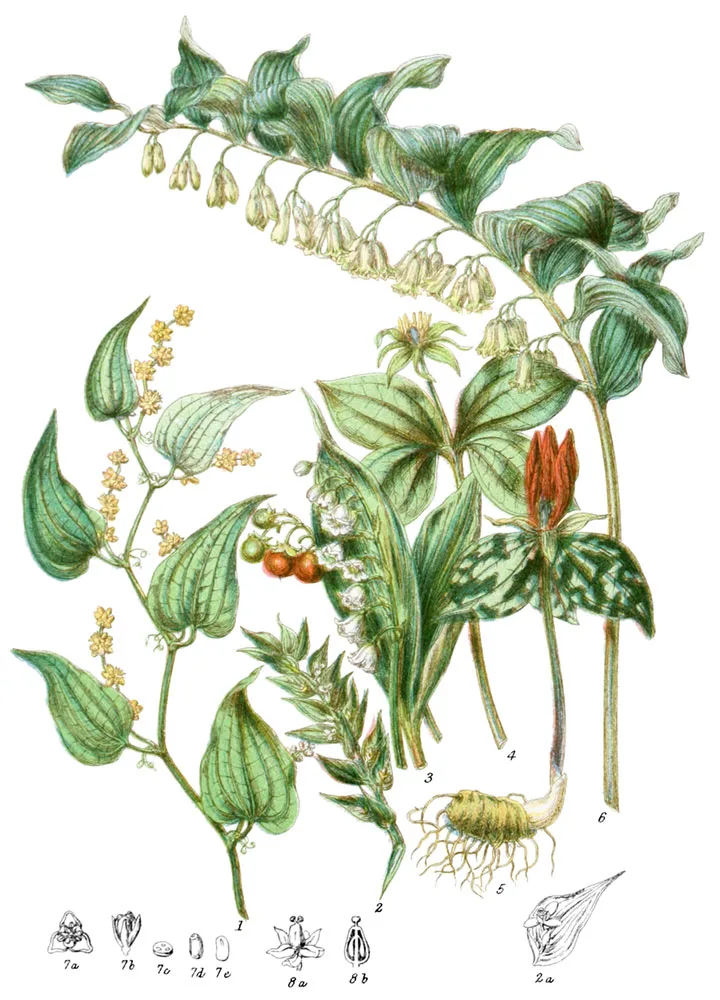
图中植物与部位
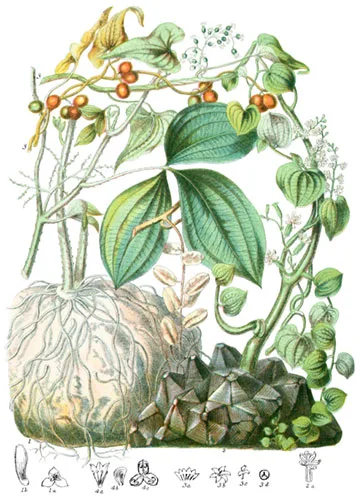
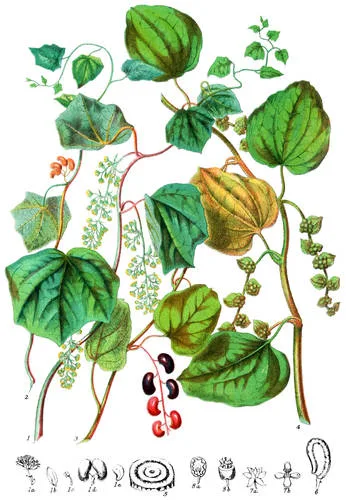
- 1. Smilax maculata , Spotted Sarsaparilla Himalaya
-
2.
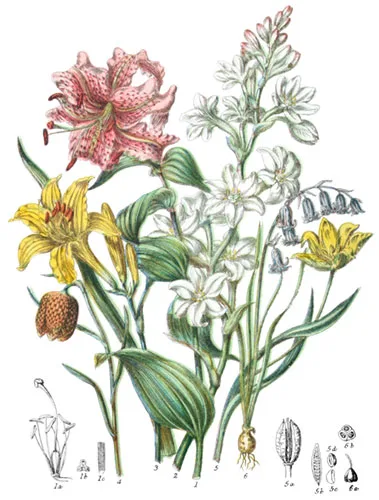
Ruscus aculeatus
, Butcher’s Broom England
- 2a. Leaf and Flower magnified
- 3. Convallaria majalis , Lily of the Valley Woods, England
- 4. Paris quadrifolia , Herb Paris Woods, England
- 5. Trillium sessile , Stalkless-leaved Trillium North America
- 6. Polygonatum multiflorum , Solomon’s Seal England
-
- 7a. S. glycyphylla , Stamen Flower
- 7b. Pistil Flower
- 7c. Section of Ovary
- 7d. Seed
- 7e. Section
-
- 8a. S. brasiliensis , Flower
- 8b. Section of Ovary
关于本图版
本图选自伊丽莎白·特温宁的《植物自然目》(Natural Orders of plants),原书 1849 年出版。原书题作“Smilaceæ”。原书为这一物种留下了成幅的彩色图像记录。
该合集全编共 160 幅图版,此图为其中之一,图版编号 Order 140,对应原书第 140 页,版式为纵幅。图像自原件扫描修复,构图与设色未经改动,授权方式见页面下方。
原书文字(英文 / 法文)
Key characteristics
Herbaceous plants, and undershrubs partly climbing, sometimes having fleshy tubers. The leaves have netted veins. The stamens and pistils are sometimes in separate flowers. The calyx and petals are similar, free, six-parted; the stamens are six, inserted near the base of the corolla, seldom placed below the ovary. The ovary is three-celled, the cells one or many-seeded, the style usually trifid, bearing three stigmas. The fruit is a roundish berry, containing seeds, with fleshy cartilaginous albumen.
This Tribe has affinity with Liliaceæ, but is distinguished by the netted veins of the leaves, and th fruit being a rounded berry.
Astringent properties exist in the roots of some of these plants.
Select plants in this order
Not all plants listed are illustrated and not all plants illustrated are listed.
- Smilax has often a tough prickly stem, whence the Greek name was derived.
- S. Sarsaparilla of North America has long, slender, white roots, covered with a wrinkled brown bark. They are of a mucilaginous nature, and slighlty bitter taste, and are considered valuable as a medicine in America and in England.
- S. maculata (1) is one of the various species which belong to the Himalayas, and is found in Nepal, Kemaon, and on Mussoree.
- On the Silhet mountains grow S. oxyphylla, S. lanceæfolia, and S. Roxburghiana, all employed by the natives medicinally.
- S. prolifera is a native of Bengal, and S. ovalifolia extends across the Peninsula, towards Bomba.
- Although the different species of Smilax exist in the greatest abundance in the tropical parts of Asia, Africa, and America, yet some are dispersed in cooler regions; S. aspera grows in Syria, S. mauritanica in the north of Africa, S. catalonica and S. nigra in Spain.
- All have more or less tuberous roots, possessing useful medicinal properties; those of S. China are probably the largest, twisted and full of knots; they afford food and medicine to the Chinese.
- S. glycyphylla* is imported largely from Australia, where it is called sweet Tea, and is though to be extremely wholesome. None of the species have much beauty of flower, but S. aspera and S. excelsa present a striking appearance when they droop from the summits of tall trees, with their slender branches covered in red berries in autumn.
- The English name was given to Ruscus aculeatus (2) because butchers used the branches for cleansing their blocks; the Italians still make brooms of it. The root is perennial, but the shrub withers the second year after flowering; it is of a very rigid nature, the leaves tipped with a sharp spine. The small flower appears to grow on the leaf, but is really on a short stalk which lies beneath the outer coat of the leaf; the fruit is a red berry of sweetish flavour, and contains one or two seeds.
- Convallaria majalis (3), the Lily of the Valley, may be considered one of the most choice plants of our British Flora, graceul and simple in form and colour, and very agreeably fragrant; it is now found only in a few localities in this country, for many of the once suitable woods are cleared, and become open fields. In the wooded parts of the Craven district of Yorkshire, the Lily of the Valley still flourishes luxuriantly, and is particularly abundant in the woods of the Vale of Arncliffe. This is one of the plants which is not to be improved by the skill of the cultivator but is perfect in its natural condition. A durable green colour may be prepared from the leaves with lime.
- Paris quadrifolia (4), a remarkable plant, neasily distinguished from all others, is rare in this country, scarcely found except in woods in Yorkshire, and a few other northern localities. The roots are said to have emetic properties, and narcotic juices prevail in the plant, although in slight degree.
- P. polyphylla is a native of Nepal.
- Convallaria and Paris occur together in the same localities in India, as in England.
- Trillium sessile (5), named from the triple division of its parts, was brought to England nearly a century ago, but is rarely to be seen in our gardens, being of slow growth and difficult to cultivate; yet its singularity renders it worthy of attention. The juice, when combined with alum, yields a blue dye.
- Polygonatum received its english name from an imagined resemblance in the twisted roots to the celebrated Seal of Solomon.
- P. multiflorum (6) is an exeedingly elegant species, adorning shady plantations and copses in May and June; this and another English species, P. verticillatum, are found also on the Himalaya. Several others are natives of Germany and North America.
- P. oppositifolium belongs to Nepal.
- Streptopus, with its twisted flower-stalks, has one species in Hungary, the others in North America.
- Smilacina bivolia is found in Northern Europe, the rest in North America.
- There is also found Medeola virginica, which, like others of this tribe, has an emetic root.
- Ophiogon is the Snake’s-head of Japan and China.
- Asparagus, and Dracæna the Dragon-tree, both belong to this order.
Locations
This Tribe is dispersed in small numbers in most parts of the world: in the woods of the Temperate regions of Europe, Asia, and North America. Smilax is found chiefly in the Tropics of Asia and America.
Legend
- Smilax maculata, Spotted Sarsaparilla. Himalaya.
- Ruscus aculeatus, Butcher’s Broom. England.
- Leaf and Flower magnified.
- Convallaria majalis, Lily of the Valley. Woods, England.
- Paris quadrifolia, Herb Paris. Woods, England.
- Trillium sessile, Stalkless-leaved Trillium. North America.
- Polygonatum multiflorum, Solomon’s Seal. England.
-
- S. glycyphylla. Stamen Flower.
- Pistil Flower.
- Section of Ovary.
- Seed.
- Section.
-
- S. brasiliensis. Flower.
- Section of Ovary.
本图涉及的植物
- Smilax maculata
- Ruscus aculeatus
- Convallaria majalis
- Paris quadrifolia
- Trillium sessile
- Polygonatum multilorum
属索引
- Asparagus
- Convallaria
- Dracæna
- Medeola
- Ophiogon
- Paris
- Polygonatum
- Ruscus
- Smilacina
- Smilax
- Streptopus
- Trillium