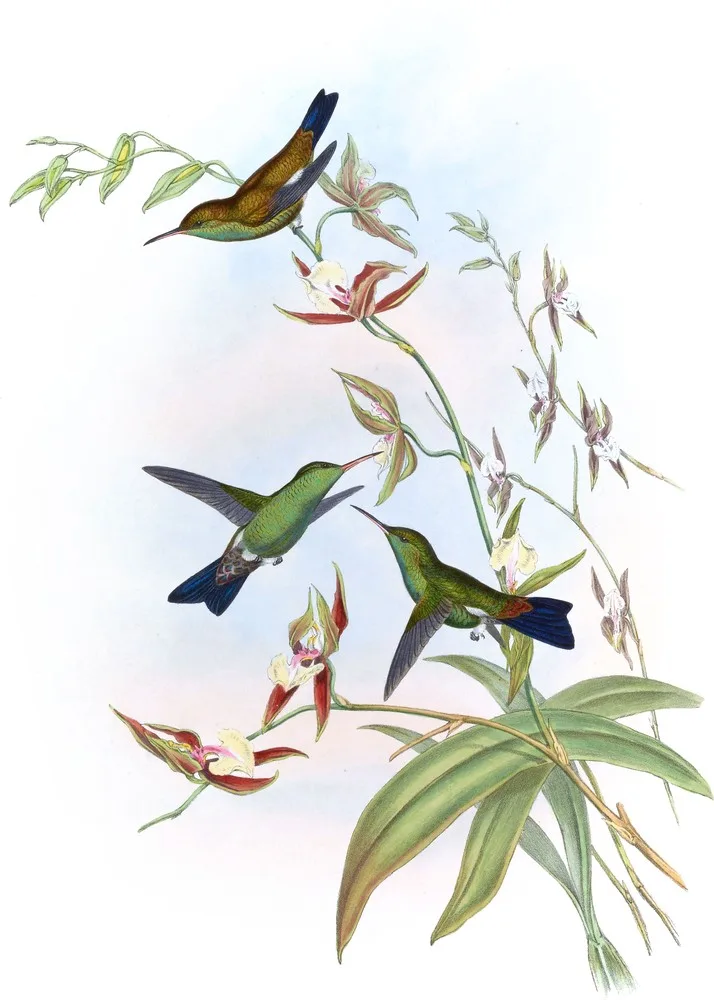
Erythronota Feliciæ
Erythronota Feliciæ
Felicia’s Erythronote
Ten ways of seeing
- upright 1.40 : 1
First Look
江馆清秋,晨起看竹,烟光日影露气,皆浮动于疏枝密叶之间。
—— 清·郑板桥《题画竹》
On an autumn morning at the river lodge I looked at the bamboo: mist, sunlight, dew, all drifting among the sparse and dense leaves.
The sheet is vertical: the eye climbs and settles on the bird. Take the posture before the plumage. Then step in close: watch where colour meets line, and whether the line ever breaks. Third, find the darkest small patch: the whole tonal order is measured from there.
Name and Thing
No reliable binomial survives, so the printed title must serve. Neither name nor binomial survives: the printed title must do.
Form and Colour
The smallest of birds: a needle-fine bill, a forked tubular tongue, wings beating so fast the bird hovers and even flies backwards. Its colour is not pigment but structure — light bent by feather barbules, changing with the angle.No colour group is recorded. Read the outline, then the colour layers, then the brush.
Composition
Tall and narrow, the bird perched mid-branch with generous margins above and below. No details are appended: a plate for looking, not for keying out. Cover the margins with your thumb and the plate suffocates; uncover them and the flower breathes again.
Line and Colour
In the later nineteenth century chromolithography took over: colour printed rather than painted, line demoted. Decide first whether it was printed or painted; only then discuss whether it is beautiful. If you mean to copy it: block in the broad shapes and colours first, detail last; lithographic softness comes from thin washes — two or three pale layers will get you close.
Poetic Resonance
穿花蛱蝶深深见,点水蜻蜓款款飞。
—— 唐·杜甫《曲江二首》
Butterflies thread the flowers, seen deep within; dragonflies touch the water and fly on, slow and deliberate.
The poem gives the mood first and the picture supplies the form; set the line beside the plate and the bird itself becomes its resting point.
Symbolism
For the Aztecs the hummingbird was warrior and sun; for Victorian Europe it was the ultimate ornament, millions killed for breast jewellery. China has no tradition here — and that blank is itself a history of exchange. In a flora it is a species first and a symbol second; the order is worth keeping.
Season and Place
temperate hummingbirds follow the bloom north and back, thousands of kilometres a year. the name arrives with late-Qing travel writing. The year 1861 on the plate is that of publication, not of flowering — the gathering came a year or two earlier. Read the locality and the flowering season both with a discount: one is hearsay, the other a ten-day peak.
The Book and the Hand
“Gould's Hummingbirds” carries only John Gould's name. A plate is collective work: drawer, engraver and colourist were different hands, and the unnamed ones decided how good it looks.
What to Take Away
Next time you watch a bird: posture first, then where the plumage is deepest, and only then the field guide. The flower of that year is dust, yet its image on paper has outlived every living cousin.
About this plate
Venezuela
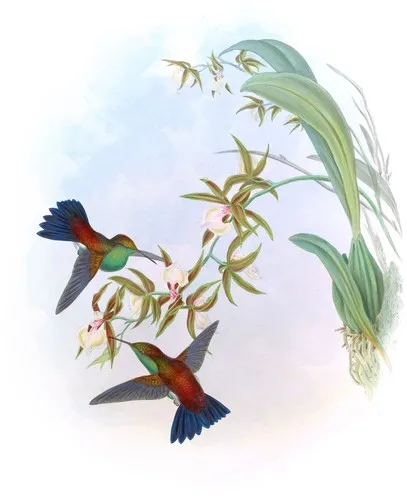
The Erythronota Feliciæ is a species closely allied to the E. antiqua—so close, in fact, that it is extremely difficult to distinguish it from that bird in some states of its plumage.
The tail-feathers of the E. Feliciæ, however, are more blue, and its upper surface is wholly green, except on the lower part of the back and on the upper tail-coverts, which in some specimens are brown, and in others violaceous. Its under tail-coverts appear to be subject to as much variation as those of its near ally; for in some they are russet brown, in others violet, in others, again, violet green, and I have seen a few in which the two colours are intermingled. Venezuela appears to be the native country of this bird. One of my specimens, collected on the Orinoco, seems to be somewhat immature; for all the tail-feathers are beautifully tipped with bright fiery purple, and the lower part of the back and upper tail-coverts are buff; still I have no doubt of its being the same bird. When the E. Feliciæ has perfected its moult, its body is clothed in a deep and pure green, which on exposure to light and air changes to a brown or golden hue. I have not been able to detect any difference in the colouring of the sexes, and I believe their discrimination will be impossible unless dissection of freshly killed examples be resorted to.
Crown-of the head, all the upper surface, and wing-coverts green, a bronzy hue prevailing on the lower part of the back; upper tail-coverts fiery purple in some specimens; all the under surface shining grassgreen; wings steel-blue; tail deep bluish black; under tail-coverts violet and green intermingled; upper mandible black; under mandible fleshy-red, with a black tip; feet black.
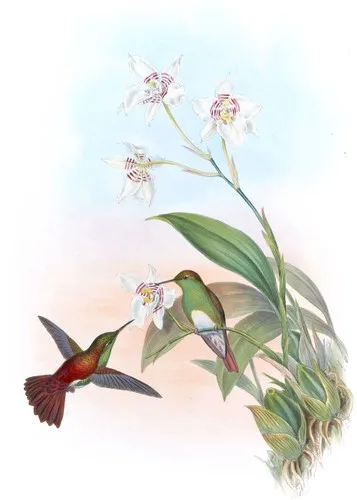
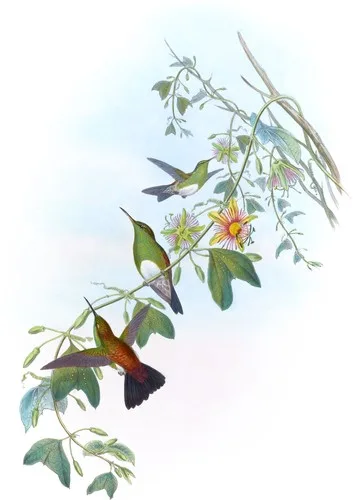
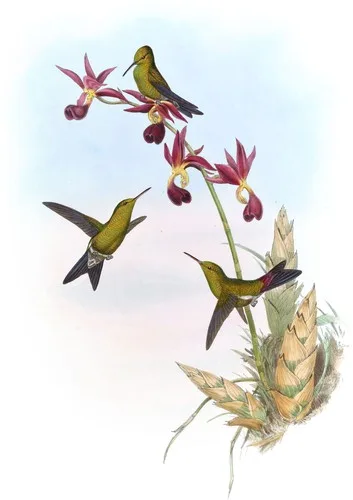
The three figures in the accompanying plate are of the size of life. The plant is the Odontoglossum hastilabium, var. fuscatum.
References
- Ornismya Feliciæ, Less. in Rev. Zool. 1840, p. 72.
- Ornismya Feliciae, Reichenb. Aufz. der Col., p. 7.
- Saucerottia felicia, Bonap. in Rev. et Mag. de Zool. 1854, p. 255.
- Chlorestes Feliciae, Reichenb. Troch. Enum., p. 6, pl. 697. figs. 455–657.
- Hemithylaca Feliciae, Cab. et Hein. Mus. Hein., p. 38, note.
- Trochilus Emile.