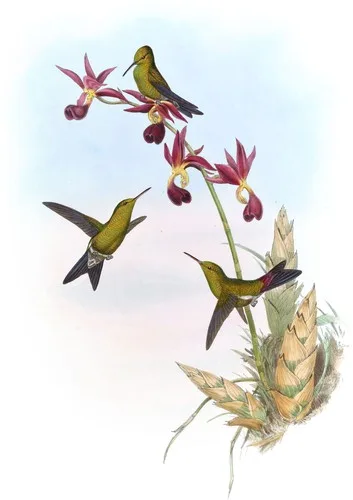
Erythonota antiqua
Erythonota antiqua
Erythronote
About this plate
Trinidad, Tobago, and Venezuela
Are we to regard the several birds generally known under the name of Erythronotes as one or as many species? Great care is required at the hand of the ornithologist respecting this peculiar section of the Trrochilidæ.
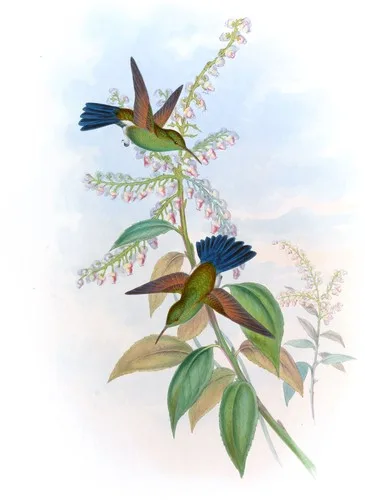
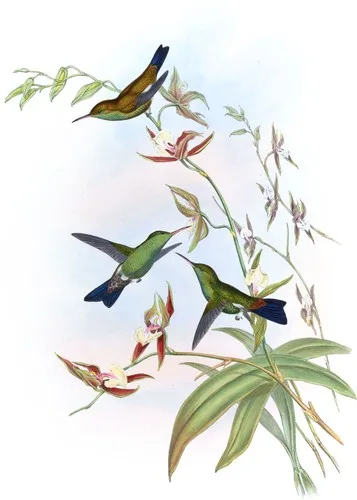
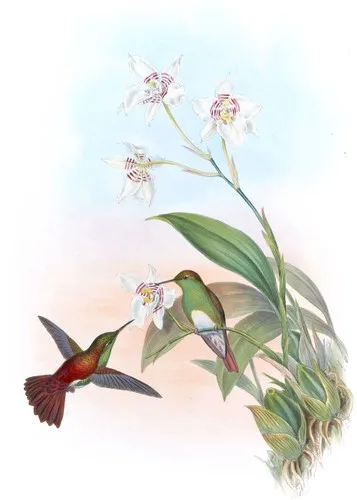
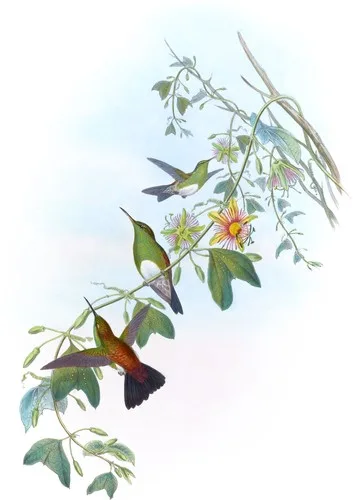
In every group of birds which the monographer attempts to illustrate, some one or two species will be found to vary, or sport as it were, in their size and colouring more than others; fortunately, however, these are the exceptions, and not the rule. I may ask, is the great bird from Tobago the same as the more diminutive bird from Trinidad? Again, is the bird from the Caraccas, which is of the same size as that from Trinidad, but from which it differs in having bright chestnut under tail-coverts, the same ? Or are we to regard them as so many species? For the present, I believe it will be better to consider them identical, for this reason: I find that the specimens from Trinidad differ very considerably among themselves, some having beautiful violet-grey under tail-coverts, while in others those feathers are uniform chestnut, and in others again they are olive-grey; it is clear, therefore, that the difference in the colouring of these feathers cannot be regarded as of importance. In making these remarks, it must be understood that I exclude the bird to which M. Bourcier has given the name of Feliciæ—a bird most nearly allied, but which has never, I believe, any red colouring on the nape and back,—a feature found in all those previously noticed, whether from Trinidad, Tobago, or the Caraccas. The figures in. the accompanying Plate were taken from Trinidad specimens to which I would apply the term antiqua, as being the oldest known. If future research should discover good grounds for separating the larger Tobago birds, they might receive a new specific name, as indeed may the other also. In the imperfect state of our knowledge, I feel that Iam right in placing them together, and I do this with a strong bias to the opinion that they will never be separated. With regard to the Trinidad bird, but little has been recorded respecting it. Mr. Tucker informed me that it is very common all over the island, inhabiting the woods as well as the savannahs, but more frequently the latter, visiting almost every flower that comes in its way. In the twentieth volume of the ‘Annals and Magazine of Natural History,’ above referred to, Sir William Jardine, quoting from Mr. Kirk’s notes on the Tobago bird, says: “begins to build about the 10th of February, generally on a small stalk, or on the upper side of some twig, sometimes so hidden from the eye by a large leaf as to preclude all possibility of seeing it from above, and often so near the ground as to remain undiscovered: makes a small nest, in which it lays two pure white eggs.” Lesson, I believe, is quite wrong in giving Brazil as the habitat of this bird, for I have no reason to suppose that it is ever found there.
Not much difference occurs in the plumage of the sexes, and the young at an early age assume the adult livery, or a dress very similar to it.
Forehead yellowish shining green; crown and nape, back, wing- and tail-coverts coppery red; wings purplish brown; tail black, with steel-blue reflexions; back of the neck green; breast and under surface shining grass-green; under tail-coverts rufous violet or grey; on each side the flanks an oblong patch of white; bill black, with a lighter base to the under mandible, that part appearing to have been flesh-colour.
The figures are of the size of life. The plant is the Odontoglossum hastilabium, var. fuscatum.
References
- Ornismya erythronotos, Less. Hist. Nat. des Ois.-Mou., p. 181. pl. 61.—Ib. Tab. des Esp. d’Ois.Mou., p. xxxii.—lb. Ind. Gen. et Syn. des Ois. du Gen. Trochilus, p. xxviii.
- Ornismya erythronotus, Less. Rev. Zool. 1839, p. 19.
- Polytmus erythronotus, Gray and Mitch. Gen. of Birds, vol. 1. p. 109, Polytmus, sp. 78.
- Saucerottia erythronota, Bonap. Consp. Gen. Av., p. 77, Saucerottia, sp. 2.—Reichenb. Auf. der Col., p. 8.—Bonap. Rev. et Mag. de Zool. 1854, p. 255.
- Trochilus erythronotus, Jard. in Ann. and Mag. Nat. Hist., vol. xx. p. 374.
Twelve ways of seeing
One plate, read twelve times over: its name, its colour, the burin and the brush, the shape of the sheet, the season, the soil it came from, the book it belongs to, its language of flowers, the poem it answers to, the lore behind it, how to look, and what remains.
-
The Name
The plate is titled “Erythonota antiqua”, numbered Pl. 316, Vol. V (book page 316). Its binomial is Erythonota antiqua: the genus places it among its kin, the epithet records a place, a shape or a person. No established Chinese name exists for this plate, so it is cited by its binomial alone.
-
Form and Colour
The smallest of birds: a needle-fine bill, a forked tubular tongue, wings beating so fast the bird hovers and even flies backwards. Its colour is not pigment but structure — light bent by feather barbules, changing with the angle. No colour group is recorded for this plate, but the palette still belongs to its season. Read the outline, then the colour layers, then the touch of the brush.
-
Line and Colour
In the later nineteenth century chromolithography took over: colour printed rather than painted, line demoted. Images grew more accurate and less personal. Look closely at the line and the colour: an unbroken line means engraving, colour crossing the outline by half a millimetre means hand-colouring. Craft leaves franker evidence than inscriptions.
-
Composition
Slightly taller than wide, the plant set a little above centre so the eye lands on the flower. (about 1.23 : 1). No details are appended: this is a plate for looking, not for keying out.
-
Season
In tropical America they are present all year, their season set by flowers; temperate hummingbirds follow the bloom north and back, thousands of kilometres a year. The year 1861 on the plate is the year of publication, not of flowering — the gathering came a year or two earlier.
-
Provenance
Americas only, from southern Alaska to Tierra del Fuego, richest in the Andes. China has no hummingbirds and no classical record of them; the name arrives with late-Qing travel writing. The volume was made in 1849-1887, when most of this knowledge came from living plants under glass rather than from the wild.
-
The Book
“Gould's Hummingbirds” was drawn by John Gould and published 1849-1887. This plate is Pl. 316, Vol. V, book page 316. The image is in the public domain; the hand-colouring on the paper is still one person's hand, two centuries ago.
-
Symbolism
For the Aztecs the hummingbird was warrior and sun; for Victorian Europe it was the ultimate ornament, millions killed for breast jewellery. China has no tradition here — and that blank is itself a history of exchange. Meanings change their tune: the same flower can say opposite things within a century.
-
Poetic Resonance
穿花蛱蝶深深见,点水蜻蜓款款飞。
—— 唐·杜甫《曲江二首》
Butterflies thread the flowers, seen deep within; dragonflies touch the water and fly on, slow and deliberate.
The poem gives the mood first and the picture supplies the form; set the line beside the plate and the bird itself becomes its resting point.
-
Classical Lore
Gould's Hummingbirds (1849–1887) used hand-coloured lithography over gold leaf so the iridescence survived on paper — a monument to Victorian printing and collecting alike. Chinese flower books ranked plants by character; European floras described them by form and name. This plate belongs to the second tradition, yet bears reading by the first. A flora asks what it is; a flower book asks what it means. Read both or half-read the plate.
-
How to Look
Look at the metallic throat and back: structural colour that needed gold leaf or layered washes to match. Then bill length against corolla depth — bird and flower evolved together. Stand back for the habit, step close for the meeting of line and colour.
-
Afterword
Two centuries on, the plant may still flower in some garden; the one on this sheet stopped in the season of 1861.