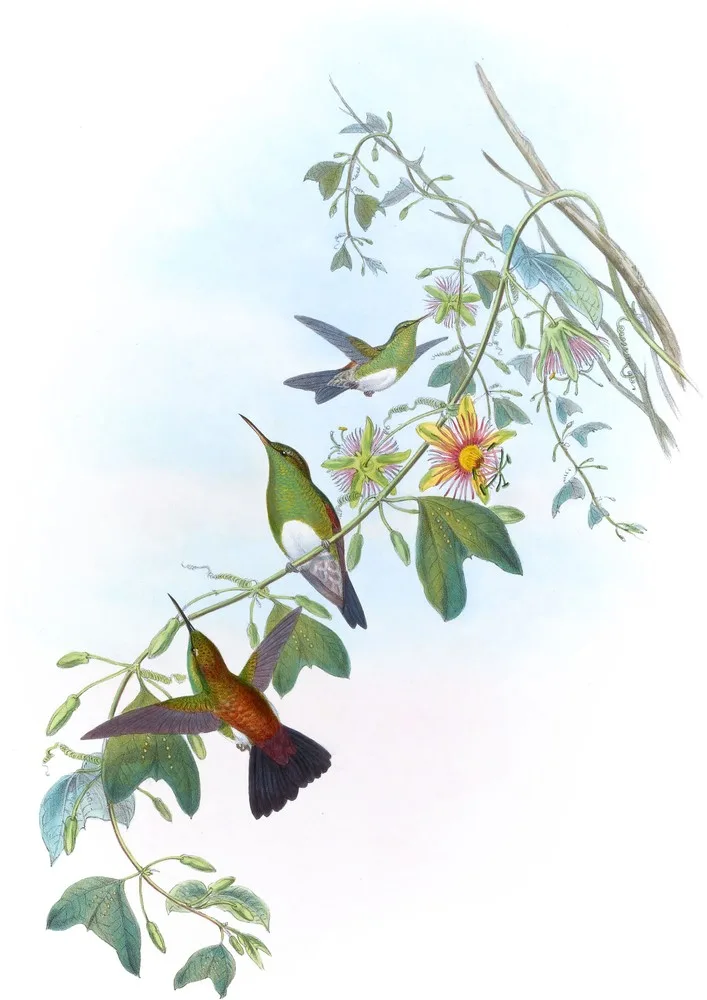
Erythronota niveiventris
红背红尾鸲
Erythronota niveiventris
White-breasted Erythronote
About this plate
Panama and Veragua
This species is very nearly allied to the Erythronota Edwardi; it is, however, a somewhat stouter bird, and is otherwise distinguishable by the lesser brilliance of the back and upper surface, and by the blackness of its tail.
Its native country is Veragua, whence I have received several examples direct; I have also a specimen procured by Dr. Berthold Seemann in Panama, and another collected by M. Warszewicz near David, at an elevation of between 5000 and 10,000 feet above the sea-level.
The whiteness of the abdomen of this species and its near ally is a character which at once separates them from the type of the genus, the Common Erythronote of Trinidad and Guiana.
The Erythronota niveiventris is at present very rare, as I know of no other examples in Europe but those contained in my own collection.
As far as I can judge, there is but little difference in the colouring of the sexes; the specimen procured by Dr. Seemann has, however, more white on the abdomen, less green on the throat, and the outer tailfeathers slightly tipped with a lighter colour, which distinctions may perhaps be characteristic of the female.
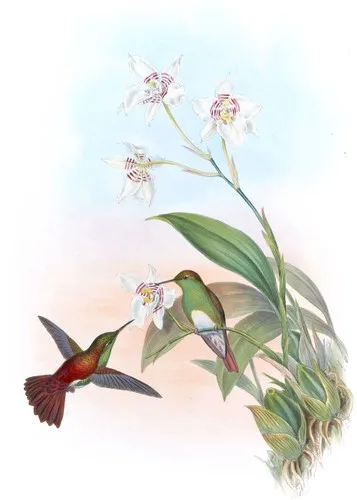
Head and upper surface green, passing into coppery red on the wing-coverts, lower part of the back and upper tail-coverts; wings dark purplish brown; tail purplish black; throat, breast and flanks luminous grass-green; abdomen white; under tail-coverts brown, fringed with white; upper mandible black; lower mandible flesh-colour.
The figures on the Plate are of the size of life. The plant is the Passiflora Medusæa.
References
- Trochilus (–––?) niveoventer, Gould in Proc. of Zool. Soc., part xviii. p. 164.
- Thaumantias niveiventer, Bonap. Rey. et Mag. de Zool. 1854, p. 255.
- Saucerottia niveiventer, Reichenb. Aufz. der Colibris, p. 8.
Ten ways of seeing
- upright 1.41 : 1
- published 1861
- Pl. 319, Vol. V
Not a catalogue entry but a way of looking: how to stand, what to notice, how the line was cut — then, halfway, a line of Chinese poetry: how the ancients saw this same flower. After it, the flower's language, its season and homeland, its book; and at the end one line of classical prose — and a pair of eyes to take away.
-
First Look
凡画山水,意在笔先。
—— 唐·王维《山水论》
In painting, the intention precedes the brush.
The sheet is vertical: the eye climbs and settles on the bird. Take the posture before the plumage. Then step in close: watch where colour meets line, and whether the line ever breaks. Third, find the darkest small patch: the whole tonal order is measured from there.
-
Name and Thing
The binomial is Erythronota niveiventris: the first word is the genus it belongs among, the second the epithet that sets it apart. Two words carry a whole provenance. The Chinese name 红背红尾鸲 is a modern rendering of the Latin, not an old garden name.
-
Form and Colour
The smallest of birds: a needle-fine bill, a forked tubular tongue, wings beating so fast the bird hovers and even flies backwards. Its colour is not pigment but structure — light bent by feather barbules, changing with the angle.No colour group is recorded. Read the outline, then the colour layers, then the brush.
-
Composition
Tall and narrow, the bird perched mid-branch with generous margins above and below. (about 1.41 : 1) No details are appended: a plate for looking, not for keying out. Cover the margins with your thumb and the plate suffocates; uncover them and the flower breathes again.
-
Line and Colour
In the later nineteenth century chromolithography took over: colour printed rather than painted, line demoted. Craft leaves franker evidence than inscriptions. If you mean to copy it: block in the broad shapes and colours first, detail last; lithographic softness comes from thin washes — two or three pale layers will get you close.
-
Poetic Resonance
夫列子御风而行,泠然善也,旬有五日而后反。
—— 《庄子·逍遥游》
Liezi rode the wind and came back after fifteen days, so light was his going.
The poem gives the mood first and the picture supplies the form; set the line beside the plate and the bird itself becomes its resting point.
-
Symbolism
For the Aztecs the hummingbird was warrior and sun; for Victorian Europe it was the ultimate ornament, millions killed for breast jewellery. China has no tradition here — and that blank is itself a history of exchange. Meanings change their tune: the same flower can say opposite things within a century.
-
Season and Place
In tropical America they are present all year, their season set by flowers. Americas only, from southern Alaska to Tierra del Fuego, richest in the Andes. China has no hummingbirds and no classical record of them. The year 1861 on the plate is that of publication, not of flowering — the gathering came a year or two earlier. Read the locality and the flowering season both with a discount: one is hearsay, the other a ten-day peak.
-
The Book and the Hand
“Gould's Hummingbirds” was drawn by John Gould and published 1849-1887. This plate is Pl. 319, Vol. V, book page 319. The image is public domain; the hand-colouring is still one person's hand.
-
The Written Tradition
人无癖不可与交,以其无深情也。
—— 明·张岱《陶庵梦忆》
Never make a friend of a man without an obsession: he has no deep feeling.
Gould's Hummingbirds (1849–1887) used hand-coloured lithography over gold leaf so the iridescence survived on paper — a monument to Victorian printing and collecting alike. You need not parse every word: take the line, and the flower acquires a second face.
What to Take Away
Appreciation is not knowledge but habit — one more look each time. Two centuries on, the plant may still flower in some garden; the one on this sheet stopped in the season of 1861.