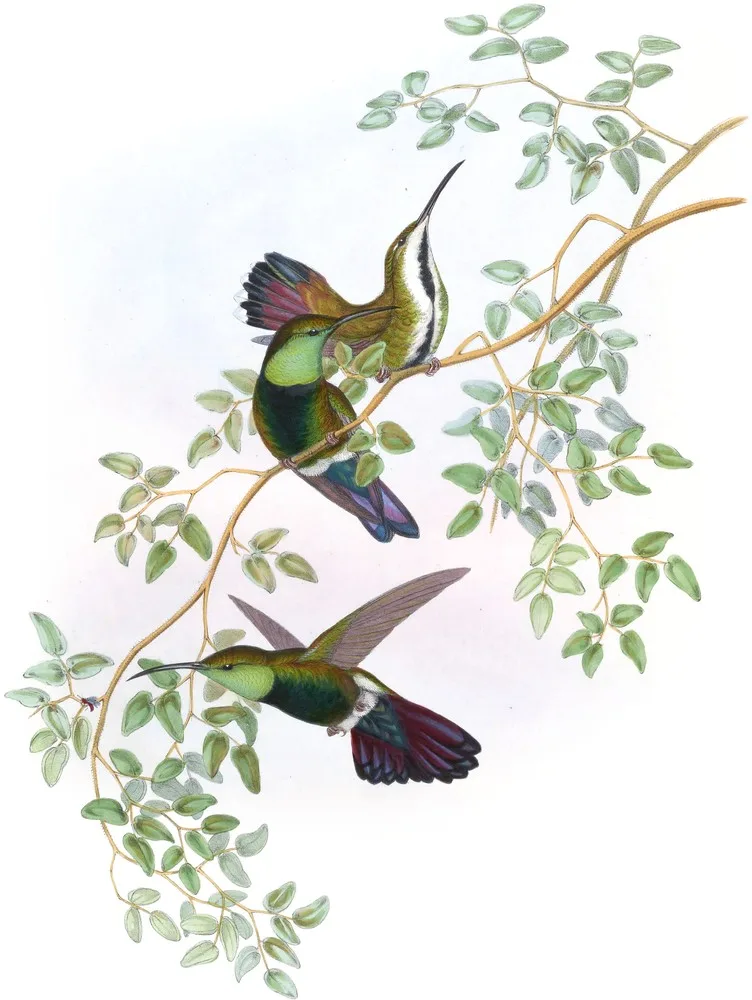
Lampornis gramineus
宝石蜂鸟属
Lampornis gramineus
Green-throated Mango
About this plate
Trinidad, Cayenne, and Guiana
So much confusion exists respecting the synonymy of this species, that, after instituting the most rigid examination, I am compelled to give up the attempt to unravel it, and content myself with enumerating those terms only which, it appears to me, certainly have reference to the present bird.
The state of confusion alluded to is due to two causes: first, from Lesson and the older authors considering the species to be a native of St. Domingo, and, secondly, in consequence of the females of two or three species bearing a great similarity to each other. Now I can positively state that the bird does not inhabit St. Domingo; nor do I believe it is to be found in any of the West India Islands, unless it be in Trinidad, and if so, that is the only one. Its true habitat is Cayenne and Guiana, whence all our collections are supplied with examples, and where it must be very numerous, as shown by the great number of specimens sent to Europe from those countries.
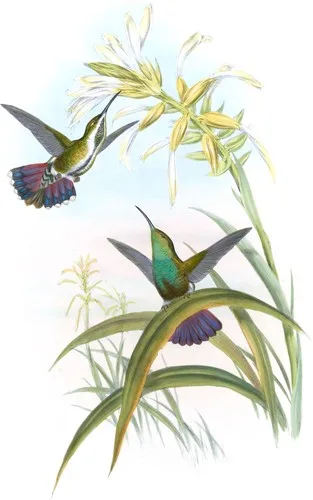
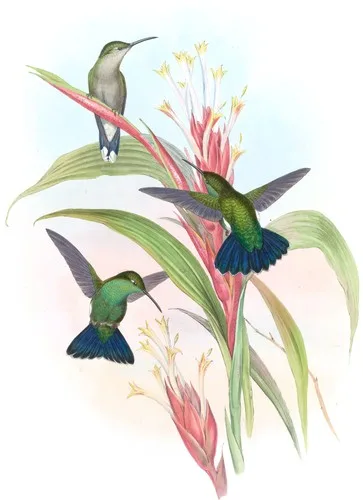
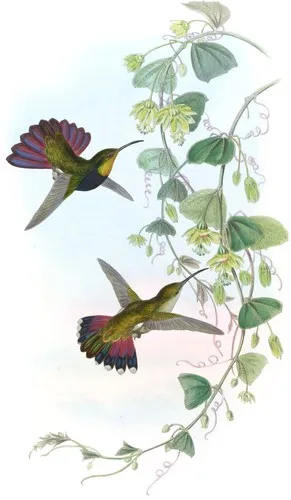
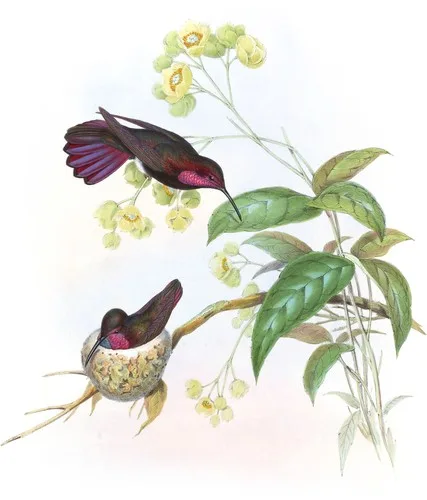
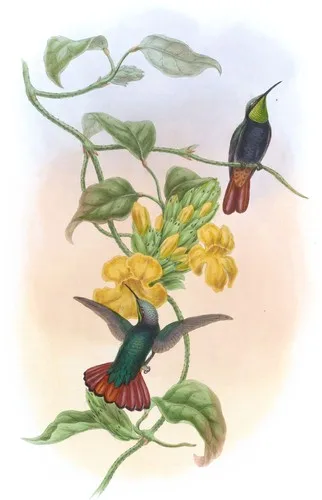
The Lampornis gramineus is a large species, distinguished by the boldness and breadth of its markings; it differs from all the other members of its genus in the grass-green of its throat, a colour beautifully relieved by the jet-black hue of its breast and abdomen. The females and young males present a very different style of colouring from that of the male, both on the under surface and in the markings of the tail, which are very beautiful.
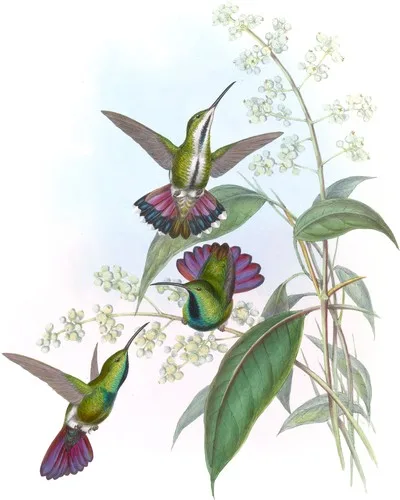
The male has the head and neck golden green, gradually passing into rich coppery green on the back, wing-coverts and upper tail-coverts; wings deep purplish brown; throat luminous grass-green; flanks golden green, with a tuft of white on each side; centre of the abdomen bluish black; in certain lights the entire abdomen and flanks appear jet-black; two centre tail-feathers bronzy purple, the remainder violet, broadly margined and tipped with steel-blue; vent white; under tail-coverts purplish green.
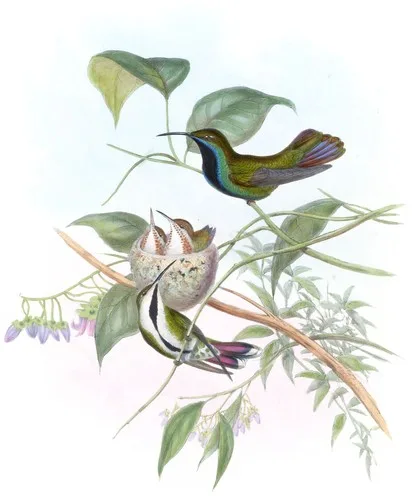
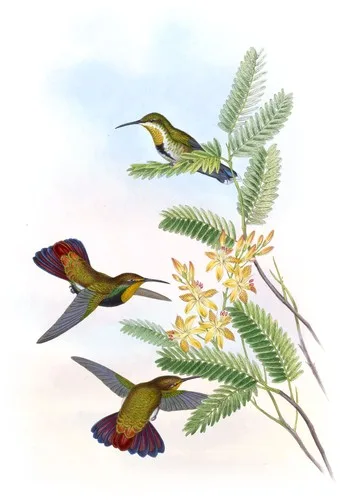
The young male has the upper surface mottled green and coppery bronze; sides of the throat and abdomen chestnut; on the centre of the throat a mark of luminous green, bounded on each side by white; down the centre of the abdomen a mark of black, bounded on each side with white; two centre tail-feathers bronzy green; the remainder chestnut-red with a rich bloom of purple; crossed near the tip by a broad band, which on the outer webs is bronzy green, on the inner steel-blue; all but the two middle feathers tipped with greyish white.
The female has all the upper surface and flanks golden green, the golden hue predominating on the rump and upper tail-coverts; throat white, with a large patch of black down the centre; central tail-feathers bronzy green, passing into black at the tip; the remainder chestnut-red, glossed with purple, crossed near the tip by a broad band of bluish black and tipped with white.
The figures are of the size of life. The plant is the Allosorus flexuosus.
References
- Trochilus gramineus, Linn. Syst. Nat., tom. i. p. 488.—Ib. Gmel. Edit., tom. i. p. 488.— Dumont, Dict. Sci. Nat., tom. x. p. 48.—Drapiez, Dict. Class. d’Hist. Nat., tom. iv. p. 318.—Less. Hist. Nat. des Col., pp. 52, 56. pls. 12, 12 bis.—Ib. Ind. Gen. et Syn. des Ois. du Gen. Trochilus, p. x.—Ib. Traité d’Orn., p. 290.—Vieill. Ois. de l’Am. Sept., tom. ii. p. 73.
- Trochilus pectoralis, Lath. Ind. Orn., vol. i. p. 306.—Vieill. Ency. Méth. Orn., part ii. p. 551. —Steph. Cont. Shaw’s Gen Zool., vol. xiv. p: 240.
- Le Hausse-col vert, Buff. Hist. Nat. des Ois., tom. vi. p. 58.—Vieill. Ois. Dor., tom. i. p. 23. pl. 9.
- Le Colibri a cravate verte, Vieill. Ois. Dor., tom. i. p. 25. pl. 10.—Buff. Hist. Nat. des Ois., tom. vi. p. 56.—Ib. Sonn. Edit., tom. xxii. p. 277.—Ib. Pl. Enl. 621. fig. 1.
- Le Plastron violet, Vieill. Ois. Dor., tom. i. p. 124. pl. 70?
- Colibri a gorge verte de Cayenne, Buff. Pl. Enl. 671. fig. 1.
- Colibri du Mexique, Buff. Pl. Enl. 580. fig. 2.
- Trochilus maculatus, Gmel. Edit. Linn. Syst. Nat., tom. i. p. 488.—Vieill. Ency. Méth. Orn., part ii. p. 563.
- Trochilus gularis, Gmel. Edit. Linn. Syst. Nat., tom. i. p. 491.—Lath. Ind. Orn., vol. i. p. 306.—Vieill. Eney. Méth. Orn., part ii. p. 553.
- Trochilus marmoratus, Vieill. Eney. Méth. Orn., part 1. p. 567.
- Polytmus domiucus, Gray and Mitch. Gen. of Birds, vol. i. p. 108, Polytmus, sp. 11.—Bonap. Rev. et Mag. de Zool. 1854, p. 250.
- Lampornis dominicus, Bonap. Consp. Gen. Ay., p. 71, Lampornis, sp. 2.
- Hypophania dominica, Reichenb. Aufz. der Colibris, p. 11.
- Green-throated Humming-bird, Lath. Gen. Syn., vol. ii. p. 755.—Ib. Gen. Hist., vol. iv. p. 305.
- Black-breasted Humming-bird, Lath. Gen. Syn., vol. ii. p. 756.—Shaw, Gen. Zool., vol. viii. p. 298.—Lath. Gen. Hist., vol. iv. p. 302.
Twelve ways of seeing
- upright 1.33 : 1
- published 1850
- Pl. 77, Vol. II
Not a catalogue entry but a way of looking: how to stand, what to notice, how the line was cut, when it flowers, where it came from, who made it — and then the poems and the classics that taught China to see the same flower. Read the twelve in order and the plate opens.
-
First Look
夫象物必在于形似,形似须全其骨气。
—— 唐·张彦远《历代名画记》
Likeness is the threshold; bone-and-breath is the point.
The sheet is vertical: the eye climbs and settles on the bird. Take the posture before the plumage. Then step in close: watch where colour meets line, and whether the line ever breaks. Third, find the darkest small patch: the whole tonal order is measured from there.
-
Name and Thing
The binomial is Lampornis gramineus: the first word is the genus it belongs among, the second the epithet that sets it apart. Two words carry a whole provenance. The Chinese name 宝石蜂鸟属 is a modern rendering of the Latin, not an old garden name.
-
Form and Colour
The smallest of birds: a needle-fine bill, a forked tubular tongue, wings beating so fast the bird hovers and even flies backwards. Its colour is not pigment but structure — light bent by feather barbules, changing with the angle.No colour group is recorded. A single plant, laid out with nothing hidden.
-
Composition
Tall and narrow, the bird perched mid-branch with generous margins above and below. (about 1.33 : 1) No details are appended: a plate for looking, not for keying out. Old plates set the plant slightly off centre, with unequal margins — that small imbalance is what keeps it alive.
-
Line and Colour
In the later nineteenth century chromolithography took over: colour printed rather than painted, line demoted. Decide first whether it was printed or painted; only then discuss whether it is beautiful.
-
Season
In tropical America they are present all year, their season set by flowers; temperate hummingbirds follow the bloom north and back, thousands of kilometres a year. The year 1850 on the plate is that of publication, not of flowering — the gathering came a year or two earlier. The plate records ten days of peak; the other three hundred are leaf, fruit and rest.
-
Provenance
Americas only, from southern Alaska to Tierra del Fuego, richest in the Andes. China has no hummingbirds and no classical record of them; the name arrives with late-Qing travel writing. The volume was made in 1849-1887, when most of this knowledge came from living plants under glass.
-
The Book and the Hand
“Gould's Hummingbirds” was drawn by John Gould and published 1849-1887. This plate is Pl. 77, Vol. II, book page 77. The image is public domain; the hand-colouring is still one person's hand.
-
Poetic Resonance
穿花蛱蝶深深见,点水蜻蜓款款飞。
—— 唐·杜甫《曲江二首》
Butterflies thread the flowers, seen deep within; dragonflies touch the water and fly on, slow and deliberate.
The poem gives the mood first and the picture supplies the form; set the line beside the plate and the bird itself becomes its resting point.
-
The Written Tradition
竖划三寸,当千仞之高;横墨数尺,体百里之迥。
—— 南朝宋·宗炳《画山水序》
A vertical stroke of three inches stands for a cliff of a thousand fathoms; a few feet of ink holds a hundred li. Smallness of scale was never the obstacle.
Gould's Hummingbirds (1849–1887) used hand-coloured lithography over gold leaf so the iridescence survived on paper — a monument to Victorian printing and collecting alike. Keep the line; it will surface the next time you meet the same plant.
-
Symbolism
For the Aztecs the hummingbird was warrior and sun; for Victorian Europe it was the ultimate ornament, millions killed for breast jewellery. China has no tradition here — and that blank is itself a history of exchange. In a flora it is a species first and a symbol second; the order is worth keeping.
-
What to Take Away
Appreciation is not knowledge but habit — one more look each time. A flora exists to be consulted; look long enough and you forget to consult — someone in 1850 gave a whole day to a single flower.