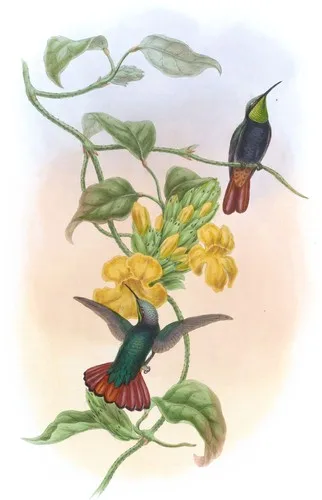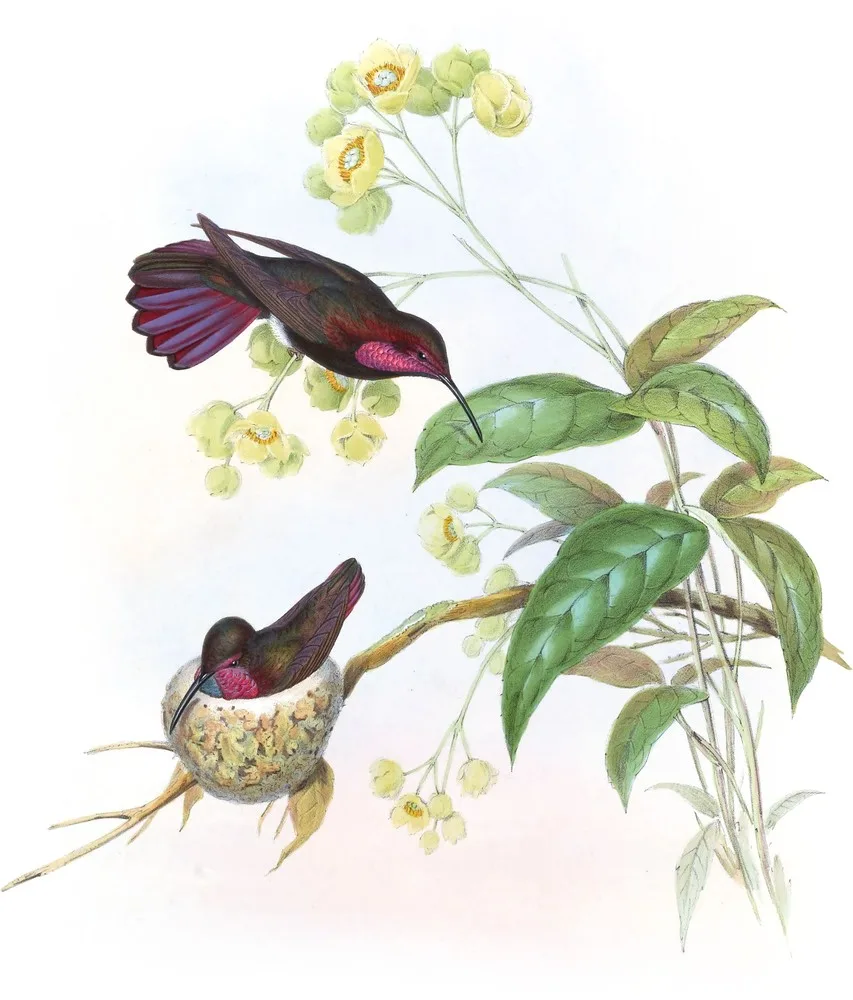
Lampornis porphyrurus
宝石蜂鸟属
Lampornis porphyrurus
Porphyry-tailed Mango
Ten ways of seeing
- slightly upright 1.17 : 1
First Look
六法者何?一、气韵生动是也;二、骨法用笔是也;三、应物象形是也;四、随类赋彩是也;五、经营位置是也;六、传移模写是也。
—— 南齐·谢赫《古画品录》
The six laws: spirit resonance alive; bone-method in the brush; matching form; colour by kind; planning the placing; copying the masters.
Slightly taller than wide; the eye lands on the bird's head, a little above centre. Then step in close: watch where colour meets line, and whether the line ever breaks. Third, find the darkest small patch: the whole tonal order is measured from there.
Name and Thing
The binomial is Lampornis porphyrurus: the first word is the genus it belongs among, the second the epithet that sets it apart. Two words carry a whole provenance. The Chinese name 宝石蜂鸟属 is a modern rendering of the Latin, not an old garden name.
Form and Colour
The smallest of birds: a needle-fine bill, a forked tubular tongue, wings beating so fast the bird hovers and even flies backwards. Its colour is not pigment but structure — light bent by feather barbules, changing with the angle.No colour group is recorded. Read the outline, then the colour layers, then the brush.
Composition
Slightly taller than wide, the bird set a little above centre, the eye landing at head and bill. No details are appended: a plate for looking, not for keying out. Blank paper is not unfinished work: it is where the eye rests.
Line and Colour
In the later nineteenth century chromolithography took over: colour printed rather than painted, line demoted. Take a loupe to three places: petal edge, leaf vein, caption. An unbroken line means engraving; colour crossing the outline means a hand. If you mean to copy it: block in the broad shapes and colours first, detail last; lithographic softness comes from thin washes — two or three pale layers will get you close.
Poetic Resonance
夫列子御风而行,泠然善也,旬有五日而后反。
—— 《庄子·逍遥游》
Liezi rode the wind and came back after fifteen days, so light was his going.
The poem gives the mood first and the picture supplies the form; set the line beside the plate and the bird itself becomes its resting point.
Symbolism
For the Aztecs the hummingbird was warrior and sun; for Victorian Europe it was the ultimate ornament, millions killed for breast jewellery. China has no tradition here — and that blank is itself a history of exchange. Meanings change their tune: the same flower can say opposite things within a century.
Season and Place
temperate hummingbirds follow the bloom north and back, thousands of kilometres a year. Americas only, from southern Alaska to Tierra del Fuego, richest in the Andes. China has no hummingbirds and no classical record of them. The year 1850 on the plate is that of publication, not of flowering — the gathering came a year or two earlier. The bud and the ripe fruit on one branch tell the season; the name in the title often tells the journey.
The Book and the Hand
“Gould's Hummingbirds” carries only John Gould's name. A plate is collective work: drawer, engraver and colourist were different hands, and the unnamed ones decided how good it looks.
What to Take Away
Appreciation is not knowledge but habit — one more look each time. A flora exists to be consulted; look long enough and you forget to consult — someone in 1850 gave a whole day to a single flower.
About this plate
Jamaica
It would scarcely be supposed that an island like Jamaica should have a large and powerful member of this group of birds peculiar to it, yet such really appears to be the case, for up to the present time the Lampornis porphyrurus has not been found elsewhere.
This fine species differs so essentially from every other known Humming-bird, that no mistake can have occurred on this point; for not only does the male present an entirely different style of colouring, but those birds which are considered to be the females of this species are also as widely different. These supposed females are indeed equally, if not more brilliantly coloured than the males, an anomaly which has much puzzled not only myself, but other Trochilidists, by one of whom, at least, these birds have been considered so distinct that he has given them a separate appellation, that of Floresi.
Few travellers have written more interestingly on the Humming-birds seen by them in a state of nature than P. H. Gosse, Esq.; in the absence, then, of any knowledge of my own, I cannot do better than copy the following details respecting this species from his “Birds of Jamaica”:—“Though occurring at all seasons, I have not found it abundant at any. It affects the lowlands in preference to the mountains, and open places rather than the deep woods; yet it is rarely seen to frequent the blossoms of herbs or shrubs, but hovers around blossoming trees. The bunch of blossom at the summit of the pole-like Papaw-tree (Carica papaya) is a favourite resort, especially at sunset. This species, when flying, often flirts and flutters the tail in a peculiar manner, and when it hangs perpendicularly in mid-air, the appearance of the broad lustrous feathers, expanded like a fan, is particularly beautiful. The lustrous glow of the neck of the adult male may be unperceived on a careless examination. In such Humming-birds as I have examined, the iridescence of those portions of the plumage that are changeable is splendid in the ratio of the acuteness of the angle formed by the incident ray of light and the reflected one. I have never met with the nest of this species, but one presented to me by my friend Mr. Hill is now before me. It has evidently been constructed to stand upon a horizontal twig, which the bottom has embraced. It is cylindrical externally, the bottom being flat. Its height is 1
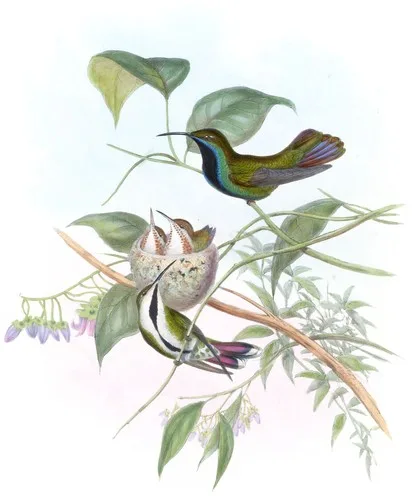
I am indebted to Mr. Gosse for the gift of a nest of this species, I believe the one described above, and which is figured on the accompanying Plate.
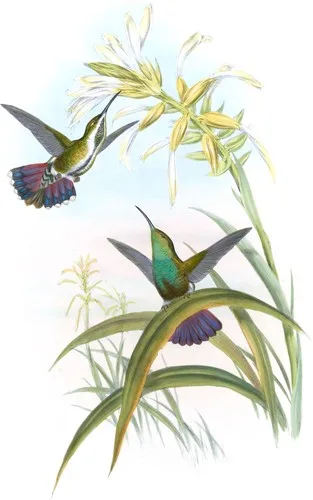
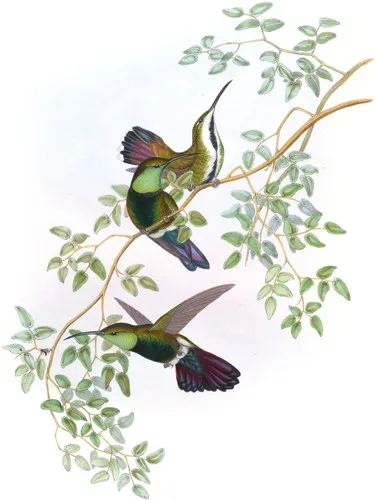
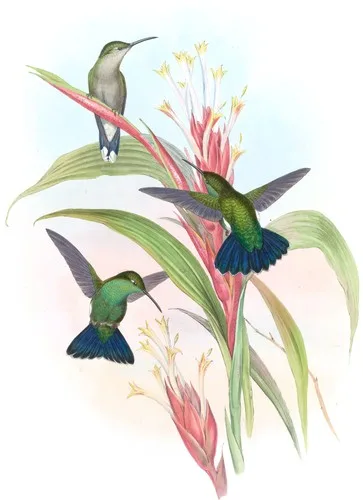
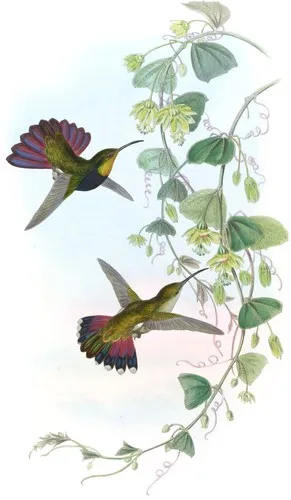
The male has the general plumage dark olivaceous brown, glossed with purple; from the bill through the eye, down each side of the neck, a brilliant purple band; throat and abdomen blackish brown; a few white feathers at the lower part of the abdomen, and on each flank a small patch of white; wings purplish brown; two centre tail feathers bronzy black; the lateral ones changeable purple, margined at the tip with bronzy black.
Female similar, but with a mark of changeable purplish green down the throat.
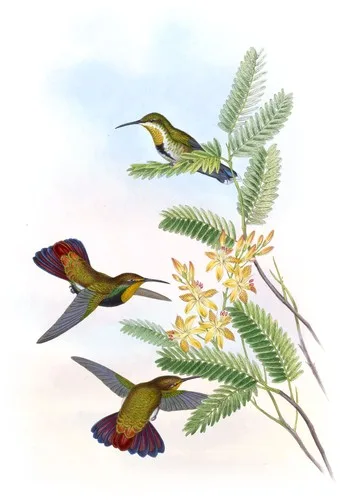
The Plate represents the two sexes of the size of life. The plant is the Pachystigma pteleoïdes.
References
- Trochilus porphyrurus, Shaw, Nat. Misc., vol. ix. pl. 383.—Ib. Gen. Zool., vol. viii. p. 296.—Ib. Steph. Cont., vol. xiv. p. 240.
- Trochilus bromicolor, Less.
- Trochilus Floresii, Boure. Ann. de la Soe. Sci. de Lyon, vol. ix. 1846, p.
- Polytmus porphyrurus, Gray and Mitch. Gen. of Birds, vol. i. p. 108, Polytmus, sp. 20.
- Lampornis mango, Gosse, Birds of Jamaica, p. 88.—Ib. Ill. Birds of Jam., pl. xviii.
- Lampornis porphyrurus, Bonap. Rev. et Mag. de Zool. 1854, p. 250.
- Floresia porphyrura, Reichenb. Aufz. der Colibris, p. 11.
- Lamporms floresi, Bonap. Consp. Gen. Av., p. 72, Lampornis, Sp. 7.
- Mango Humming-bird, var. A., Lath. Gen. Syn., vol. ii. p. 759.—Ib. Gen. Hist., vol. iv. p. 311.