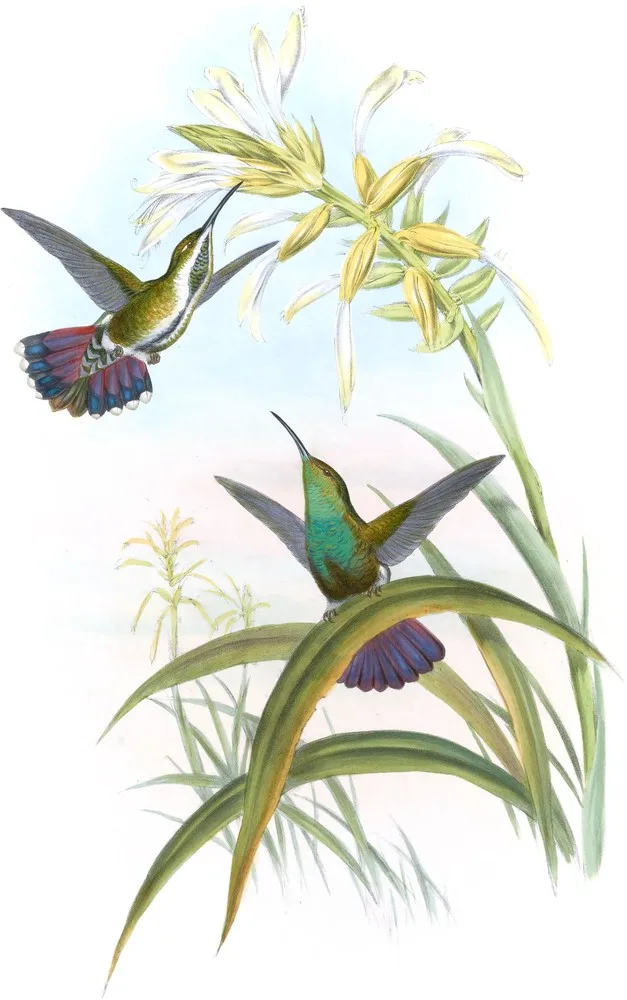
Lampornis Veraguensis
宝石蜂鸟属·Lampornis Veraguensis
Lampornis Veraguensis
Veraguan Mango
Ten ways of seeing
- upright 1.59 : 1
First Look
竖划三寸,当千仞之高;横墨数尺,体百里之迥。
—— 南朝宋·宗炳《画山水序》
A vertical stroke of three inches stands for a cliff of a thousand fathoms; a few feet of ink holds a hundred li.
The sheet is vertical: the eye climbs and settles on the bird. Take the posture before the plumage. Then step in close: watch where colour meets line, and whether the line ever breaks. Third, find the darkest small patch: the whole tonal order is measured from there.
Name and Thing
The binomial is Lampornis veraguensis: the first word is the genus it belongs among, the second the epithet that sets it apart. Two words carry a whole provenance. No established Chinese name exists, so it is cited by its binomial alone.
Form and Colour
The smallest of birds: a needle-fine bill, a forked tubular tongue, wings beating so fast the bird hovers and even flies backwards. Its colour is not pigment but structure — light bent by feather barbules, changing with the angle.No colour group is recorded. Read the outline, then the colour layers, then the brush.
Composition
Tall and narrow, the bird perched mid-branch with generous margins above and below. No details are appended: a plate for looking, not for keying out. Cover the margins with your thumb and the plate suffocates; uncover them and the flower breathes again.
Line and Colour
In the later nineteenth century chromolithography took over: colour printed rather than painted, line demoted. Take a loupe to three places: petal edge, leaf vein, caption. An unbroken line means engraving; colour crossing the outline means a hand. If you mean to copy it: block in the broad shapes and colours first, detail last; lithographic softness comes from thin washes — two or three pale layers will get you close.
Poetic Resonance
夫列子御风而行,泠然善也,旬有五日而后反。
—— 《庄子·逍遥游》
Liezi rode the wind and came back after fifteen days, so light was his going.
The poem gives the mood first and the picture supplies the form; set the line beside the plate and the bird itself becomes its resting point.
Symbolism
For the Aztecs the hummingbird was warrior and sun; for Victorian Europe it was the ultimate ornament, millions killed for breast jewellery. China has no tradition here — and that blank is itself a history of exchange. In a flora it is a species first and a symbol second; the order is worth keeping.
Season and Place
In tropical America they are present all year, their season set by flowers. the name arrives with late-Qing travel writing. The year 1850 on the plate is that of publication, not of flowering — the gathering came a year or two earlier. Read the locality and the flowering season both with a discount: one is hearsay, the other a ten-day peak.
The Book and the Hand
“Gould's Hummingbirds” carries only John Gould's name. The image is public domain; the hand-colouring is still one person's hand.
What to Take Away
Carry three rules away: whole before detail; line before colour; picture before book. The flower of that year is dust, yet its image on paper has outlived every living cousin.
About this plate
Veragua and Costa Rica
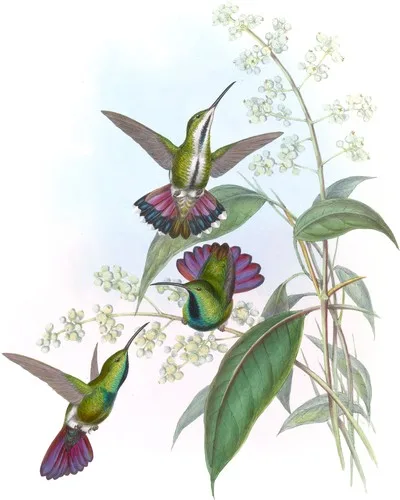
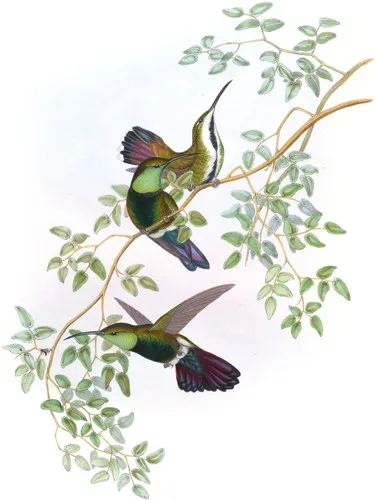
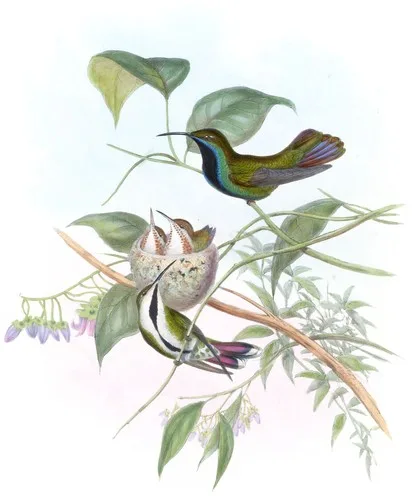
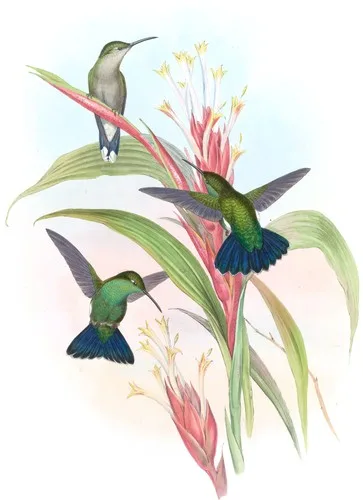
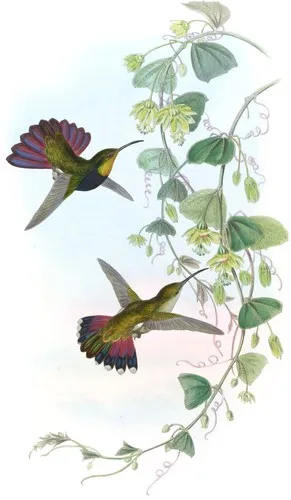
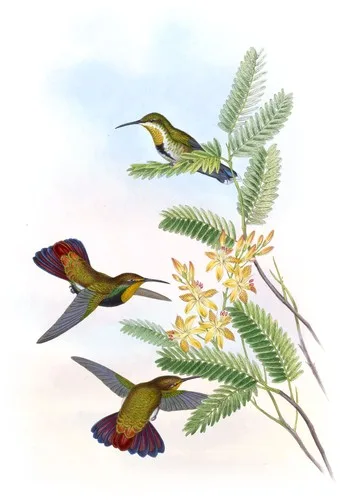
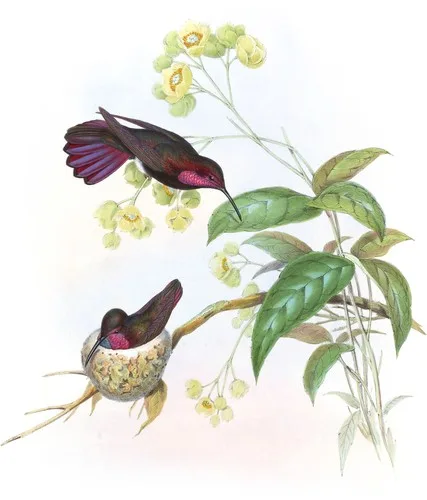
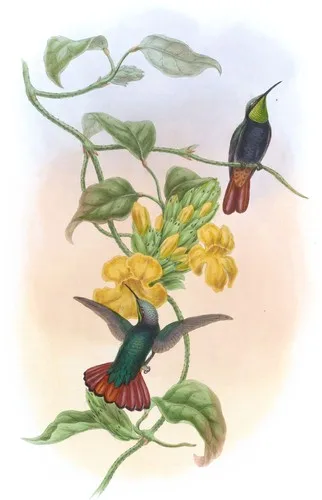
Several years have now elapsed since I received both drawings and specimens of this new Humming-bird from M. Warszewicz, the celebrated South American traveller and botanist. The specimens referred to were collected near the voleano of Chiriqui in Veragua; subsequently I received examples from Costa Rica, and more recently still from the vicinity of David, transmitted by Mr. Bridges: nothing can be more certain, therefore, than that the countries immediately to the northward of the Isthmus of Panama are the native habitat of this bird. As a species, the Lampornis Veraguensis is as well marked as any member of the genus; it possesses a combination of characters which ally it to the L. gramineus and L. Prevost; it differs, however, from the former in its much smaller size, and in the brilliant green of the throat being continued over the chest to the abdomen; and from the L. Prevosti, which it about equals in size, by the total absence of black on the throat. I am so fortunate as to possess males, females and young males of this fine species, which may be thus described.
The male has all the upper surface, wing-coverts and flanks golden green; throat glittering green, inclined to blue in the centre, and becoming of a deeper blue on the chest and centre of the abdomen; wings purplish brown; tail purple, each feather narrowly edged and tipped with darker purple, the two centre feathers tinged with bronze; tuft on each flank white.
The young male is similar on the upper surface; has the throat-mark less brilliant and bordered with white; the centre tail-feathers bronzy green; the lateral feathers purple at the base, crossed near the tip with steel-blue and tipped with white.
The female is of a more golden hue above and on the flanks; has a mark of blackish green bordered with white down the throat and the lateral tail-feathers as in the young male.
The figures are of the natural size. The plant is the Pitcairnia macrocalyx.
References
- Lamporns Veraguensis, Gould, MSS.
- Lampornis veraguensis, Bonap. Rev. et Mag. de Zool. 1854, p. 250.
- Sericotes veraguensis, Reichenb. Aufz. der Colibris, p. 11.