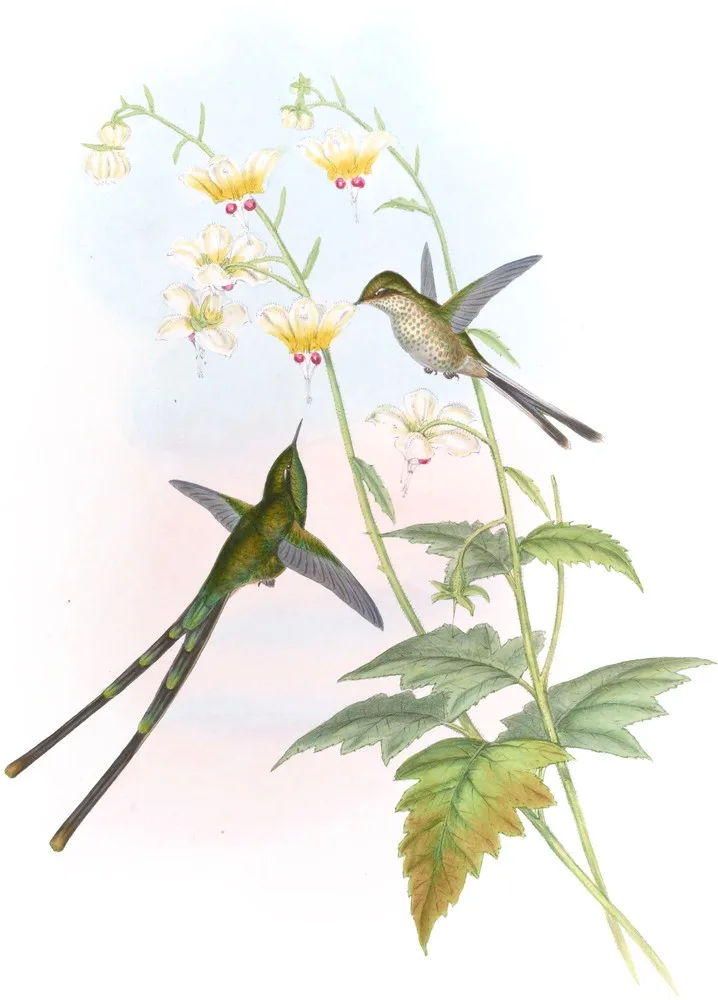
Lesbia gracilis
篱笆豆粉蝶
Lesbia gracilis
Graceful Train-bearer
About this plate
Ecuador
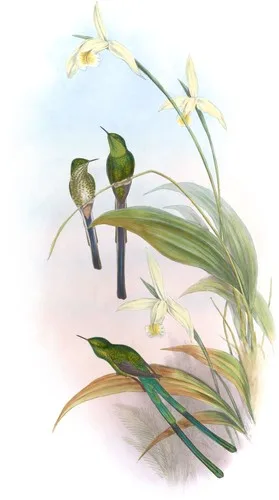
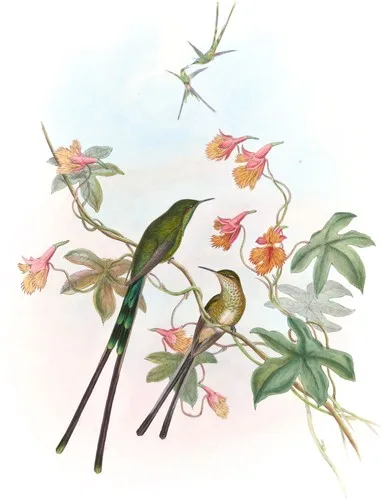
This very elegant little species differs from the Lesbia Gouldi in having much narrower tail-feathers, and in the green colouring of the outermost of these feathers being much less extensive; the basal portion of their outer webs is also much lighter, approaching to white: in other respects the two birds are much alike.
The native country of this little sylph-like bird is Ecuador, where it appears to be very numerous. It was first brought to Europe by M. Bourcier; examples have since been sent to me by Professor Jameson, and others have been procured by Mr. Fraser, from whose notes we learn that it is found ‘ above Puellaro and Calacali, but at the latter place is not common. It is readily distinguishable from all others by the peculiar loud humming noise produced by the wings, and which is audible at the distance of twenty or thirty yards.” He “did not find it near the pueblo, but at some height up one of the hills. The gizzards of those examined contained insects. It is difficult to get a sufficient distance from these birds to shoot them, on account of their quickness and uneasiness of motion; they would seldom be seen but for their chirping, and the humming noise produced by their wings.”
The female is almost as graceful as the male, the pretty green spotting of the breast contrasting beautifully with the greyish white ground-colour of the under surface.
On looking over my collection, I find a single specimen of this bird, obtained by M. Warszewicz in Peru, which proves that it frequents countries south of the equator, where it doubtless represents the L. Gouldi, found in the neighbourhood of Bogota.
The male has the throat beautiful shining metallic green; the remainder of the body golden green; wings brown; outer tail-feathers bronzy brown, the bronze gradually increasing in intensity and becoming a brilliant spot at the tip; basal half of the outer webs buffy white; remaining feathers brown at the base and shining golden green for the remainder of their length; under tail-coverts buff, slightly washed with green; bill black.
The female is similarly coloured on the upper surface, but has a shorter and less brilliantly coloured tail; the under surface is greyish white, thickly spangled with green.
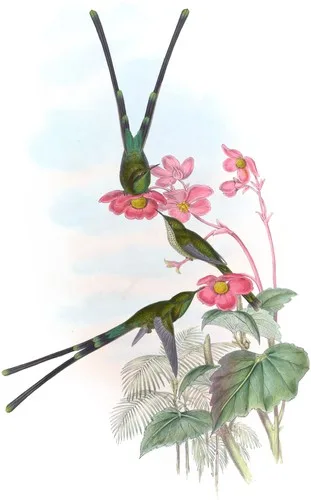
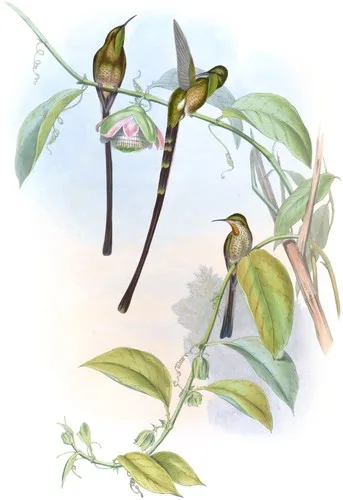
The Plate represents a male and a female, of the natural size. The plant is the Loasa picta.
References
- Trochilus (Leshia) gracilis, Gould in Proc. of Zool. Soc., part xiv. p. 86.
- Mellisuga gracilis, Gray and Mitch. Gen. of Birds, vol. i. p. 118, Mellisuga, sp. 53.
- Cynanthus gracilis, Bonap. Consp. Gen. Av., p. 81, Cynanthus, sp. 5.
- Lesbia gracilis, Reichenb. Auf. der Col., p. 8.—Proc. of Zool. Soc., part xxvi. p. 460.—Sclat. in Proc. of Zool. Soc., part xxvui. pp. 70, 94.
Twelve ways of seeing
- upright 1.39 : 1
- published 1852
- Pl. 168, Vol. III
Not a catalogue entry but a way of looking: how to stand, what to notice, how the line was cut, when it flowers, where it came from, who made it — and then the poems and the classics that taught China to see the same flower. Read the twelve in order and the plate opens.
-
First Look
江馆清秋,晨起看竹,烟光日影露气,皆浮动于疏枝密叶之间。
—— 清·郑板桥《题画竹》
On an autumn morning at the river lodge I looked at the bamboo: mist, sunlight, dew, all drifting among the sparse and dense leaves.
The sheet is vertical: the eye climbs and settles on the bird. Take the posture before the plumage. Then step in close: watch where colour meets line, and whether the line ever breaks. Third, find the darkest small patch: the whole tonal order is measured from there.
-
Name and Thing
The binomial is Lesbia gracilis: the first word is the genus it belongs among, the second the epithet that sets it apart. Two words carry a whole provenance. The Chinese name 篱笆豆粉蝶 is a modern rendering of the Latin, not an old garden name.
-
Form and Colour
The smallest of birds: a needle-fine bill, a forked tubular tongue, wings beating so fast the bird hovers and even flies backwards. Its colour is not pigment but structure — light bent by feather barbules, changing with the angle.No colour group is recorded. A single plant, laid out with nothing hidden.
-
Composition
Tall and narrow, the bird perched mid-branch with generous margins above and below. (about 1.39 : 1) No details are appended: a plate for looking, not for keying out. Old plates set the plant slightly off centre, with unequal margins — that small imbalance is what keeps it alive.
-
Line and Colour
In the later nineteenth century chromolithography took over: colour printed rather than painted, line demoted. There is evidence on the back too: the plate mark pressed into the paper, the slight relief of the pigment, lines worn shallow in a later printing.
-
Season
In tropical America they are present all year, their season set by flowers; temperate hummingbirds follow the bloom north and back, thousands of kilometres a year. The year 1852 on the plate is that of publication, not of flowering — the gathering came a year or two earlier. The plate records ten days of peak; the other three hundred are leaf, fruit and rest.
-
Provenance
Americas only, from southern Alaska to Tierra del Fuego, richest in the Andes. China has no hummingbirds and no classical record of them; the name arrives with late-Qing travel writing. The localities on the plate are those of a century ago; plants travel and places change their names.
-
The Book and the Hand
“Gould's Hummingbirds” was drawn by John Gould and published 1849-1887. This plate is Pl. 168, Vol. III, book page 168. The image is public domain; the hand-colouring is still one person's hand.
-
Poetic Resonance
夫列子御风而行,泠然善也,旬有五日而后反。
—— 《庄子·逍遥游》
Liezi rode the wind and came back after fifteen days, so light was his going.
The poem gives the mood first and the picture supplies the form; set the line beside the plate and the bird itself becomes its resting point.
-
The Written Tradition
竖划三寸,当千仞之高;横墨数尺,体百里之迥。
—— 南朝宋·宗炳《画山水序》
A vertical stroke of three inches stands for a cliff of a thousand fathoms; a few feet of ink holds a hundred li. Smallness of scale was never the obstacle.
Gould's Hummingbirds (1849–1887) used hand-coloured lithography over gold leaf so the iridescence survived on paper — a monument to Victorian printing and collecting alike. You need not parse every word: take the line, and the flower acquires a second face.
-
Symbolism
For the Aztecs the hummingbird was warrior and sun; for Victorian Europe it was the ultimate ornament, millions killed for breast jewellery. China has no tradition here — and that blank is itself a history of exchange. In a flora it is a species first and a symbol second; the order is worth keeping.
-
What to Take Away
Carry three rules away: whole before detail; line before colour; picture before book. Two centuries on, the plant may still flower in some garden; the one on this sheet stopped in the season of 1852.