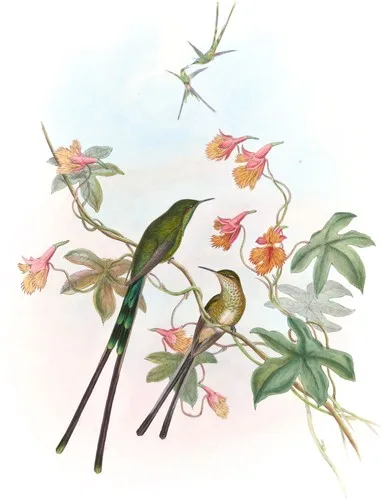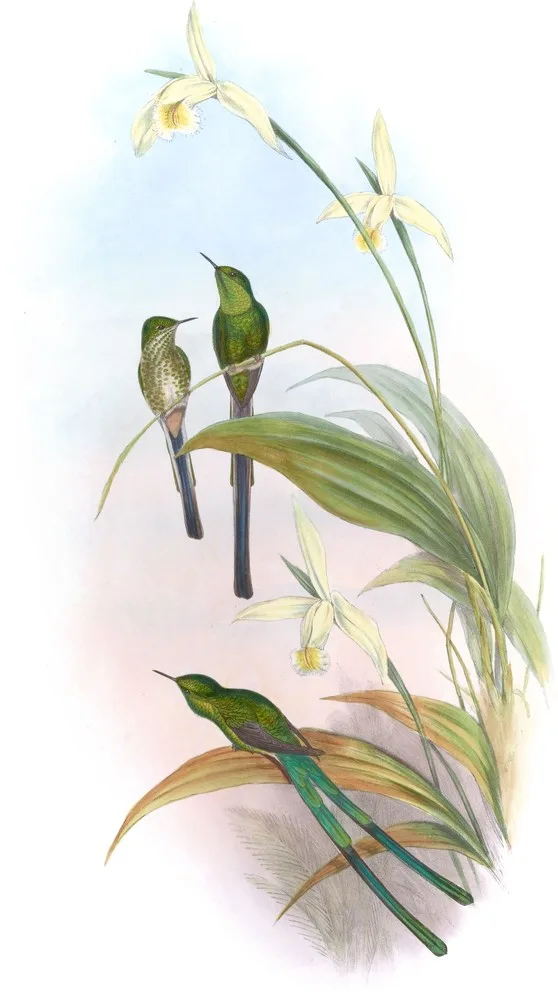
Lesbia Gouldi
篱笆豆粉蝶·Lesbia Gouldi
Lesbia Gouldi
Bogota Train-bearer
Ten ways of seeing
- upright 1.79 : 1
First Look
江馆清秋,晨起看竹,烟光日影露气,皆浮动于疏枝密叶之间。
—— 清·郑板桥《题画竹》
On an autumn morning at the river lodge I looked at the bamboo: mist, sunlight, dew, all drifting among the sparse and dense leaves.
The sheet is vertical: the eye climbs and settles on the bird. Take the posture before the plumage. Then step in close: watch where colour meets line, and whether the line ever breaks. Third, find the darkest small patch: the whole tonal order is measured from there.
Name and Thing
The binomial is Lesbia gouldi: the first word is the genus it belongs among, the second the epithet that sets it apart. Two words carry a whole provenance. No established Chinese name exists, so it is cited by its binomial alone.
Form and Colour
The smallest of birds: a needle-fine bill, a forked tubular tongue, wings beating so fast the bird hovers and even flies backwards. Its colour is not pigment but structure — light bent by feather barbules, changing with the angle.No colour group is recorded. A single plant, laid out with nothing hidden.
Composition
Tall and narrow, the bird perched mid-branch with generous margins above and below. No details are appended: a plate for looking, not for keying out. Old plates set the plant slightly off centre, with unequal margins — that small imbalance is what keeps it alive.
Line and Colour
In the later nineteenth century chromolithography took over: colour printed rather than painted, line demoted. Take a loupe to three places: petal edge, leaf vein, caption. An unbroken line means engraving; colour crossing the outline means a hand. If you mean to copy it: block in the broad shapes and colours first, detail last; lithographic softness comes from thin washes — two or three pale layers will get you close.
Poetic Resonance
夫列子御风而行,泠然善也,旬有五日而后反。
—— 《庄子·逍遥游》
Liezi rode the wind and came back after fifteen days, so light was his going.
The poem gives the mood first and the picture supplies the form; set the line beside the plate and the bird itself becomes its resting point.
Symbolism
For the Aztecs the hummingbird was warrior and sun; for Victorian Europe it was the ultimate ornament, millions killed for breast jewellery. China has no tradition here — and that blank is itself a history of exchange. Flower language was added later; the flower knows nothing of it, and that innocence is part of its power.
Season and Place
In tropical America they are present all year, their season set by flowers. Americas only, from southern Alaska to Tierra del Fuego, richest in the Andes. China has no hummingbirds and no classical record of them. The year 1852 on the plate is that of publication, not of flowering — the gathering came a year or two earlier. Read the locality and the flowering season both with a discount: one is hearsay, the other a ten-day peak.
The Book and the Hand
“Gould's Hummingbirds” carries only John Gould's name. A plate is collective work: drawer, engraver and colourist were different hands, and the unnamed ones decided how good it looks.
What to Take Away
Appreciation is not knowledge but habit — one more look each time. The flower of that year is dust, yet its image on paper has outlived every living cousin.
About this plate
The high lands of New Granada, particularly the neighbourhood of Bogota
At the scientific meeting of the Zoological Society of London held on the 10th of January, 1832, Mr. Loddiges brought before the notice of the members present, a series of Humming Birds, which he considered to be new to science, one of which—the bird here represented—he was pleased to dedicate to myself, calling it Trochilus Gouldii subsequently it was characterized by M. Lesson as Ornismya sylphia, a name which I would gladly retain, did not the tacit understanding which now prevails among naturalists, that the appellation first given should be the one adopted, preclude me from so doing; for although fully appreciating the kindness of my late friend, I would rather that a more appropriate designation had been given to it, and regret that the law above referred to will not allow me to employ that of sylphia, which would have been singularly applicable, inasmuch as the form of the bird is exceedingly elegant, and its actions, according to report, are light and sylph-like.
Although only twenty-five years have elapsed since its first discovery, few birds have become more common, it being literally sent in thousands from that great emporium for Humming-bird collectors, Santa Fé de Bogota, where it ranges over an area, of which the city of Bogota may be considered the centre, of ‘about one thousand miles along the temperate regions of the Andes. In Ecuador and Peru its place appears to be filled by other nearly allied species.
As is the case with all the members of this genus, the sexes of the present species differ considerably both in size and colouring; the female, as will be seen on reference to the accompanying Plate, being much less splendidly adorned than her mate.
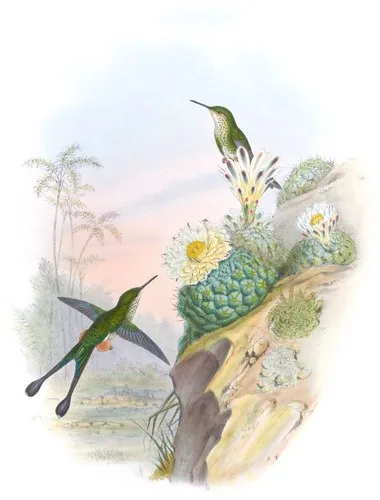
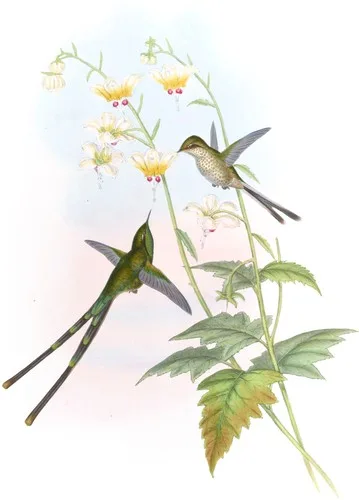
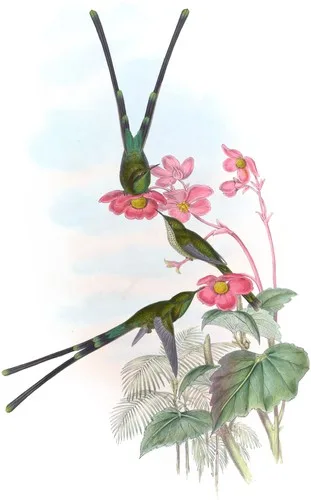
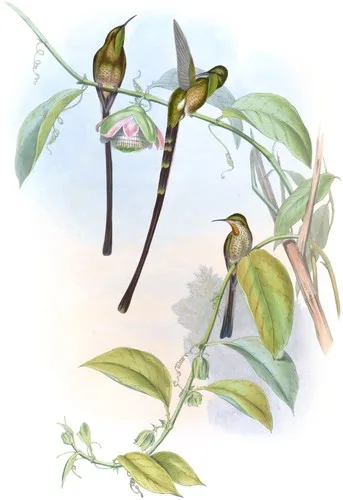
The male has the head green; back of the neck, back, and wing-coverts golden green; wings purplishbrown; rump, upper tail-coverts, and all but the two outer tail-feathers, resplendent grass-green; two outer tail-feathers dark brown for two-thirds of their length, the apical third glossed with green, increasing in brilliancy to the apex; throat luminous grass-green; remainder of the under surface golden green; bill black; feet brown.
The female has the whole of the upper surface golden green; the rump and central tail-feathers of a yellower green than in the male; and the outer feathers, which are not more than half the length of the corresponding feathers in the male, brown, with the basal two-thirds of the outer web, the shaft and the tip buffy grey; under surface grey, speckled with bronzy green.
The Plate represents the two sexes of the size of life. The plant is the Sobralia fragrans.
References
- Trochilus Gouldii, Lodd. in Proc. of Comm. of Sei. and Corr. of Zool. Soe., part ii. p. 7.
- Ornismya sylphia, Less. Rev. Zool. 1840, p. 73.
- Mellisuga Gouldii, Gray and Mitch. Gen. of Birds, vol. i. p. 118, Mellisuga, sp. 51.
- Cynanthus gouldi, Bonap. Consp. Gen. Av., p. 81, Cynanthus, sp. 4.—Ib. Rev. et Mag. de Zool. 1854, p. 252.
- Lesbia Gouldii, Reichenb. Aufz. der Colibris, p. 8.—Ib. Troch. enumer., p. 5. pl. dccxii. figs. 4615-4617.