Lesbia Nuna
篱笆豆粉蝶·Lesbia Nuna
Lesbia Nuna
Nouna-Koali
About this plate
Peru
No one point connected with the family of Humming-Birds has been more puzzling to the Trochilidist than the attempt to identify the species intended to be represented by Lesson on the 35th plate of the Supplement to his ‘Histoire Naturelle des Oiseaux-Mouches,’ and to which he has given the name of Nouna-Koali; unfortunately the typical specimen has been, I believe, irrecoverably lost, and, consequently, the matter can never be satisfactorily set at rest.
Lesson’s figure was evidently taken from a young bird, probably an immature Cynanthus smaragdinicaudus; this, at least, is my own impression,—an opinion not participated in by my French coadjutors, since they are inclined to think that M. Lesson’s plate represents a true Lesbia. M. Bourcier has sent me an example of a bird in a state of plumage which he considers to be that of the adult Nouna-Koali, but which I find to be identical with his Eucharis. My friend M. Edouard Verreaux has a bird in his collection which he considers to be the Nuna-Koali, but this again differs very materially from M. Bourcier’s Eucharis, and, indeed, from every other known Humming-Bird. In its affinities it is more nearly allied to the Lesbia Gouldi than to any other; but it is of much larger size, in which respect it approaches Eucharis and Amaryllis, but again differs from them in the form of the luminous throat-mark—a rounded gorget of brilliant green, precisely similar to the throat-mark in Lesbia Gouldi and L. gracilis; the three species form, in fact, one of the three or four small sections into which the fork-tailed Humming-Birds appear to be naturally divided. In one of these sections we have Phaon and Sparganurus, to which the generic name of Cometes has been assigned; in another, cyanurus and smaragdinicaudus, forming the genus Cynanthus; in the third, Amaryllis and Eucharis, constituting the genus Lesbia; and the fourth, for which no generic name has yet been proposed, comprising gracilis, Gouldi, and Nuna (the bird here represented).
With the exception of a female in my own collection (procured in Peru by M. Warszewicz), M. Verreaux’s bird, for which I retain the appellation Muna, is the only specimen I have ever seen; like my own, it was, I believe, received from Peru. It is an elegant and highly interesting species; its form graceful in the extreme. I trust that no disaster may befall M. Verreaux’s specimen, and that, as the type from which my figure was taken, it will be long and carefully preserved.
With regard to the name of Nouna-Koali, M. Lesson says,—“Son nom est celui d’une vierge américaine dont le touchant souvenir restera parmi les amis de la littérature, grâce à la suavité des charmes dont s’est plu à l’embellir la plume de notre ami Ferdinand Denis.” See his historical romance entitled ‘Ismaël Ben Kaïzar, ou la découverte du Nouveau Monde.’
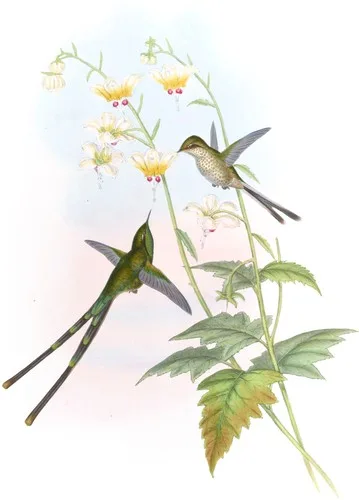
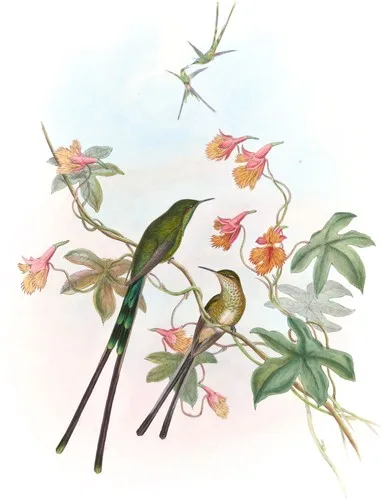
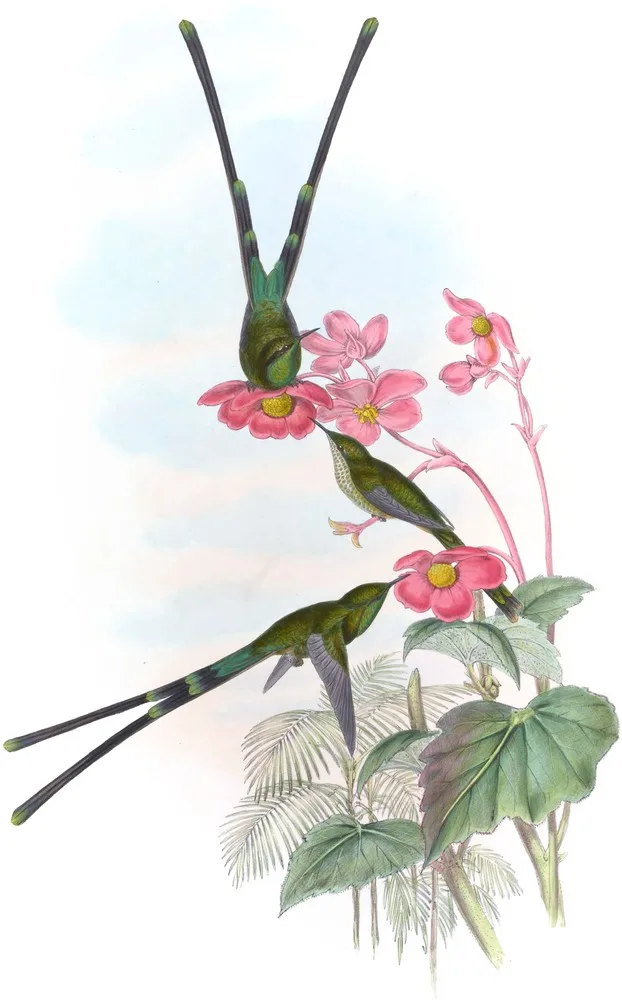
The male has the crown of the head, back, wing-coverts, sides of the neck, and abdomen dark bronzy green; on the throat a rounded gorget of brilliant metallic grass-green; wings purplish brown; all the tail-feathers dark purplish black at the base, the apical half of all but the two outer ones luminous grass-green; the outer feather on each side washed, on its apical part, with metallic green, which increases in intensity to the apex; these feathers, moreover, are edged with pale brown on the basal half of the outer web.
The female is similarly coloured to the male on the upper surface, but has a shorter and less brilliantly coloured tail; the under surface is white, spangled with brilliant green.
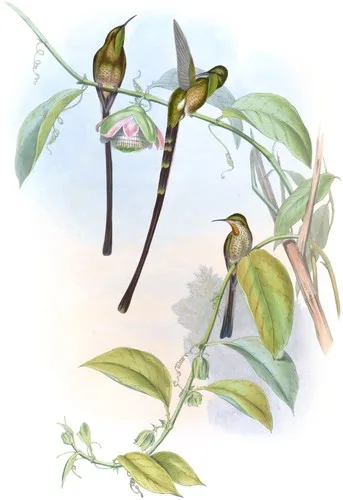
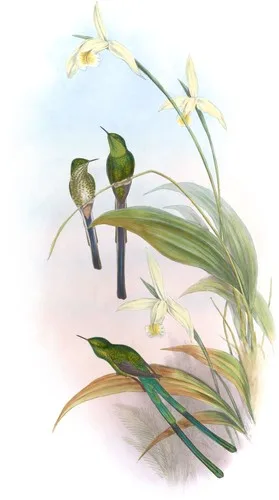
The Plate represents two males and a female, of the natural size. The plant is the Begonia cinnabarina.
References
- Ornismya Nuna, Less. Supp. des Ois.-Mou., p. 169. pl. 35?—Ib. Ind. Gen. et Syn. des Ois. du Gen. Trochilus, p. xvii?—lb. Rev. Zool. 1838, p. 314?, and 1839, p. 19?
Twelve ways of seeing
- upright 1.61 : 1
- published 1852
- Pl. 169, Vol. III
Not a catalogue entry but a way of looking: how to stand, what to notice, how the line was cut, when it flowers, where it came from, who made it — and then the poems and the classics that taught China to see the same flower. Read the twelve in order and the plate opens.
-
First Look
真山水之川谷,远望之以取其势,近看之以取其质。
—— 宋·郭熙《林泉高致·山水训》
Mountains and valleys: from afar take their momentum, up close take their texture — the two distances from which any picture is read.
The sheet is vertical: the eye climbs and settles on the bird. Take the posture before the plumage. Then step in close: watch where colour meets line, and whether the line ever breaks. Third, find the darkest small patch: the whole tonal order is measured from there.
-
Name and Thing
The binomial is Lesbia nuna: the first word is the genus it belongs among, the second the epithet that sets it apart. Two words carry a whole provenance. No established Chinese name exists, so it is cited by its binomial alone.
-
Form and Colour
The smallest of birds: a needle-fine bill, a forked tubular tongue, wings beating so fast the bird hovers and even flies backwards. Its colour is not pigment but structure — light bent by feather barbules, changing with the angle.No colour group is recorded. A single plant, laid out with nothing hidden.
-
Composition
Tall and narrow, the bird perched mid-branch with generous margins above and below. (about 1.61 : 1) No details are appended: a plate for looking, not for keying out. Old plates set the plant slightly off centre, with unequal margins — that small imbalance is what keeps it alive.
-
Line and Colour
In the later nineteenth century chromolithography took over: colour printed rather than painted, line demoted. Take a loupe to three places: petal edge, leaf vein, caption. An unbroken line means engraving; colour crossing the outline means a hand.
-
Season
In tropical America they are present all year, their season set by flowers; temperate hummingbirds follow the bloom north and back, thousands of kilometres a year. The year 1852 on the plate is that of publication, not of flowering — the gathering came a year or two earlier. The plate records ten days of peak; the other three hundred are leaf, fruit and rest.
-
Provenance
Americas only, from southern Alaska to Tierra del Fuego, richest in the Andes. China has no hummingbirds and no classical record of them; the name arrives with late-Qing travel writing. The localities on the plate are those of a century ago; plants travel and places change their names.
-
The Book and the Hand
“Gould's Hummingbirds” was drawn by John Gould and published 1849-1887. This plate is Pl. 169, Vol. III, book page 169. The image is public domain; the hand-colouring is still one person's hand.
-
Poetic Resonance
穿花蛱蝶深深见,点水蜻蜓款款飞。
—— 唐·杜甫《曲江二首》
Butterflies thread the flowers, seen deep within; dragonflies touch the water and fly on, slow and deliberate.
The poem gives the mood first and the picture supplies the form; set the line beside the plate and the bird itself becomes its resting point.
-
The Written Tradition
庭下如积水空明,水中藻荇交横,盖竹柏影也。
—— 宋·苏轼《记承天寺夜游》
The courtyard seemed flooded with clear water, weeds crossing in it — in fact the shadows of bamboo and cypress.
Gould's Hummingbirds (1849–1887) used hand-coloured lithography over gold leaf so the iridescence survived on paper — a monument to Victorian printing and collecting alike. You need not parse every word: take the line, and the flower acquires a second face.
-
Symbolism
For the Aztecs the hummingbird was warrior and sun; for Victorian Europe it was the ultimate ornament, millions killed for breast jewellery. China has no tradition here — and that blank is itself a history of exchange. In a flora it is a species first and a symbol second; the order is worth keeping.
-
What to Take Away
Appreciation is not knowledge but habit — one more look each time. A flora exists to be consulted; look long enough and you forget to consult — someone in 1852 gave a whole day to a single flower.