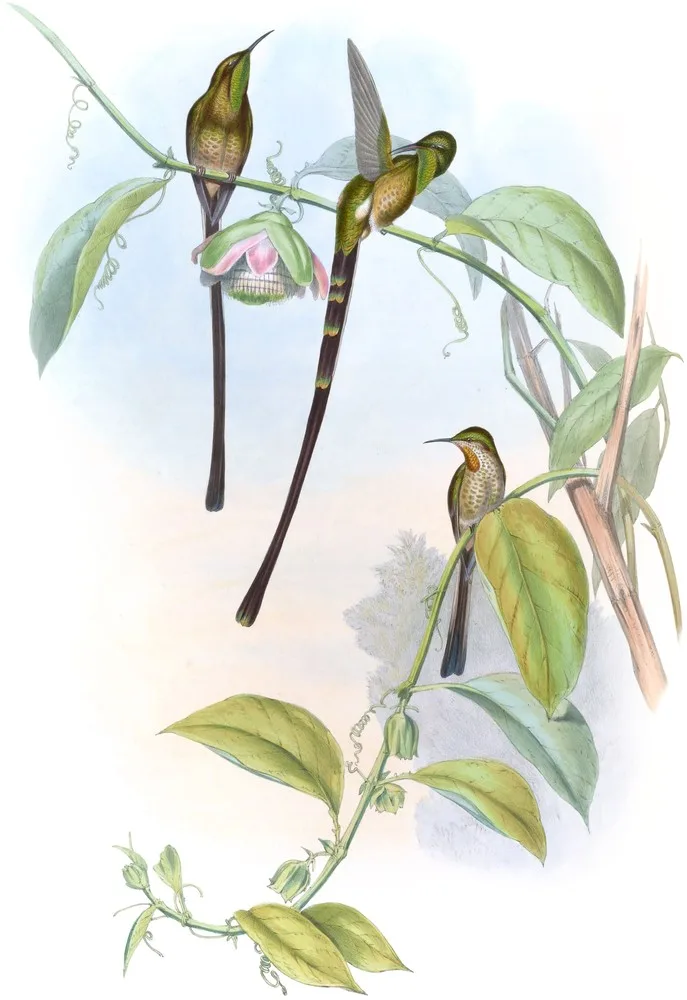
Lesbia Amaryllis
篱笆豆粉蝶·Lesbia Amaryllis
Lesbia Amaryllis
Train-bearer
Ten ways of seeing
- upright 1.46 : 1
First Look
竖划三寸,当千仞之高;横墨数尺,体百里之迥。
—— 南朝宋·宗炳《画山水序》
A vertical stroke of three inches stands for a cliff of a thousand fathoms; a few feet of ink holds a hundred li.
The sheet is vertical: the eye climbs and settles on the bird. Take the posture before the plumage. Then step in close: watch where colour meets line, and whether the line ever breaks. Third, find the darkest small patch: the whole tonal order is measured from there.
Name and Thing
The binomial is Lesbia amaryllis: the first word is the genus it belongs among, the second the epithet that sets it apart. Two words carry a whole provenance. No established Chinese name exists, so it is cited by its binomial alone.
Form and Colour
The smallest of birds: a needle-fine bill, a forked tubular tongue, wings beating so fast the bird hovers and even flies backwards. Its colour is not pigment but structure — light bent by feather barbules, changing with the angle.No colour group is recorded. A single plant, laid out with nothing hidden.
Composition
Tall and narrow, the bird perched mid-branch with generous margins above and below. No details are appended: a plate for looking, not for keying out. Old plates set the plant slightly off centre, with unequal margins — that small imbalance is what keeps it alive.
Line and Colour
In the later nineteenth century chromolithography took over: colour printed rather than painted, line demoted. Craft leaves franker evidence than inscriptions. If you mean to copy it: block in the broad shapes and colours first, detail last; lithographic softness comes from thin washes — two or three pale layers will get you close.
Poetic Resonance
夫列子御风而行,泠然善也,旬有五日而后反。
—— 《庄子·逍遥游》
Liezi rode the wind and came back after fifteen days, so light was his going.
The poem gives the mood first and the picture supplies the form; set the line beside the plate and the bird itself becomes its resting point.
Symbolism
For the Aztecs the hummingbird was warrior and sun; for Victorian Europe it was the ultimate ornament, millions killed for breast jewellery. China has no tradition here — and that blank is itself a history of exchange. Meanings change their tune: the same flower can say opposite things within a century.
Season and Place
In tropical America they are present all year, their season set by flowers. Americas only, from southern Alaska to Tierra del Fuego, richest in the Andes. China has no hummingbirds and no classical record of them. The year 1852 on the plate is that of publication, not of flowering — the gathering came a year or two earlier. Much of what that generation knew of such birds came from specimens and cages; read locality and season both as hearsay.
The Book and the Hand
“Gould's Hummingbirds” carries only John Gould's name. The image is public domain; the hand-colouring is still one person's hand.
What to Take Away
Next time you watch a bird: posture first, then where the plumage is deepest, and only then the field guide. Two centuries on, the plant may still flower in some garden; the one on this sheet stopped in the season of 1852.
About this plate
New Granada, Ecuador, and Peru
It must, I think, be apparent to every one who has studied natural history, that in every true genus some one character or set of characters predominates over the rest; and I may remark that in no department of this branch of science is this feature more conspicuous than among birds, where, in addition to some distinctive character being common to all the species of a genus, we frequently find that character carried in one or other of them to an extent far greater than in any of the others.
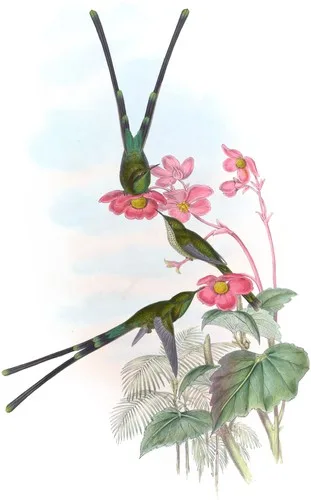
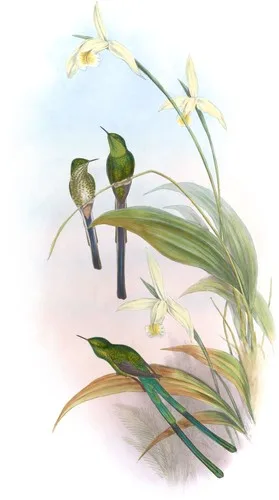
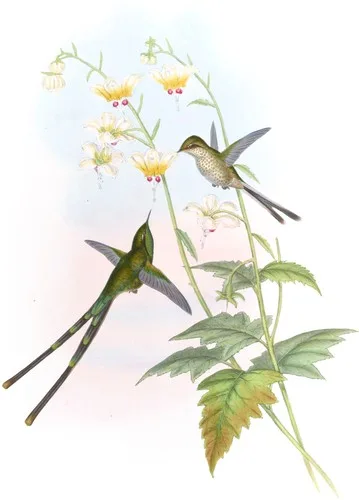
In the genus Lesbia, the dominant feature is the great development of the tail-feathers, and it would appear to be carried to the utmost extent in the Lesbia Amaryllis, the feathers being very much longer in that species than in any other.
The native country of this singularly graceful bird, as well as of every other member of the genus, is the temperate regions of the Andes, for about ten degrees on each side of the equator. The Lesbia Amaryllis may be said to be strictly equatorial, being most abundant in Ecuador; its range, however, extends southward to Peru and northward to Bogota; in all the countries within this area, wherever situations favourable to its existence occur, it is to be found. Professor Jameson states that it frequents the gardens in the city of Quito, and is so familiar a bird that it is well known to every one. Mr. Mark, Her Majesty’s Consul at Bogota, tells me that it is equally common in Bogota; that it was a daily visitor in the garden of his house, and was particularly fond of searching the flowers of the scarlet geraniums after a shower; if not frightened, it would then rest itself upon the plants and shrubs close to the window; when poised in the air with outspread tail, the rapid motion of its wings made a loud humming noise.
Like many other members of the family, this bird is very pugnacious, and frequent combats take place between the males whenever one intrudes into the domain of another, the contest being carried on in the air, and the combatants rising, falling, and continuing to fight after the manner described by Mr. Gosse when speaking of Lampornis Mango, in his interesting “Birds of Jamaica.”
The female differs very considerably from the male both in size and colouring, and in the lesser development of the outer tail-feathers.
Among the numerous specimens sent to this country, young male examples may be found in every state of change from youth to maturity.
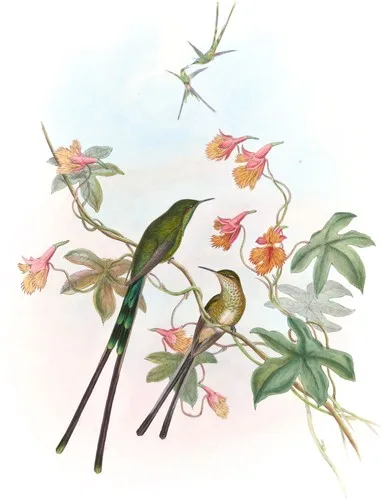
The male has the crown of the head, upper surface, wing-coverts, sides of the neck and under surface golden green; on the chin and throat a lengthened patch of brilliant metallic yellowish green; wings purplish brown; tail-feathers dull black, each tipped with rich greenish bronze; basal portion of the under surface of the shafts of the outer feathers brownish white; vent and under tail-coverts buff.
The very old female has the upper surface golden green; tail-feathers shorter than those of the male, and the shaft and external web of the outer one buff for two-thirds of its length from the base; down the centre of the throat a patch of brilliant metallic orange, on each side of which is a double row of brilliant green spots on a white ground; feathers of the chest greyish white with a spot of brilliant green at the tip of each.
In the young males the general colouring resembles that of the adult, but the throat-mark is merely indicated by a few specks of brilliant green on a buffy-grey ground, and the tail-feathers are much less developed.
The figures represent two males and a female on a species of Passiflora, of the natural size.
References
- Trochilus Amaryllis, Boure. et Muls. Rev. Zool. 1848, p. 273.—Gray and Mitch. Gen. of Birds, vol. ni. Supp. App. 30a, App. to p. 103.
- Cynanthus amaryllis, Bonap. Consp. Troch. in Rey. et Mag. de Zool. 1854, p. 252.