Spathura melananthera
Spathura melananthera
Ecuadorian Racket-tail
- 学名
- Spathura melananthera
- 合集
- 古尔德蜂鸟图谱
- 绘者
- John Gould(约翰·古尔德)
- 年代
- 1852
- 图版号
- Pl. 163, Vol. III
- 原书页码
- p.163
- 授权
- CC0 1.0 Universal (Public domain)
十观
- 略纵 1.23∶1
第一眼
竖划三寸,当千仞之高;横墨数尺,体百里之迥。
—— 南朝宋·宗炳《画山水序》
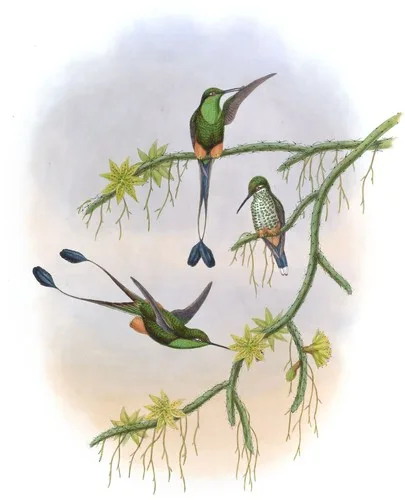
三寸的竖线可当千仞高山,几尺横墨能容百里之远。尺幅从来不是障碍,取舍才是本事。这一幅略高于宽,落点在中央偏上那只鸟的头部。第二步凑近一寸:看线与色的交界,色有没有压住线,线有没有断。第三步,把视线放到最深的那一小块:整幅的用色秩序,都是从那里排开的。
名与实
学名 Spathura melananthera:前一词是属,管它归在哪一类;后一词是种加词,管它在这一类里凭什么与众不同。名字是通行证,也是懒办法——记住两个词,就抓住了一整个物种。此幅尚无通行中文名,姑以学名相称;在没有本地名字的地方,学名就是它唯一的身份证。
形与色
蜂鸟为美洲最小之鸟,喙细长如针,舌分叉成管,可伸入花心吸蜜;翼小而振频极高,能悬停、能倒飞。此幅未作色相归档,只能就形制论。看羽:先看覆羽的层次,再看飞羽的排列,最后才看颜色——颜色是最后才被注意到的部分。
构图与呼吸
画幅略高于宽,鸟身居中偏上,视线落在头部与喙。全幅只画一只,不作解剖附图——这类图更近于“观赏”,而非“鉴定”。试着用拇指遮住空白处——画面立刻变闷;放开,它才重新“喘上气”。留白,是给主体让出的气口。
一刀一色
十九世纪后半叶,石版与彩色石印渐成主流:颜色可以直接印出,不再依赖手工,线条反倒退居其次。图像的“准确”提高了,手性却淡了。还有一种证据在纸背:铜版压进纸里的那道痕、上色处微微凸起的颜料、再版时磨浅的线。扫描件里也能看出七分。想动笔临它的人记住一句:先铺大块的形与色,干后再收细部;石印的柔和层次来自薄涂与网点,水彩分两三遍淡铺即可逼近。
诗境
夫列子御风而行,泠然善也,旬有五日而后反。
—— 《庄子·逍遥游》
蜂鸟悬停于空,不落不飞,最近于“御风”。庄子说的是一种自由的姿态,蜂鸟把它做成了生理事实。诗以气行,画以形立;两种“看”叠在一起,才是看画的意思。
花语
阿兹特克以蜂鸟为战神与太阳的化身;欧洲维多利亚时代则以蜂鸟为收藏与装饰的极致,百万只羽毛被做成胸饰。中国旧籍无此鸟,故无象征——这空白本身,就是一部博物学交流史。花语是后人添上去的,花本身并不知道;但这层“不知道”,正是它最动人的地方。
时与地
温带种类的蜂鸟则随花北迁,一年往返数千公里。仅产美洲,自阿拉斯加南部至火地岛,以安第斯山最为繁盛。中土无蜂鸟,汉籍不载,晚清海外游记始见其名。图上所记的 1852 年是刊行之年,不是采到那只鸟的年份;真正的观察记录通常比出版早一两年。那一代人对这类鸟的知识,多半来自标本与笼养。看这一类图,不妨把产地和季节都当“据说”来读。
书与人
《古尔德蜂鸟图谱》只署了约翰·古尔德一个人的名字。版画是集体工程:绘图、刻版、上色各有其人,真正决定这幅图好不好看的,常是没留下名字的刻工与上色师。
带走一双眼睛
如果只能记一句,就记郭熙那八个字:远望取其势,近看取其质。看图、看花、看人,都一样。图谱的用意是“以备查考”,看久了却会忘记查考:1852 年的一个人,为一只鸟花了整整一天。
关于本图版
这幅图版出自《古尔德蜂鸟图谱》(Gould's Hummingbirds),由约翰·古尔德绘制,1849—1887 年间出版。图中描绘的是 Spathura melananthera,归入蜂鸟科(Trochilidae)。
全编共收录 421 幅图版,本图是其中一幅,原书将其列为 Pl. 163, Vol. III,见第 163 页,版式为纵幅。扫描件取自公有领域原件,经高分辨率修复与色彩校正,可按原大放大查看线条与设色。
原书文字(英文 / 法文)
Ecuador
It is to Sir William Jardine, Bart., that the credit is due of giving the first description of this very distinct species of Spathura, which appears to take the place in Ecuador of the more generally known S. Underwood so commonly sent from Bogota in Columbia.
Both these birds are hill species, and both doubtless have similar habits and economies. The S. melananthera differs from S. Underwoodi in being of a smaller size, and in the form of the spatules, those of the former being shorter and more club-shaped than those of the latter; there is also a difference in the colouring of the spatules, those of the smaller bird frequently having a tinge of shining green pervading them, while the colour of those of S. Underwoodi is steel-blue; the S. melananthera has also a broad black band on the throat, while the corresponding mark in S. Underwoodi is smaller and often almost obsolete. The greatest difference, however, occurs in the females of the two species; the breast and centre of the abdomen of that sex being pure white in S. melananthera, while the same parts in the female of S. Underwoodi are spangled with green.
All the specimens of S. melananthera I have seen are from Ecuador, whence they have been sent by Professor Jameson and Mr. Fraser.
Sir William Jardine, when first describing this species in his “Contributions to Ornithology for 1851,” says,
The last post from Quito brought us some Humming-birds which were of great interest; among them was one belonging to the subgroup which has been called Spathura, and of which the beautiful species S. Underwoodii, with its white boots and racket-tail, has been considered typical. This species, figured in the only Number yet published of Mr. Gould’s Monograph, is found in the neighbourhood of Santa Fé de Bogota, and in Galipan, between La Guayra and the Caraccas, at an elevation of from 5000 to 9000 feet. Of the specimen lately received, Professor Jameson writes (considering it to be S. Underwoodii),—“I am not aware of its being hitherto met with to the south of the equator.” Along with a true S. Underwoodii, Mr. Gould had enclosed a female of a Spathura with an unspotted breast, with an opinion that the male of the latter would prove distinct; and on comparing the Quitian birds with these and the figure and description in the Monograph, there appears to be a considerable difference. The proportions and tints vary, and the large space of black on the chin and maxilla is very marked. We are not aware whether M. Bourcier has noticed it, and an examination of more specimens must decide whether it be only a local variety; but meanwhile we have applied the above specific name quite provisionally, until the point as to species is cleared up, and give a description from the specimen before us.
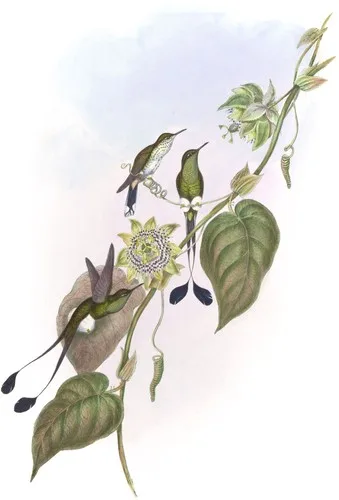
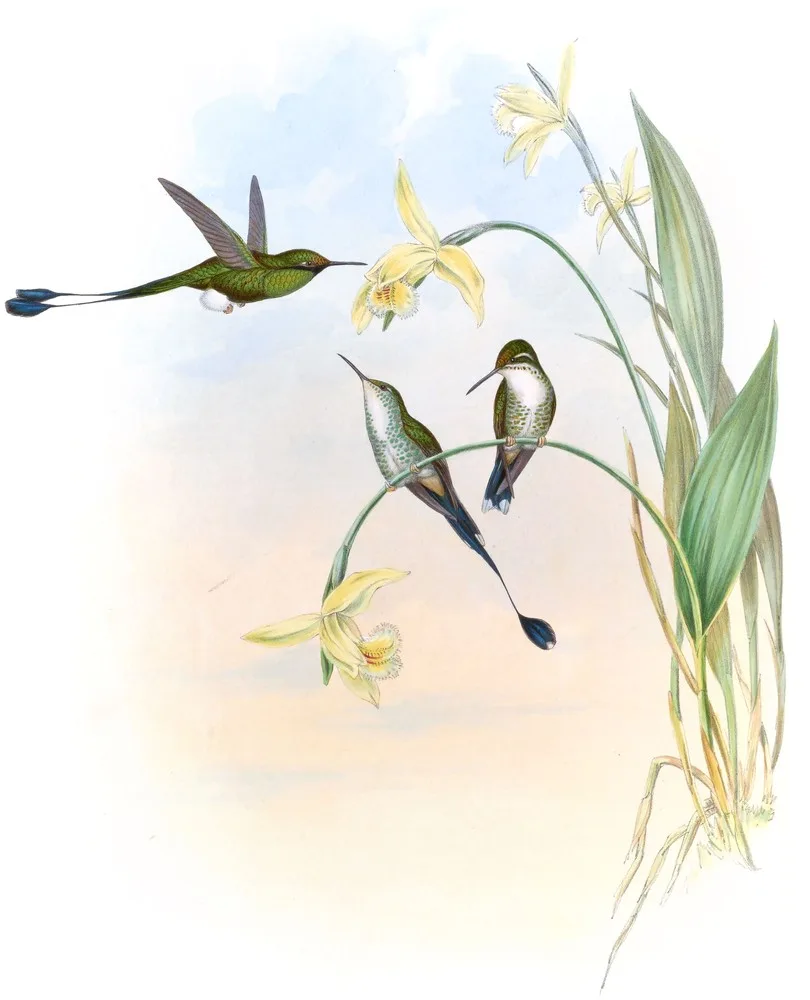
Male, above green, bronzed on the upper tail-coverts; wings purplish black; tail bronzy green, the long exterior feathers black, the spatulate ends velvet-black, with rich green reflexions below; chin and maxilla velvet-black; centre of the throat and stretching round below the auriculars, with the sides of the neck, emerald-green, forming a brilliant gorget; belly and vent green; boots large and pure white.
Female, above green, much bronzed on the whole of the crown; tail slightly forked; the outer feather tipped with white, the second with only a slight indication of it; below pure white; flanks green, with a few spots on the sides of the belly; under tail-coverts pale sienna-brown.
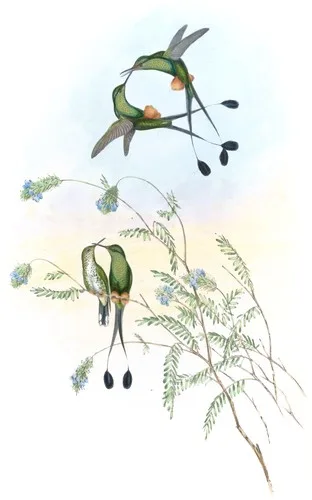
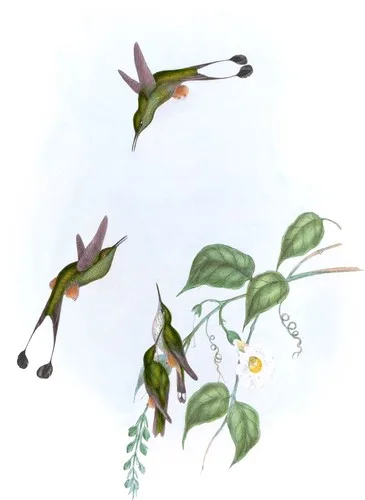
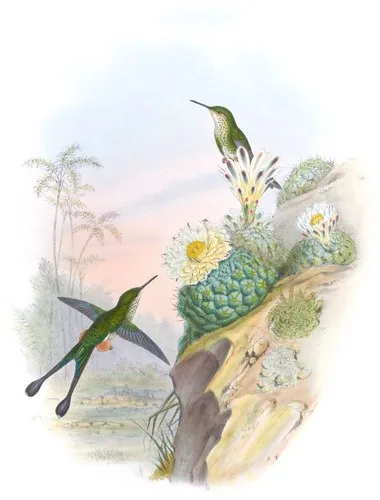
The figures represent both sexes of the size of life. The plant is the Sobrahli fragrans.
References
- Trochilus (Spathura) melananthera, Jard. Cont. to Orn. 1851, p. 111. pl. lxxx.
- Steganura melananthera, Reich. Auf. der Col., p. 8.
- Discura melananthera, Bonap. Rev. Zool. 1854, p. 256.