Thalurania? Wagleri
Thalurania? Wagleri
Wagler’s Wood-Nymph
Ten ways of seeing
- upright 1.45 : 1
First Look
六法者何?一、气韵生动是也;二、骨法用笔是也;三、应物象形是也;四、随类赋彩是也;五、经营位置是也;六、传移模写是也。
—— 南齐·谢赫《古画品录》
The six laws: spirit resonance alive; bone-method in the brush; matching form; colour by kind; planning the placing; copying the masters.
The sheet is vertical: the eye climbs and settles on the bird. Take the posture before the plumage. Then step in close: watch where colour meets line, and whether the line ever breaks. Third, find the darkest small patch: the whole tonal order is measured from there.
Name and Thing
No reliable binomial survives, so the printed title must serve. Neither name nor binomial survives: the printed title must do.
Form and Colour
The smallest of birds: a needle-fine bill, a forked tubular tongue, wings beating so fast the bird hovers and even flies backwards. Its colour is not pigment but structure — light bent by feather barbules, changing with the angle.No colour group is recorded. Three things fix the habit: leaf arrangement, tepal count, and how the flower is borne.
Composition
Tall and narrow, the bird perched mid-branch with generous margins above and below. No details are appended: a plate for looking, not for keying out. Cover the margins with your thumb and the plate suffocates; uncover them and the flower breathes again.
Line and Colour
In the later nineteenth century chromolithography took over: colour printed rather than painted, line demoted. Craft leaves franker evidence than inscriptions. If you mean to copy it: block in the broad shapes and colours first, detail last; lithographic softness comes from thin washes — two or three pale layers will get you close.
Poetic Resonance
穿花蛱蝶深深见,点水蜻蜓款款飞。
—— 唐·杜甫《曲江二首》
Butterflies thread the flowers, seen deep within; dragonflies touch the water and fly on, slow and deliberate.
The poem gives the mood first and the picture supplies the form; set the line beside the plate and the bird itself becomes its resting point.
Symbolism
For the Aztecs the hummingbird was warrior and sun; for Victorian Europe it was the ultimate ornament, millions killed for breast jewellery. China has no tradition here — and that blank is itself a history of exchange. Meanings change their tune: the same flower can say opposite things within a century.
Season and Place
In tropical America they are present all year, their season set by flowers. the name arrives with late-Qing travel writing. The year 1850 on the plate is that of publication, not of flowering — the gathering came a year or two earlier. Read the locality and the flowering season both with a discount: one is hearsay, the other a ten-day peak.
The Book and the Hand
“Gould's Hummingbirds” carries only John Gould's name. A plate is collective work: drawer, engraver and colourist were different hands, and the unnamed ones decided how good it looks.
What to Take Away
Appreciation is not knowledge but habit — one more look each time. Two centuries on, the plant may still flower in some garden; the one on this sheet stopped in the season of 1850.
About this plate
Brazil
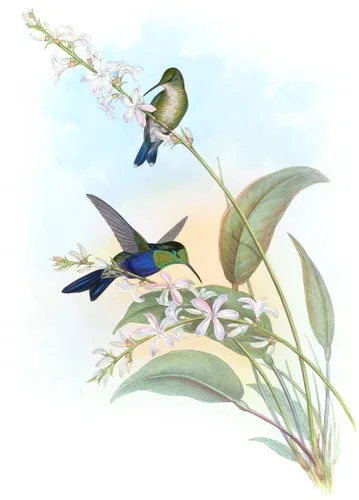
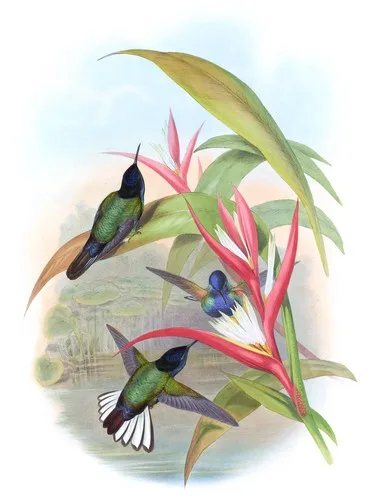
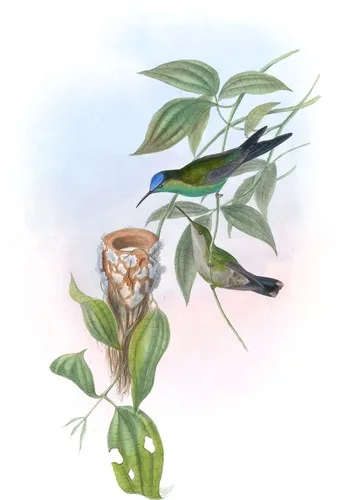
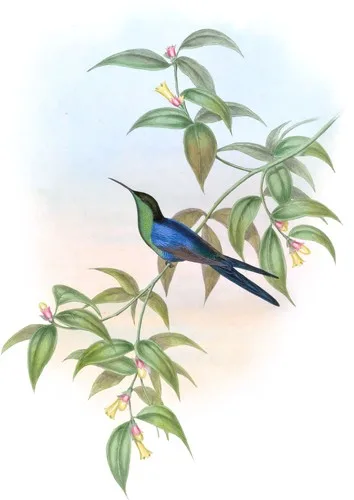
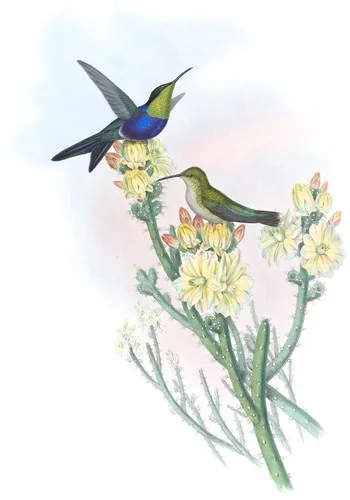
It has long been a question with me, as I am sure it must have been with every person who has made the Trochilidæ their study, to which genus of the family this species should be assigned: some Trochilidists may hereafter go so far as to separate it from all the genera at present proposed, and make it the type of a new one; but, after an examination of the female, which I have lately received through the kindness of M. Bourcier, I have little hesitation in associating it with the other Wood-Nymphs of the genus Thalurania, a genus comprising many species widely dispersed over the continent of America.
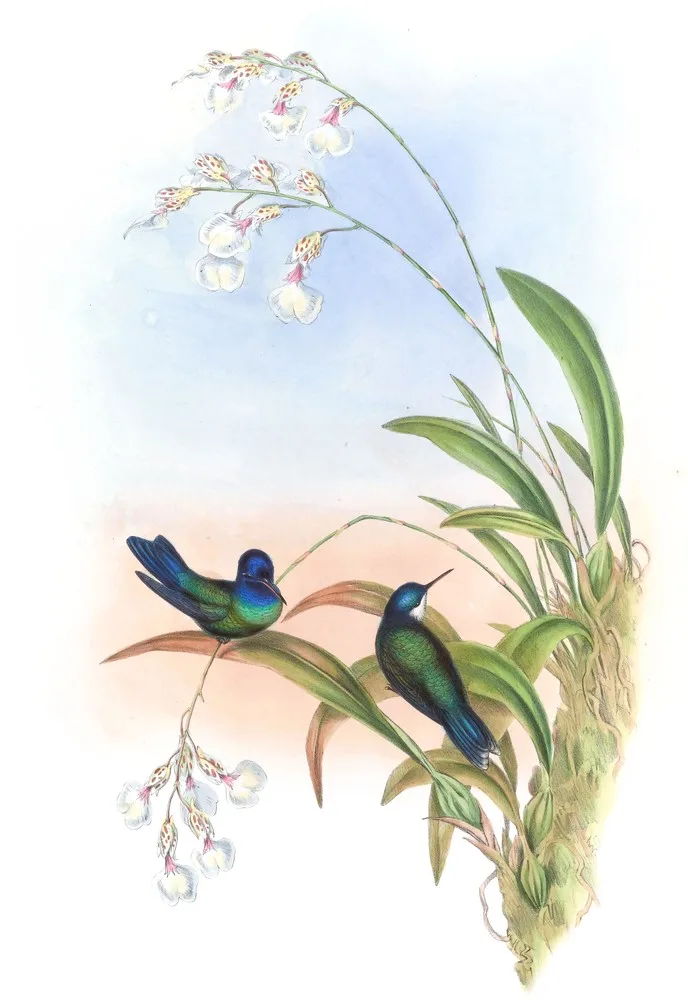
The present bird is the only one of them that has the throat and the crown of the head blue. Its native habitat is the northern part of Brazil, but it may perhaps visit Guiana. It is by no means a common bird, and unfortunately most of the specimens hitherto sent to Europe have been more or less defective.
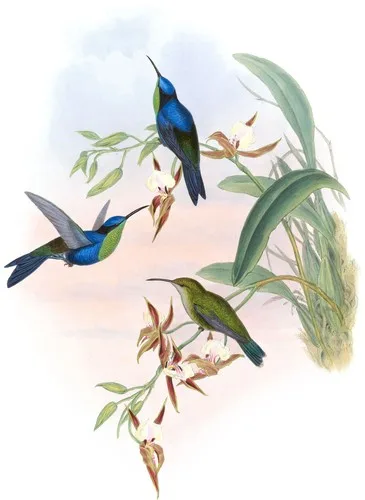
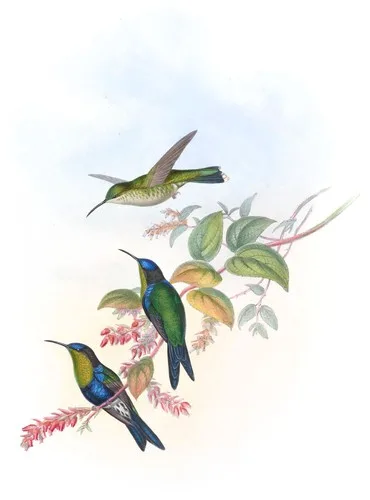
The male has the crown of the head, face, chin and throat very rich deep blue; all the upper surface and wing-coverts shining bronzy-green; under surface shining dark grass-green; wings very dark purplishbrown; upper tail-coverts and tail very dark steel-blue; bill black; the basal portion of the under mandible fleshy.
The female has the crown of the head and greater wing-coverts green; upper surface and lesser wingcoverts bronzy-green; upper tail-coverts bluish-green; wings purplish-brown; tail steel-blue glossed with green, and the two outer feathers on each side tipped with white; lores and ear-coverts brown; under surface brownish-white, washed with bronze on the flanks; upper mandible dark brown; under mandible fleshy-brown.
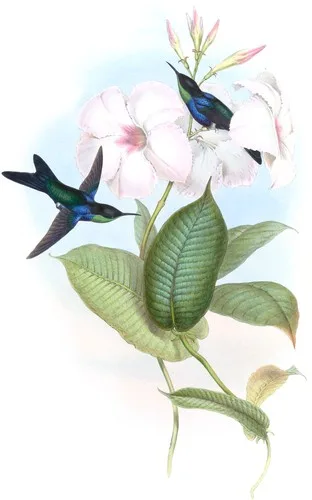
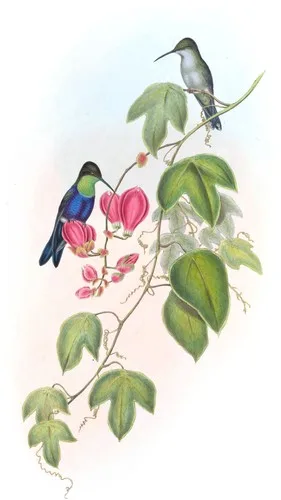
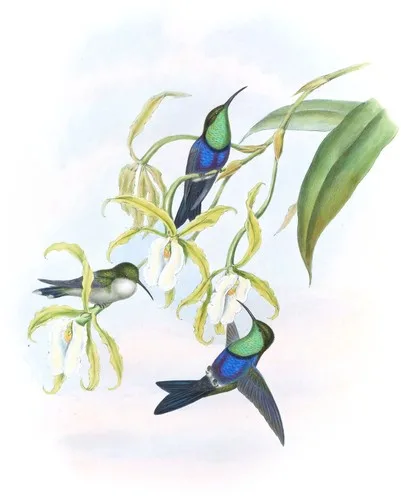
The Plate represents the two sexes of the natural size. The plant is the Burlingtonia decora.
References
- Ornismya Waglerii, Less. Hist. Nat. des Ois. Mou., p. 203. pl. 73.—Ib. Traité d’Orn., p. 274.— Ib. Ind. Gen. et Syn. des Ois. du gen. Trochilus, p. xxi.
- Le Saphir-émeraude, Aud. et Vieill. Ois. dor., tom. i. p: 79. pl. 36.
- Trochilus Waglerii, Sard. Nat. Lib. Humming Birds, vol. ii. p. 83. pl. 16.
- Cynanthus Waglerii, Jard. Nat. Lib. Humming Birds, vol. ii. p. 147.
- Hylocharis Wagleri, Gray and Mitch. Gen. of Birds, vol. i. p. 114, Hylocharis, sp. 14.
- Thalurania Wagleri, Bonap. Consp. Gen.sAv., p. 77, Thalurania, sp. 6.—Reichenb. Aufz. der Col., p. 7.—Bonap. Rev. et Mag. de Zool. 1854, p. 254.