Thaumastura enicura
矛尾蜂鸟属
Thaumastura enicura
Slender Shear-tail
Ten ways of seeing
- upright 1.36 : 1
First Look
搜尽奇峰打草稿。
—— 清·石涛《苦瓜和尚画语录》
Exhaust the strange peaks, and then make the sketch.
The sheet is vertical: the eye climbs and settles on the bird. Take the posture before the plumage. Then step in close: watch where colour meets line, and whether the line ever breaks. Third, find the darkest small patch: the whole tonal order is measured from there.
Name and Thing
The binomial is Thaumastura enicura: the first word is the genus it belongs among, the second the epithet that sets it apart. Two words carry a whole provenance. The Chinese name 矛尾蜂鸟属 is a modern rendering of the Latin, not an old garden name.
Form and Colour
The smallest of birds: a needle-fine bill, a forked tubular tongue, wings beating so fast the bird hovers and even flies backwards. Its colour is not pigment but structure — light bent by feather barbules, changing with the angle.No colour group is recorded. A single plant, laid out with nothing hidden.
Composition
Tall and narrow, the bird perched mid-branch with generous margins above and below. No details are appended: a plate for looking, not for keying out. Cover the margins with your thumb and the plate suffocates; uncover them and the flower breathes again.
Line and Colour
In the later nineteenth century chromolithography took over: colour printed rather than painted, line demoted. Decide first whether it was printed or painted; only then discuss whether it is beautiful. If you mean to copy it: block in the broad shapes and colours first, detail last; lithographic softness comes from thin washes — two or three pale layers will get you close.
Poetic Resonance
穿花蛱蝶深深见,点水蜻蜓款款飞。
—— 唐·杜甫《曲江二首》
Butterflies thread the flowers, seen deep within; dragonflies touch the water and fly on, slow and deliberate.
The poem gives the mood first and the picture supplies the form; set the line beside the plate and the bird itself becomes its resting point.
Symbolism
For the Aztecs the hummingbird was warrior and sun; for Victorian Europe it was the ultimate ornament, millions killed for breast jewellery. China has no tradition here — and that blank is itself a history of exchange. In a flora it is a species first and a symbol second; the order is worth keeping.
Season and Place
temperate hummingbirds follow the bloom north and back, thousands of kilometres a year. Americas only, from southern Alaska to Tierra del Fuego, richest in the Andes. China has no hummingbirds and no classical record of them. The year 1852 on the plate is that of publication, not of flowering — the gathering came a year or two earlier. Read the locality and the flowering season both with a discount: one is hearsay, the other a ten-day peak.
The Book and the Hand
“Gould's Hummingbirds” carries only John Gould's name. The image is public domain; the hand-colouring is still one person's hand.
What to Take Away
Carry three rules away: whole before detail; line before colour; picture before book. Two centuries on, the plant may still flower in some garden; the one on this sheet stopped in the season of 1852.
About this plate
Guatemala
Although Lesson and other authors have stated Brazil to be the native country of this elegant species, it is quite certain that Central America is its true and natural habitat, most of the specimens forwarded to Europe having been sent from Guatemala.
I have no evidence that it is found to the south of the Isthmus of Panama, and that it does not extend beyond the eighteenth degree northwards is almost certain; my own opinion is that its range is confined to the warmer and temperate region of Guatemala and Yucatan, where in all probability it is stationary or non-migratory, its diminutive wing being ill-adapted for the performance of extensive journeys.
The form of this species is as delicate and symmetrical as its colours are chaste and harmoniously blended; and this remark is equally applicable to both sexes, which, however, are so remarkably different in colouring, that their belonging to the same species might justly be doubted, if we had not positive evidence that such is the case. Don Constancia has kindly sent me a male and a stuffed female, sitting on her tiny nest, and gives me his positive authority upon the foregoing point.
In its deeply forked and singularly formed tail, this species differs from all its congeners. The Prince of Canino considers the Trochilus Swainsonii of Lesson to be the female of this bird; and in the absence of any proof to the contrary, I coincide in the Prince’s view.
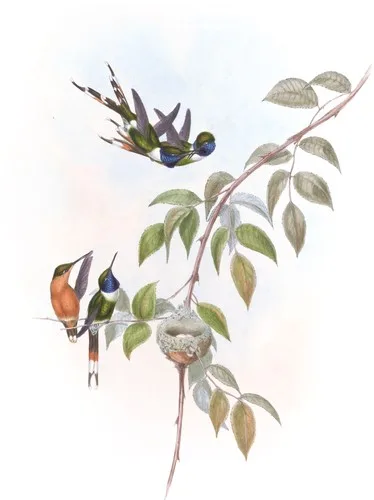
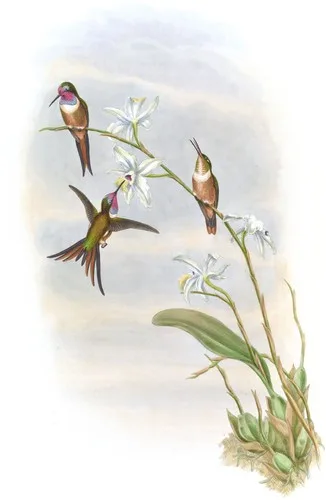
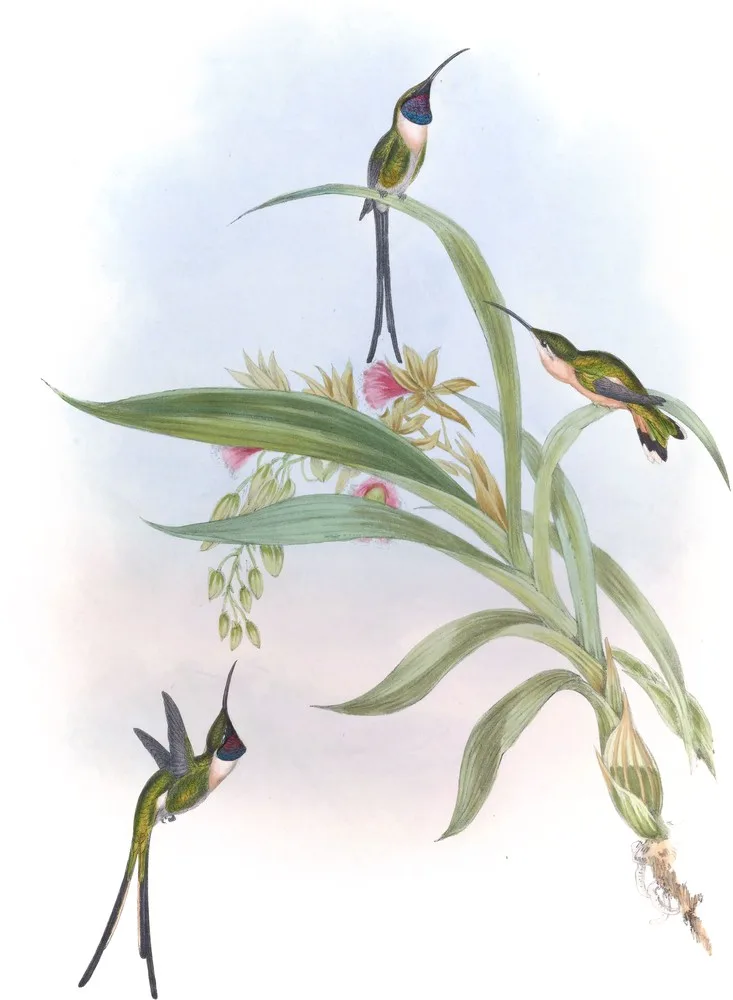
Upper surface deep shining green, tinged with brown on the head, and with a rich bronzy lustre on the back and wing-coverts; wings purplish brown; tail purplish black, the inner webs of the two outer feathers sometimes narrowly margined with brown; chin black, glossed with green; throat deep rich metallic purple, below which is a very broad crescentic mark of buff; under surface bronzy green with a spot of buff on the flanks; across the lower part of the abdomen an irregular band of white; centre of the abdomen dark grey; under tail-coverts greenish; bill and feet blackish brown.
The female has the whole of the head, upper surface, wing-coverts, upper tail-coverts, and four middle tail-feathers bronzy green; wings purple-brown; on each side of the back a patch of white; under surface rufous fading into a paler tint on the chin; two outer tail-feathers on each side rufous at the base, to which succeeds a broad band of black, the tip being white; the third feather on each side rufous at the base, and largely tipped with black.
The Plate represents two males and a female, on a branch of one of the fine Orchids of Guatemala.
References
- Trochilus enicurus, Vieill. Nouy. Dict. d’ Hist. Nat., 2nde Edit., tom. xxii. p. 429.—Ib. Ency. Méth. Orn., part 1. p. 560.—Temm. Pl. Col. 66, fig. 3.—Jard. Nat. Lib. Humming-Birds, vol. i. p. 145. pl. 27.
- Ornismya heteropygia, Less. Hist. Nat. des Ois. Mou., p. 72. pl. 15.
- Trochilus Swainsonti, Less. Les Troch., p. 167. pl. 66, female.
- Calothorax enicurus, Bonap. Consp. Gen. Av., p. 85, Calothorax, sp. 7.