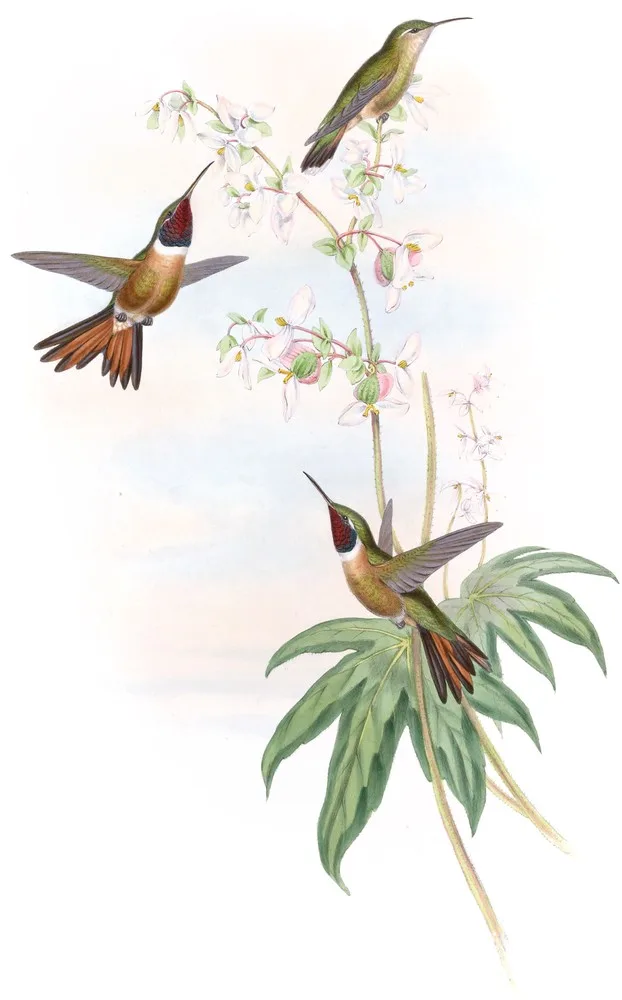
Thaumastura Evelynæ / Calothorax Evelynæ
Thaumastura Evelynæ / Calothorax Evelynæ
Bahama Wood-star
Ten ways of seeing
- upright 1.61 : 1
First Look
凡画山水,意在笔先。
—— 唐·王维《山水论》
In painting, the intention precedes the brush.
The sheet is vertical: the eye climbs and settles on the bird. Take the posture before the plumage. Then step in close: watch where colour meets line, and whether the line ever breaks. Third, find the darkest small patch: the whole tonal order is measured from there.
Name and Thing
Only the genus Calothorax is given; species-level names came later. No established Chinese name exists, so it is cited by its binomial alone.
Form and Colour
The smallest of birds: a needle-fine bill, a forked tubular tongue, wings beating so fast the bird hovers and even flies backwards. Its colour is not pigment but structure — light bent by feather barbules, changing with the angle.No colour group is recorded. Read the outline, then the colour layers, then the brush.
Composition
Tall and narrow, the bird perched mid-branch with generous margins above and below. No details are appended: a plate for looking, not for keying out. Old plates set the plant slightly off centre, with unequal margins — that small imbalance is what keeps it alive.
Line and Colour
In the later nineteenth century chromolithography took over: colour printed rather than painted, line demoted. There is evidence on the back too: the plate mark pressed into the paper, the slight relief of the pigment, lines worn shallow in a later printing. If you mean to copy it: block in the broad shapes and colours first, detail last; lithographic softness comes from thin washes — two or three pale layers will get you close.
Poetic Resonance
夫列子御风而行,泠然善也,旬有五日而后反。
—— 《庄子·逍遥游》
Liezi rode the wind and came back after fifteen days, so light was his going.
The poem gives the mood first and the picture supplies the form; set the line beside the plate and the bird itself becomes its resting point.
Symbolism
For the Aztecs the hummingbird was warrior and sun; for Victorian Europe it was the ultimate ornament, millions killed for breast jewellery. China has no tradition here — and that blank is itself a history of exchange. Flower language was added later; the flower knows nothing of it, and that innocence is part of its power.
Season and Place
temperate hummingbirds follow the bloom north and back, thousands of kilometres a year. Americas only, from southern Alaska to Tierra del Fuego, richest in the Andes. China has no hummingbirds and no classical record of them. The year 1852 on the plate is that of publication, not of flowering — the gathering came a year or two earlier. Much of what that generation knew of such birds came from specimens and cages; read locality and season both as hearsay.
The Book and the Hand
“Gould's Hummingbirds” carries only John Gould's name. A plate is collective work: drawer, engraver and colourist were different hands, and the unnamed ones decided how good it looks.
What to Take Away
Carry three rules away: whole before detail; line before colour; picture before book. A flora exists to be consulted; look long enough and you forget to consult — someone in 1852 gave a whole day to a single flower.
About this plate
Bahama Islands
To be aware of the existence of a Humming-Bird on the principal of the Bahama Islands, and to fail in every attempt to procure a specimen of it during a period of thirty long years, seems scarcely possible, nevertheless such has been the case.
Through the instrumentality of a friend at Liverpool, the late Mr. Swainson procured a male from New Providence about thirty years ago, and presented it to the late Mr. George Loddiges; from that date the bird appears not to have been noticed by any traveller or naturalist until 1859, when it was observed by Dr. Bryant during his four months’ sojourn in the neighbourhood of Nassau in New Providence. It will be seen from the following note that it is by no means rare on at least the principal island of the Bahama group; indeed it would seem to be even more numerous than is usual with the other members of the group. I am very much indebted to my friend George N. Lawrence, Esq., of New York, for the loan of the two specimens of each sex for the purpose of the accompanying illustration, both of which were collected by Dr. Bryant, to whom much credit is due for the masterly manner in which he has described the birds of that little-known group of islands, the Bahamas. I regret exceedingly to be obliged to reduce the specific name of Bahamensis assigned to the bird by this gentleman to the rank of a synonym; but I have no alternative, that of Evelynæ having been given to it some years before by M. Bourcier, when describing some of the rarities contained in the Loddigesian collection.
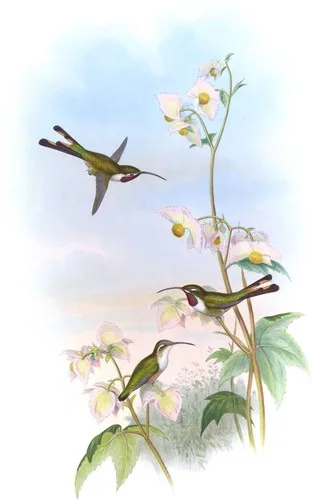
The Bahama Wood-star may be ranked among the most beautiful members of its genus; but few of them possessing greater elegance of form, and certainly none a more lovely-coloured throat.
I append Dr. Bryant’s observations on the bird, together with his description:—
This species of Humming-Bird is the only one found at Nassau and neighbouring islands. It is quite abundant there, and a constant resident. All the specimens I procured, seven in number, were killed in February and the early part of March; at that time its food consisted almost entirely of a small green aphis, found abundantly on the West Indian vervain (V. Stachytarpheta), a small blue flower that grows in all the dry pastures. Gosse calls the least Humming-Bird of Jamaica the Vervain Humming-Bird, from its hovering round this plant; but the name would apply equally as well to the present species. I saw nothing in its habits differing from those of the common ruby-throated species, with the exception that it was more quarrelsome in its disposition, chasing the ‘fighter,’ as the Tyrannus caudifasciatus is called, whenever it came near him, and that its note is louder and shriller, and much more frequently uttered. Incubation commences by the 1st of March. I saw three nests of this bird: one, found on the 3rd of March, contained two egos partly hatched; a second, April 10th, one egg; and another in May, two eggs. The nests are all composed of the same materials, principally the cotton from the silk cotton-tree, with a few downy masses that looked as if derived from some species of Asclepias; this was felted and matted together, and the outside stuck over with bits of lichen and little dry stalks or fibres of vegetable matter: one now before me measures ·030 in diameter and ·033 in height externally, and the inside ·018 in depth and ·025 in diameter. The eggs, like those of all the other members of the family, are two in number, snow-white when blown, and slightly rosy before, and measure ·012 in length by ·008 in breadth.
Description.—Adult male:—Above, green with metallic reflexions, slightly golden on the back, and with the tips of some of the feathers in some specimens bluish; the head darker and more sombre; wings brownish purple, with dull greenish reflexions in some lights; tail dark purple, almost black, also with greenish reflexions; the outer feather on each side with an almost obsolete terminal spot of rufous, the next with the whole of the inner web bright cinnamon, the next again with the whole of the inner and the basal half of the outer web of the same colour, this colour then running nearly to the tip in a diagonal manner, leaving the part next the shaft purple; the basal half of all the shafts, except the two outer, cinnamon; throat magnificent purple-violet; immediately below this a broad gorget of white; abdomen green mixed with rufous; thighs white; crissum pale rufous white; bill and tarsi black.
Adult female:—Upper parts less lustrous than in the male, the feathers margined more or less with rufous grey; wings as in the male; tail with the middle feathers brilliant green, the rest cinnamon, with a purplish-black band running from the outer feather obliquely downward and inward to the tips of the fourth on each side, forming a broadly-shaped mark; between the black band and the cinnamon there is a spot of bright green, most conspicuous in the feather next the central ones, and growing gradually indistinct towards the outer ones; throat pale rufous white, the centre of the feathers darkest, and on the sides and posteriorly a little green; abdomen entirely rufous; legs and crissum pale rufous. The dimensions do not differ from those of the male.
Young male in winter:—Upper parts intermediate in brightness between the male and female; throat white, with a few feathers beginning to show the violet; tail as in the male.
All the males procured by me, four in number, had but eight tail-feathers; while all the females, three in number, had ten. It can hardly be supposed that in four specimens, the same two feathers, and but two, should have been lost from every specimen. In form the tail-feathers are rather narrow, and the inner webs of the two outer slightly falciform or emarginated. The two outer feathers are slightly shorter than the next, which are the longest; the next two again are rather shorter, and the central ones considerably shorter. The feathers composing the tail of the female are broader than those of the male; the third from the outside is the longest; the first, second, and central one as in the male; and the fourth slightly shorter than the third.
Dr. Bryant has deceived himself as to the number of the tail-feathers in the male: all Humming-Birds have ten; but in some instances the middle feathers are so short as to be entirely hidden by the coverts, and this is precisely the case in the male of Calothorax Evelynæ.
The Plate represents both sexes of the natural size. The plant is the Begonia heracleifolia, var, nigricans.
References
- Trochilus Evelynæ, Boure. Proc. Zool. Soc., part xv. p. 44.—Ib. Rev. Zool. 1847, p. 256.
- Calothorax Evelynæ, Gray and Mitch. Gen. of Birds, vol. i. p. 110, Calothorax, sp. 9.
- Calothorax Eveline, Reich. Auf. der Col., p. 18.—Ib. Troch. Enum., p. 10.
- Callothorax evillina, Bonap. Rey. et Mag. de Zool. 1854, p. 257.
- Trochilus Bahamensis, Bryant, List of Birds seen at the Bahamas, &c., p. 5.