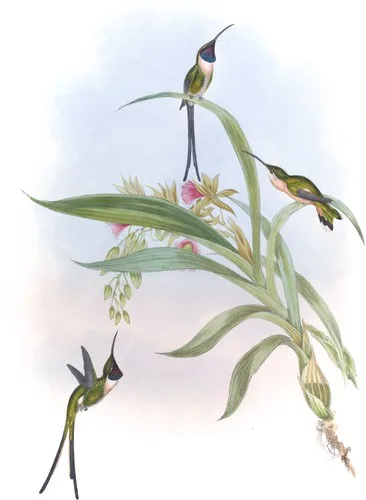
Doricha lyrura
中美剪尾蜂鸟属
Doricha lyrura
Lyre-shaped Wood-Star
Ten ways of seeing
- upright 1.53 : 1
First Look
凡画山水,意在笔先。
—— 唐·王维《山水论》
In painting, the intention precedes the brush.
The sheet is vertical: the eye climbs and settles on the bird. Take the posture before the plumage. Then step in close: watch where colour meets line, and whether the line ever breaks. Third, find the darkest small patch: the whole tonal order is measured from there.
Name and Thing
The binomial is Doricha lyrura: the first word is the genus it belongs among, the second the epithet that sets it apart. Two words carry a whole provenance. The Chinese name 中美剪尾蜂鸟属 is a modern rendering of the Latin, not an old garden name.
Form and Colour
The smallest of birds: a needle-fine bill, a forked tubular tongue, wings beating so fast the bird hovers and even flies backwards. Its colour is not pigment but structure — light bent by feather barbules, changing with the angle.No colour group is recorded. A single plant, laid out with nothing hidden.
Composition
Tall and narrow, the bird perched mid-branch with generous margins above and below. No details are appended: a plate for looking, not for keying out. Old plates set the plant slightly off centre, with unequal margins — that small imbalance is what keeps it alive.
Line and Colour
In the later nineteenth century chromolithography took over: colour printed rather than painted, line demoted. Craft leaves franker evidence than inscriptions. If you mean to copy it: block in the broad shapes and colours first, detail last; lithographic softness comes from thin washes — two or three pale layers will get you close.
Poetic Resonance
穿花蛱蝶深深见,点水蜻蜓款款飞。
—— 唐·杜甫《曲江二首》
Butterflies thread the flowers, seen deep within; dragonflies touch the water and fly on, slow and deliberate.
The poem gives the mood first and the picture supplies the form; set the line beside the plate and the bird itself becomes its resting point.
Symbolism
For the Aztecs the hummingbird was warrior and sun; for Victorian Europe it was the ultimate ornament, millions killed for breast jewellery. China has no tradition here — and that blank is itself a history of exchange. In a flora it is a species first and a symbol second; the order is worth keeping.
Season and Place
temperate hummingbirds follow the bloom north and back, thousands of kilometres a year. Americas only, from southern Alaska to Tierra del Fuego, richest in the Andes. China has no hummingbirds and no classical record of them. The year 1887 on the plate is that of publication, not of flowering — the gathering came a year or two earlier. Read the locality and the flowering season both with a discount: one is hearsay, the other a ten-day peak.
The Book and the Hand
“Gould's Hummingbirds” carries only John Gould's name. From drawing to plate the sheet passed through several hands — the engraver aimed at accuracy, the colourist at speed, and between them lies each plate's unevenness.
What to Take Away
Appreciation is not knowledge but habit — one more look each time. A flora exists to be consulted; look long enough and you forget to consult — someone in 1887 gave a whole day to a single flower.
About this plate
This is one of the most beautiful little gems that inhabit the Bahamas.
The whole form and the very graceful lyre-shaped tail, I believe, are not seen in any other Humming-bird; hence its specific name is very appropriate.
I make the following quotation from my paper in the ‘Annals of Natural History’ (vol. iv., fourth series, 1869).
Having lately received, through the kindness of his Excellency Sir James Walker, Governor of the Bahama Islands, four specimens of a Humming-bird, of which for the last twenty years I have been anxious to procure examples, I feel convinced that, as I had for some time supposed from a conversation I bad with the late Dr. Bryant, two species of this lovely family of birds inhabit those islands; and this conviction is strengthened by the circumstance that when in England, just prior to his lamented death, he informed me that the Humming-bird of the southern islands was supposed to be distinct from that killed in the neighbourhood of Nassau. He at the same time promised that I should have any examples that he could spare from his collection—a promise which has been partly performed by either Mrs. Bryant or her late husband’s executors sending me, through Mr. G. N. Lawrence of New York, a male, which I find is different from those sent me by Sir James Walker. As the birds killed round Nassau are identical with the type of the genus Doricha (D. evelynæ), which is still in the Loddigesian collection, the southern bird requires a specific appellation; and it would have given me great pleasure to name it after its discoverer, had not another species of the same section of the Trochilida been named bryantæ by Mr. Lawrence.
In size the new species, which I propose to call Doricha lyrura, is about the same as D. evelynæ; but the tail is distinctly forked, and its outer feathers are much longer, narrower, and outcurved at the apex, while the remainder regularly graduate towards the two central ones, which are very short. When the tail is raised and the feathers partially spread, they assume a lyre-like appearance; hence the specific appellation. Not wishing to depend upon my own judgment alone, I submitted this bird to the inspection of Mr. Salvin, who, after a careful examination, came to the same conclusion as myself, that the bird is distinct, and that the form of the feathers just described is the natural one. All my Nassau specimens, as well as others I have seen from that district, have the beautiful luminous lilaceous feathers confined to the throat, while in the specimen sent to me through Mr. Lawrence the whole face is luminous, the metallic lilaceous colour extending across the forehead.
Mr. Charles B. Cory, an American gentleman, has recently explored the Bahama Islands, and writes concerning the present species:—
Like many others of its family, the Lyre-tailed Humming-bird is restricted to a single island. It inhabits Inagua, and, although not rare, cannot be considered an abundant species. All the specimens which I procured were killed near Matherstome; and none were taken on any other part of the island. Its habits, as far as I was able to observe, were the same as those of Doricha evelynæ, from which it is impossible to distinguish it while darting from one flower to another. A negro brought me a fine male alive, which he had caught ina small net as it hovered over a flower. When living, the plumage shows somewhat brighter than in a dead specimen.
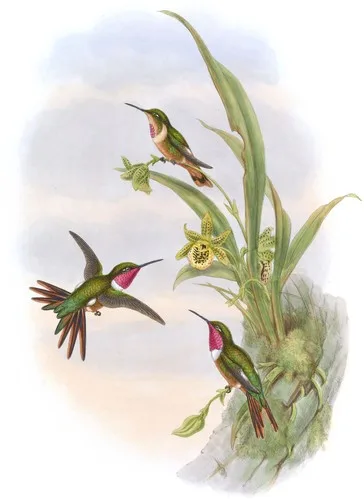
I find I have drawn three birds of this species, viz. two males and one female. Consequently a long description of the species is not required. I append, however, a brief diagnosis:—
The male has the forehead, throat, and breast beautiful shining lilac bordered with blue, the two colours blending at their juncture; immediately below the gorget is a band of greyish white, remainder of the abdomen bronzy brown; axillz rusty red; wings purplish brown; upper surface golden green; the narrow outer tail-feather on each side black; the next two black on the outer web, chestnut-red on the inner one, the next blackish brown with green reflections; the two middle ones green. Total length 3
Female. Bill black, a little curved; crown, back of the neck, and all the upper part green; ear, outer part of the throat, sides of the neck, centre of the belly, all white tinged with buffy white; under tail-coverts buff; four central tail-feathers, three outer on each side with a square band of black; a patch of buffy white on lower part of the back. Total length 3
References
- Doricha lyrura, Ann. & Mag. Nat. Hist. 1869, 4th series, vol. iv. pp. 111, 112.—Elliot, Ibis, 1872, p. 354.—Muls, Hist. Nat. Ois.-Mouches, 1877, vol. iv. p. 41.—Elliot, Synopsis, 1879, p. 126.—Cory, Birds of the Bahama Islands, p. 110.