Thaumastura Elizæ
Thaumastura Elizæ
Mexican Shear-tail
Ten ways of seeing
- upright 1.60 : 1
First Look
真山水之川谷,远望之以取其势,近看之以取其质。
—— 宋·郭熙《林泉高致·山水训》
Mountains and valleys: from afar take their momentum, up close take their texture — the two distances from which any picture is read.
The sheet is vertical: the eye climbs and settles on the bird. Take the posture before the plumage. Then step in close: watch where colour meets line, and whether the line ever breaks. Third, find the darkest small patch: the whole tonal order is measured from there.
Name and Thing
No reliable binomial survives, so the printed title must serve. Neither name nor binomial survives: the printed title must do.
Form and Colour
The smallest of birds: a needle-fine bill, a forked tubular tongue, wings beating so fast the bird hovers and even flies backwards. Its colour is not pigment but structure — light bent by feather barbules, changing with the angle.No colour group is recorded. Read the outline, then the colour layers, then the brush.
Composition
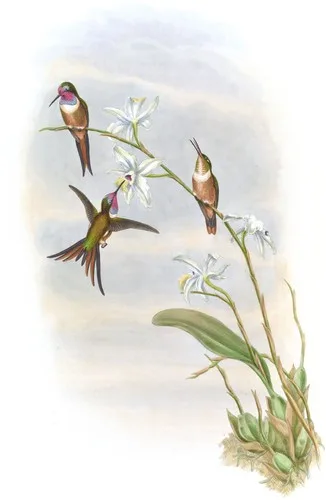
Tall and narrow, the bird perched mid-branch with generous margins above and below. No details are appended: a plate for looking, not for keying out. Cover the margins with your thumb and the plate suffocates; uncover them and the flower breathes again.
Line and Colour
In the later nineteenth century chromolithography took over: colour printed rather than painted, line demoted. Decide first whether it was printed or painted; only then discuss whether it is beautiful. If you mean to copy it: block in the broad shapes and colours first, detail last; lithographic softness comes from thin washes — two or three pale layers will get you close.
Poetic Resonance
夫列子御风而行,泠然善也,旬有五日而后反。
—— 《庄子·逍遥游》
Liezi rode the wind and came back after fifteen days, so light was his going.
The poem gives the mood first and the picture supplies the form; set the line beside the plate and the bird itself becomes its resting point.
Symbolism
For the Aztecs the hummingbird was warrior and sun; for Victorian Europe it was the ultimate ornament, millions killed for breast jewellery. China has no tradition here — and that blank is itself a history of exchange. Flower language was added later; the flower knows nothing of it, and that innocence is part of its power.
Season and Place
temperate hummingbirds follow the bloom north and back, thousands of kilometres a year. Americas only, from southern Alaska to Tierra del Fuego, richest in the Andes. China has no hummingbirds and no classical record of them. The year 1852 on the plate is that of publication, not of flowering — the gathering came a year or two earlier. Much of what that generation knew of such birds came from specimens and cages; read locality and season both as hearsay.
The Book and the Hand
“Gould's Hummingbirds” carries only John Gould's name. The image is public domain; the hand-colouring is still one person's hand.
What to Take Away
If you keep one line, keep Guo Xi's: from afar its momentum, up close its texture. The flower of that year is dust, yet its image on paper has outlived every living cousin.
About this plate
Southern Mexico
We have here a Humming-bird of especial beauty; its colouring being so chaste and its form so elegant, that it is unsurpassed in loveliness by any other member of the section to which it belongs.
It is indeed an object strictly in unison with the rich and fairy-like lands of which it is a native, namely Jalapa and the other genial provinces of Mexico. Few of the Trochilidæ are more rare, and few are the collections which contain examples; I, however, have the good fortune to possess a male and a female with their nest and eggs, all of which were procured at Cordova in Mexico by M. Sallé.
The first description of the species appeared in the “Revue Zoologique” for 1839, from the pen of M. DeLattre, a gentleman well acquainted with the Trochilide, but who unhappily is now no more, and who, it is to be feared, contracted the disease which terminated his useful life during his pursuit of this group of birds, of which he obtained many new species.
The following remarks, which are given in M. DeLattre’s own words, comprise all that is at present known respecting this lovely bird:—
Cette espéce, excessivement rare, a été rencontré dans le pays appellé le Pas de Taureau, entre la Vera Crux et Jalapa. Elle est trés matinale, vit en société, et reste en repos depuis neuf heures du matin jusqu’a quatre heures du soir. Le mile fait entendre en volant un bourdonnement assez fort. Il se couche tard et lorsqu’il ne voit absolument plus. II se nourrit sur les arbres.
M. DeLattre named this species Eliza in honour of the wife of Dr. Amédée Lefèvre, Professor of Zoology and Materia Medica at Rochefort.
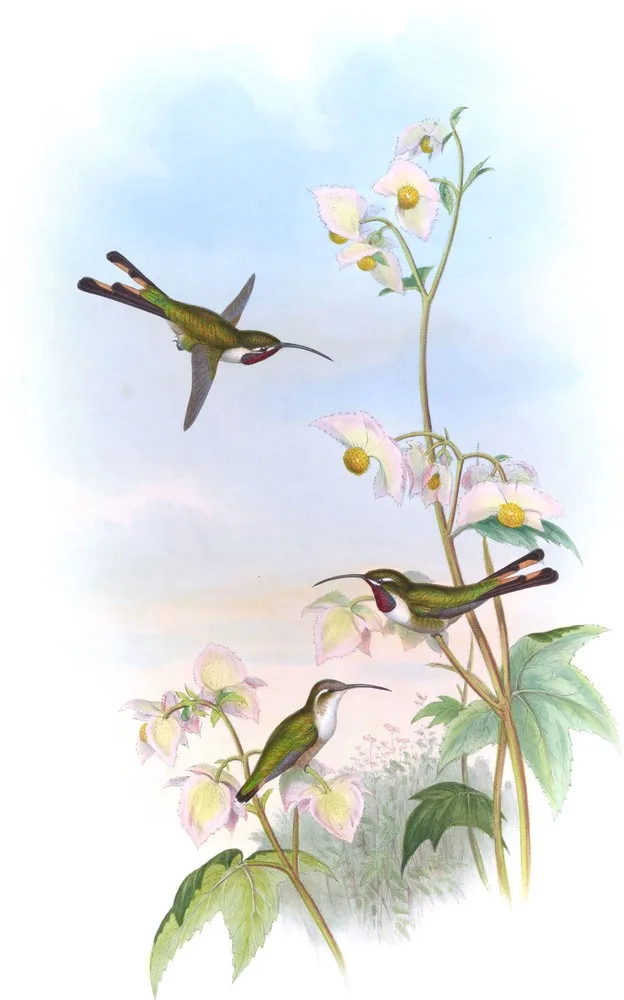
The male has the crown of the head bronzy-brown; sides of the head, back of the neck, all the upper surface of the body, upper and under wing-coverts and flanks of a rich shining golden hue; upper tail-coverts shining green; wings purplish-brown; chin and chest beautiful metallic violaceous-crimson; across the breast a broad gorget of white; centre of the abdomen, vent and under tail-coverts dull white; tail purplishblack, all but the outer feather on each side margined internally from the base to near the tip with deep sandy-buff; bill and feet blackish-brown.
The female has the crown greyish-brown; all the upper surface golden-green; wings purplish-black; central tail-feathers shining green, the remainder sandy-buff at the base, then black, and white at the tip; under surface white tinged with buff.
The nest is of a round, cup-shaped, but somewhat lengthened form, and is placed in the fork of a small upright branch: it is composed of a cottony material coated on the outside with a dark reddish-coloured moss, flat pieces of lichens, &c., bound together with cobwebs; the eggs as usual are white and two in number.
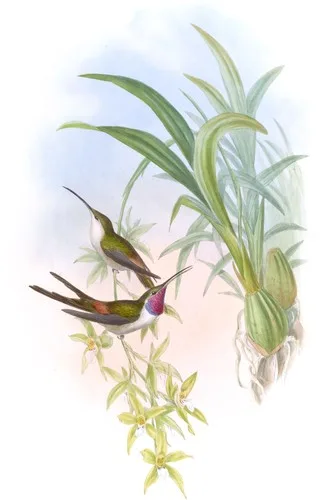
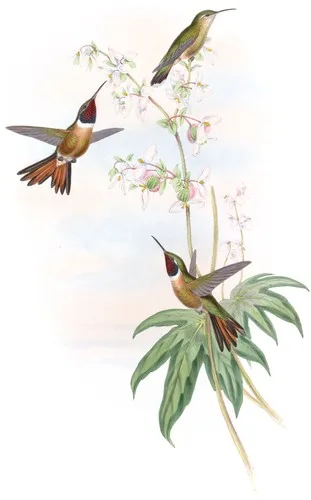
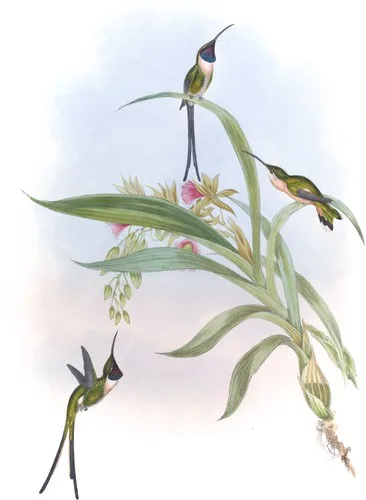
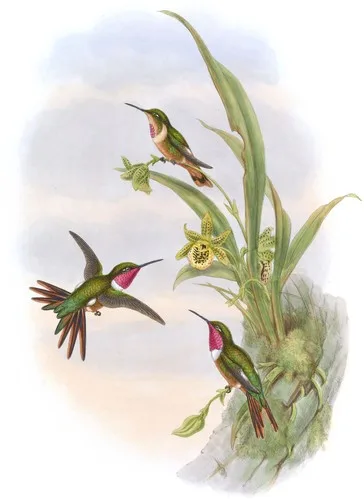
The Plate represents two males and a female of the natural size. The plant is the Begonia biserrata.
References
- Trochilus Eliza, Less. et DeLatt. Rev. Zool. 1839, p. 20.
- Myrtis Elisa, Reich. Aufz. der Colibris, p. 13.
- Lucifer elisa, Bonap. Rev. et Mag. de Zool. 1854, p. 257.
- Calothorax Eliza, Gray and Mitch. Gen. of Birds, vol. i. p. 110, Calothorax, sp. 8.