Amaryllis Longifolia
Amaryllis Longifolia
Amaryllis a Longues Feuilles
About this plate
Description
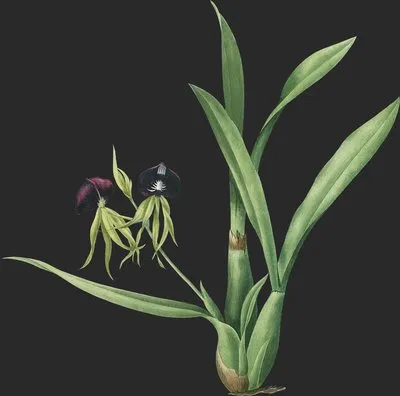
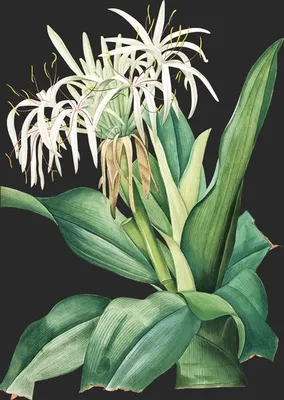
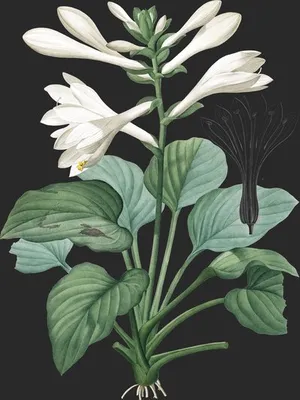
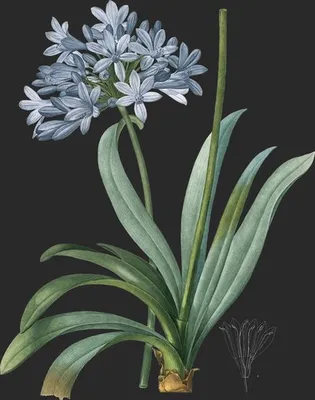
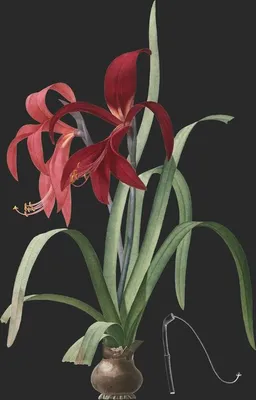
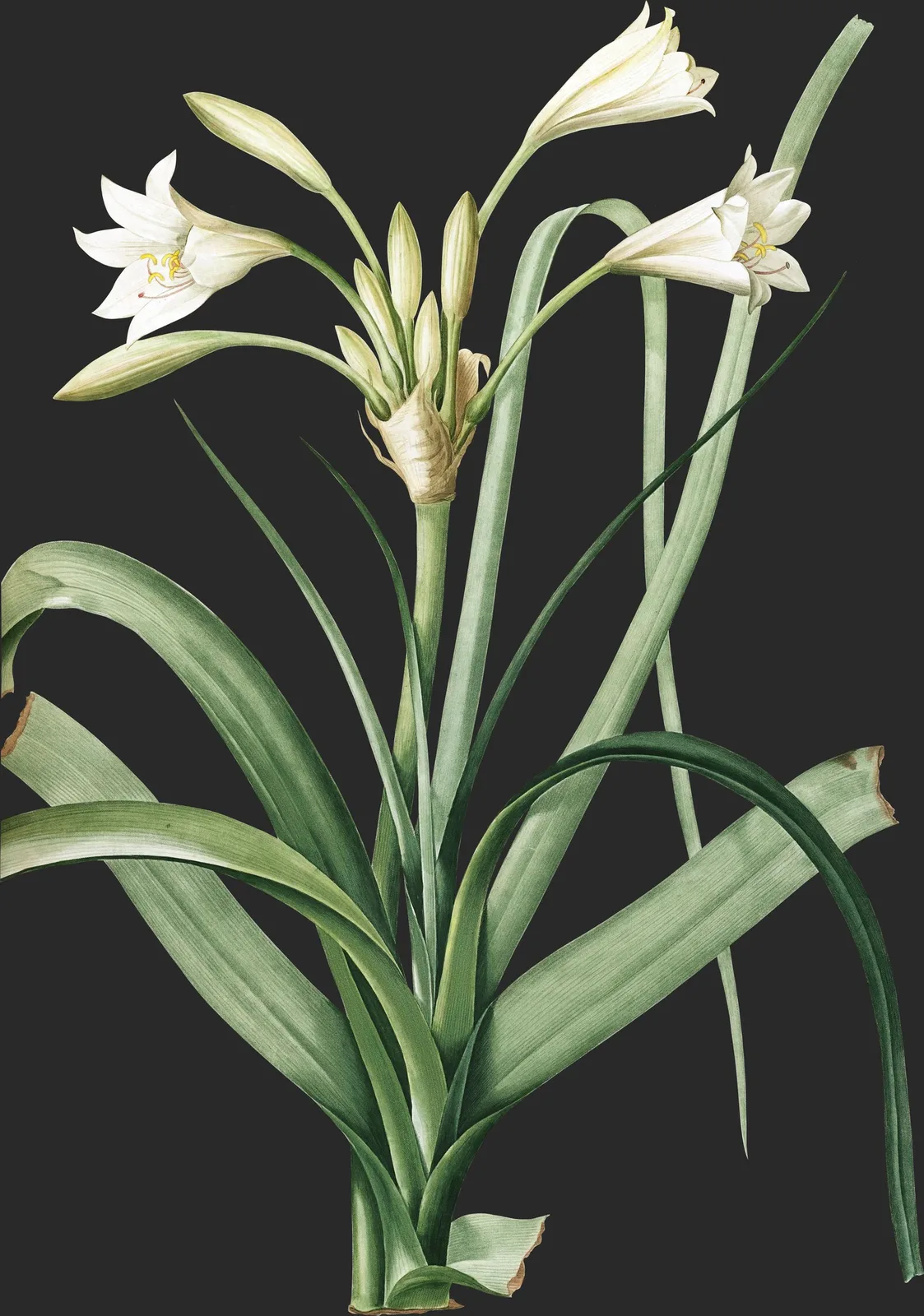
Les feuilles de cette Amaryllis sont linéaires, assez étroites, très-nombreuses, courbées en gouttière, glabres, glauques, aigués, trèsentières. Elles sont, en général, dressées dans leur moitié inférieure, recourbées et pendantes dans la supérieure. Elles atteignent communément la longueur d’un mètre ou plus. Leur largeur est, dans le bas, de trois ou quatre centimètres, et elles se rétrécissent graduellement jusqu’au sommet. Les intérieures sont plus étroites.
La hampe est droite, presque cylindrique ou trèslégèrement triangulaire, glabre, glauque, haute de quatre ou cinq centimètres. Elle sort du sommet de la bulbe, à côté et en dehors du faisceau formé par les feuilles, qui sont dans leur entier développement au moment de la floraison.
Les fleurs sont au nombre de douze environ, disposées en ombelle, et portées sur des pédicelles presque eylindriques, longs de trois ou cinq centimètres. La spathe qui les entoure est à deux valves ovales, membraneuses.
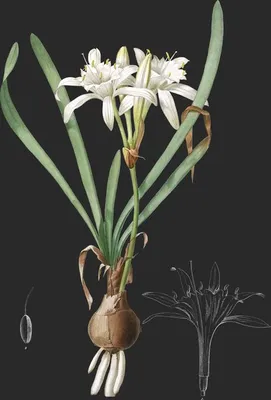
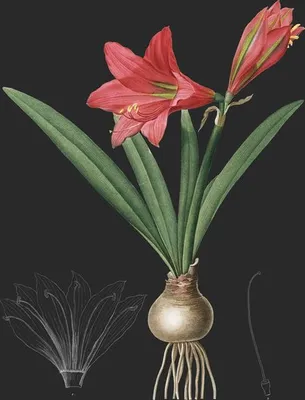
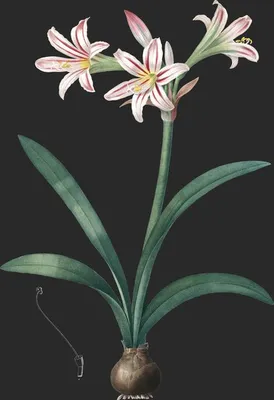
Le périgone est en forme d’entonnoir peu évasé. Le tube, en y comprenant la partie qui adhère à l’ovaire, est un peu plus long que le limbe. Il est verdâtre, presque cylindrique, arqué, creusé de trois sillons longitudinaux. Les divisions du limbe sont longues de six centimètres, lancéolées, un peu serrées les unes contre les autres, blanches, avec une raie longitudinale d’un brun rougeâtre. Les trois extérieures se renversent en dehors au sommet. Les trois intérieures sont terminées par une sorte de callosité qui porte en dedans un petit crochet.
Les étamines sont toutes déjetées vers le côté inférieur de la fleur, et n’atteignent pas tout-i-fait la longueur des segments du limbe du périgone. Leurs filaments sont filiformes, blancs dans le bas, rougeâtres dans le haut, fortement arqués au dessous de leur sommet. Les anthères sont linéaires, vacillantes, arquées, d’un jaune pâle.
L’ovaire est ovale, lisse, vert. Le style est filiforme, rougeâtre dans le haut, un peu plus long que les étamines, dont il suit à peu près la courbure et la di-rection. Le stigmate est eu forme de tête triangulaire.
Histoire
L’Amaryllis à longues feuilles est, diton, originaire du Capde Bonne-Espé rance. On la cultive dans la plupart des jardins de botanique.
Elle fleurit à la fin du printemps.
Observations
Il est très-douteux que la plante dont nous venons de donner la description soit celle que Linné a voulu désigner par le nom d’Amaryllis longifolia. En effet. des deux figures qu’il a citées, l’une très-mauvaise, ne ressemble guère à notre plante; et l’autre, celle d’Ebret, parait appartenir à l’une des variétés de l’Amaryllis ornata. Cependant, comme elle est bien certainement la même que l’Amaryllis longifolia de Jacquin et de M. Gawler, et qu’il en existe déjà deux bonnes figures sous ce nom, nous croyons devoir le lui conserver.
Fam. des Narcisses. Juss.—Hexandrie monogynie. Lin.
- Amaryllis longifolia, A, suberecto-multiflora, foliis glaucis, extimis scapo longioribus, floribus pedicellatis, tubo obtusè trigono, curvulo, limbo subringente et turbinatim campanulato subduplò longiore, stigmate depresso capitellato. Gawl. in Curt. bot. mag. 661.
- Amaryllis longifolia. A. floribus pedicellatis, spathá 12-20-florâ, corollis basi tubulosis, tubo curvo brevi, limbi laciniis lanceolatis obtusis canaliculatis apice flaccidis. Ait. Kew. p. 419. Willd. sp. pl. 2. p. 55. Hort. Berol. 355. Pers. enchir. 1. p. 354.
- Amaryllis longifolia. A. floribus umbellatis pedunculatis tubulosis sexpartitis, foliis scapo duplò longioribus. L’Hérit. sert. Angl. 13.
- Amaryllis longifolia. A, spathâ multiflorâ, corollis campanulatis æqualibus, genitalibus declinatis, scapo compresso longitudine umbellæ. Roy. Lugd-b. 36. Lin. sp. pl. 1. p. 421? exelus. syn. Ehret. Mill. dict. n. 7. Jacq. ic. 2. t. 362. Collect. 4. p. 205.
- Lilium Africanum humile longissimis foliis polyanthos, saturato colore purpurascens. Herm. parad. 1. 195?
Ten ways of seeing
- measured cast yellow-green
- upright 1.43 : 1
- published 1811
- Plate 347
Not a catalogue entry but a way of looking: how to stand, what to notice, how the line was cut — then, halfway, a line of Chinese poetry: how the ancients saw this same flower. After it, the flower's language, its season and homeland, its book; and at the end one line of classical prose — and a pair of eyes to take away.
-
First Look
夫象物必在于形似,形似须全其骨气。
—— 唐·张彦远《历代名画记》
Likeness is the threshold; bone-and-breath is the point.
The sheet is vertical: the eye climbs and settles in the upper half. Let the plant stand before you look for detail. Then step in close: watch where colour meets line, and whether the line ever breaks. Third, find where the green is deepest: the whole tonal order is measured from that patch.
-
Name and Thing
The binomial is Amaryllis longifolia: the first word is the genus it belongs among, the second the epithet that sets it apart. Two words carry a whole provenance. The older system filed it under Amaryllidaceæ by overall affinity; Linnaeus, counting stamens only, placed it in Hexandria — two ways of asking what a plant is. No established Chinese name exists, so it is cited by its binomial alone.
-
Form and Colour
Measured on this plate: flower colour covers 2.5% of the sheet, foliage 16.9%, the cast yellow-green. No other plate shares exactly this measure. Bulbous plants store the year underground — bulb, corm or tuber — then send up a few thick leaves and a single scape, with six tepals in cup, funnel or star. Filed under green — a moss green, a colour that comes mostly from leaf and stem. A single plant, laid out with nothing hidden.
-
Composition
Tall and narrow, the plant rising in one movement with generous margins — the upright format of most floras. (about 1.43 : 1) No details are appended: a plate for looking, not for keying out. The plant takes about 32% of the sheet, centred near the centre — the easy measure most florists kept to. Old plates set the plant slightly off centre, with unequal margins — that small imbalance is what keeps it alive.
-
Line and Colour
The first half of the nineteenth century moved from copper to steel to lithography; stipple could render the softest transition. Take a loupe to three places: petal edge, leaf vein, caption. An unbroken line means engraving; colour crossing the outline means a hand. If you mean to copy it: take its skeleton, its margins and the order of its colours; the burin's hatching is the language of copper — suggest it with pencil density, do not imitate it stroke for stroke.
-
Poetic Resonance
郁金香汗裛歌巾,山石榴花染舞裙。
—— 唐·白居易《盧侍御小妓乞詩座上留贈》
The poem gives the mood first and the picture supplies the form; set the line beside the plate and the green the corolla becomes its resting point.
-
Symbolism
The tulip was an imperial emblem in Istanbul and a speculative bubble in Amsterdam; the hyacinth sprang from a boy's blood in Greek myth. What bulbs share is concealment: next year kept underground. Meanings change their tune: the same flower can say opposite things within a century.
-
Season and Place
Early spring to early summer, genus by genus: tulips and hyacinths first, gladiolus and amaryllis later. Three homelands: the Mediterranean, Central Asia and South Africa. The tulip came from Ottoman gardens and became a Dutch mania. The year 1811 on the plate is that of publication, not of flowering — the gathering came a year or two earlier. Read the locality and the flowering season both with a discount: one is hearsay, the other a ten-day peak.
-
The Book and the Hand
“The Liliaceae” was drawn by Pierre-Joseph Redouté and published 1802-1816. This plate is Plate 347, book page 347. The image is public domain; the hand-colouring is still one person's hand.
-
The Written Tradition
气之动物,物之感人,故摇荡性情,形诸舞咏。
—— 南朝梁·钟嵘《诗品序》
The vital breath moves things, things move men, and the stirred heart takes shape in song.
Li Bai's 'orchid wine, fragrant with yujin' is often misread as tulips; the Tang yujin was a turmeric-like root used to scent wine — same name, different plant. The difference is not of quality but of question: Europe asks what it is, China asks whom it resembles.
What to Take Away
If you keep one line, keep Guo Xi's: from afar its momentum, up close its texture. Two centuries on, the plant may still flower in some garden; the one on this sheet stopped in the season of 1811.