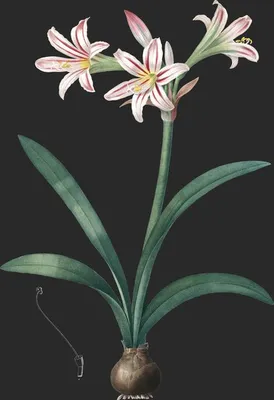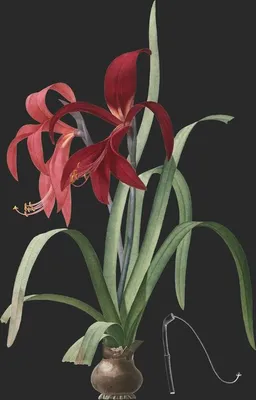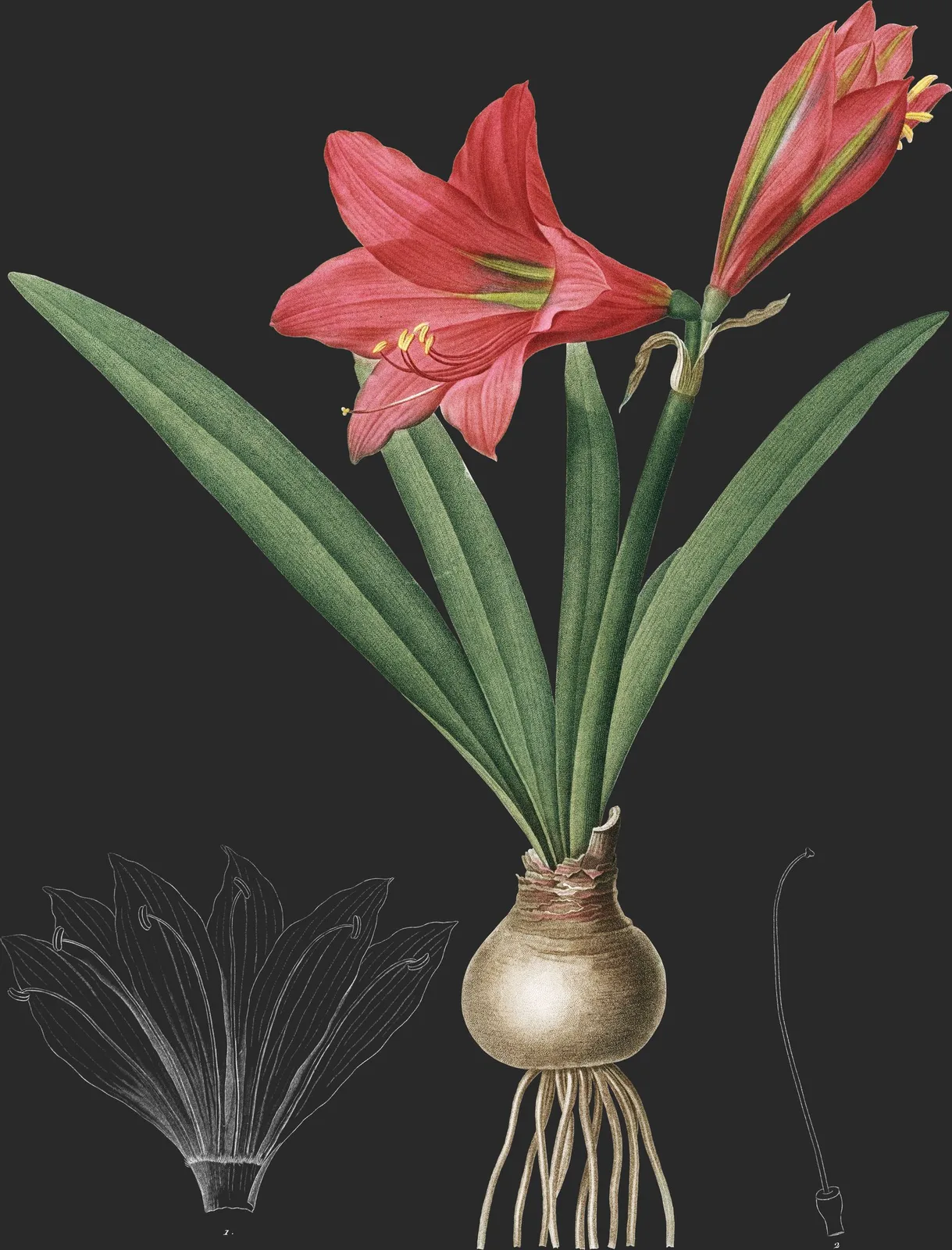
Amaryllis Reginæ
南方火眼蝶
Amaryllis de la Reine
About this plate
Description
Au milieu do brillant genre des Amaryllis, cette espèce se fait remarquer par la beanté de sa fleur, qui est très-grande et d’un beau rouge ponceau.
Les fibres de la racine sont grisâtres, nombreuses, épaisses, cylindriques; elles partent d’une bulbe assez grosse, arrondie, et formée de tuniques exactement appliquées les unes sur les autres; d’entre ces tuniques part une touffe de feuilles disposées sur deux rangs opposés, peu nombreuses, droites à leur base, étalées à leur sommet, oblongues-lancéolées, pointues, glabres, lon gues de quatre décimètres, larges de trois centimètres.
De la meme bulbe, mais à d’antres places, sélevent t-s hampes de moitié plas courtes que les feailles, cylindriques, creuses, un peu comprimées à leur base; chaque hampe porte à son sommet 2–4 fleurs posées sur des pédicelles courts, droits, cylindriques, entourés de deus bractées larges, lancéolées, mem-braneuses, embrassant la tietentre les pédicelles se trouvent 2–4 filets lineaires, membraneux, qui paratast des bractées avortées.
Les fleurs sont horizontales sur le pédicelle: elles sont composées d’une corolle en cloche, dont le est court; la gorge est barbue, c’est-à-dire, qu’inne houppe de poils d’une nature analogue aux étamines est placée à la base des divisions de la corolle: ces divisions au nombre de six, profondes, ovales, un peu rétrécies à la base, d’un beau rouge, avec on onglet blanc an milieu et verdatre sur les bords; les troi divisions extérieures sont terminées par une callosité verte et pointue en dehors, un peu velue en dedans.
Les six étamines sont insérées sur la corolle, placées devant chaque division, droites dans leur partie inférieure, redressées vers leur sommet; les filets sont cylindriques, minces au sommet, blancs vers le bas, rouges dans la partie supérieure; ils portent des anthères vacillantes, alongées, blanchâtres: ces anthères sont longues de vo-re millimètres, et diminuent de moitié après la fecondation.
Sous la corolle est placé l’ovaire qui est lisse, vert et à trois angles obtus; le style est filiforme, plus long que les étamines, dans la même direction qu’elles; le stigmate est hérissé en tête, partagé en trois lobes courts et arrondis.
Je n’ai jamais vu mûrir le fruit.
Histoire
Cette plante est originaire du Cap-de-Bonne-Espérance; elle est introduite depuis long-temps dans les jardins de botanique dont elle fait l’ornement; elle fleurit en hiver ou au printemps: on la multiplie de caïeux.
Explication de la planche
La Plante de grandeur naturelle.
- La corolle étalée pour montrer les étamines.
- Le pistil.
Fam. des Narcisses. Juss. Hexandrie Monogynie. Lin.
- Amaryllis reginæ. A, spathâ sobbiflorâ, pedicellis divaricatis, corollis campanulatis brevè tubulosis natantibus, fauce tubi hirsutá. Ait. Kew. 1. p. 416. Wild. Spec. 2. p. 53.
- Amaryllis reginæ. A. spathâ multiflorâ, corollis campamulatis æqualibus undulatis, genitalibus declinatis. Lin. Spec. 421. Mill. Dict. n. 5. Ic. p. 16. t. 24.
- Amaryllis reginæ. A. spathâ subiflorâ, corollis basi tabulosis campanulatis quinquepartitis, fance tubi hirsutâ. L’Her. Sert. angl. 12.
- Amaryllis punicea. Lam. Dict. 1. p. 122?
Twelve ways of seeing
- measured cast red
- upright 1.31 : 1
- published 1802
- Plate 9
Not a catalogue entry but a way of looking: how to stand, what to notice, how the line was cut, when it flowers, where it came from, who made it — and then the poems and the classics that taught China to see the same flower. Read the twelve in order and the plate opens.
-
First Look
六法者何?一、气韵生动是也;二、骨法用笔是也;三、应物象形是也;四、随类赋彩是也;五、经营位置是也;六、传移模写是也。
—— 南齐·谢赫《古画品录》
The six laws: spirit resonance alive; bone-method in the brush; matching form; colour by kind; planning the placing; copying the masters.
The sheet is vertical: the eye climbs and settles in the upper half. Let the plant stand before you look for detail. Then step in close: watch where colour meets line, and whether the line ever breaks. Third, find where the green is deepest: the whole tonal order is measured from that patch.
-
Name and Thing
Only the genus Amaryllis is given; species-level names came later. The older system filed it under Amaryllidaceæ by overall affinity; Linnaeus, counting stamens only, placed it in Hexandria — two ways of asking what a plant is. The Chinese name 南方火眼蝶 is a modern rendering of the Latin, not an old garden name.
-
Form and Colour
Measured on this plate: flower colour covers 11.3% of the sheet, foliage 8.6%, the cast red with a second note of amber. No other plate shares exactly this measure. Bulbous plants store the year underground — bulb, corm or tuber — then send up a few thick leaves and a single scape, with six tepals in cup, funnel or star. Filed under green — a moss green, a colour that comes mostly from leaf and stem. A single plant, laid out with nothing hidden.
-
Composition
Tall and narrow, the plant rising in one movement with generous margins — the upright format of most floras. (about 1.31 : 1) No details are appended: a plate for looking, not for keying out. The plant covers only 24% of the sheet, centred above centre; the emptiness is where the eye rests. Cover the margins with your thumb and the plate suffocates; uncover them and the flower breathes again.
-
Line and Colour
The first half of the nineteenth century moved from copper to steel to lithography; stipple could render the softest transition. There is evidence on the back too: the plate mark pressed into the paper, the slight relief of the pigment, lines worn shallow in a later printing.
-
Season
Early spring to early summer, genus by genus: tulips and hyacinths first, gladiolus and amaryllis later. The year 1802 on the plate is that of publication, not of flowering — the gathering came a year or two earlier. The best time to read such a plate is its flowering season: three minutes under the tree explains what no text can.
-
Provenance
Three homelands: the Mediterranean, Central Asia and South Africa. The tulip came from Ottoman gardens and became a Dutch mania; South African bulbs filled European glasshouses after 1800. The volume was made in 1802-1816, when most of this knowledge came from living plants under glass.
-
The Book and the Hand
“The Liliaceae” was drawn by Pierre-Joseph Redouté and published 1802-1816. This plate is Plate 9, book page 9. The image is public domain; the hand-colouring is still one person's hand.
-
Poetic Resonance
东风夜放花千树,更吹落、星如雨。
—— 宋·辛弃疾《青玉案·元夕》
East wind at night sets a thousand trees of flowers alight, then blows them down like rain of stars.
The poem gives the mood first and the picture supplies the form; set the line beside the plate and the green the corolla becomes its resting point.
-
The Written Tradition
人无癖不可与交,以其无深情也。
—— 明·张岱《陶庵梦忆》
Never make a friend of a man without an obsession: he has no deep feeling.
Li Bai's 'orchid wine, fragrant with yujin' is often misread as tulips; the Tang yujin was a turmeric-like root used to scent wine — same name, different plant. You need not parse every word: take the line, and the flower acquires a second face.
-
Symbolism
The tulip was an imperial emblem in Istanbul and a speculative bubble in Amsterdam; the hyacinth sprang from a boy's blood in Greek myth. What bulbs share is concealment: next year kept underground. Meanings change their tune: the same flower can say opposite things within a century.
-
What to Take Away
Next time you stand before a flowering plant, give it three minutes: leaf arrangement, direction of the flower, the darkest patch. The flower of that year is dust, yet its image on paper has outlived every living cousin.