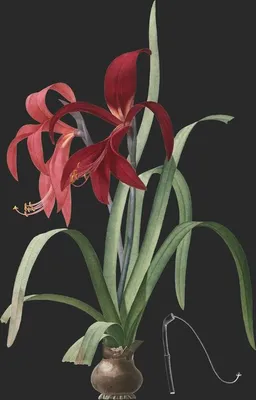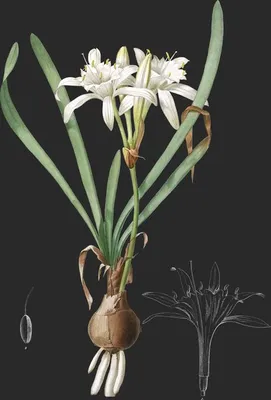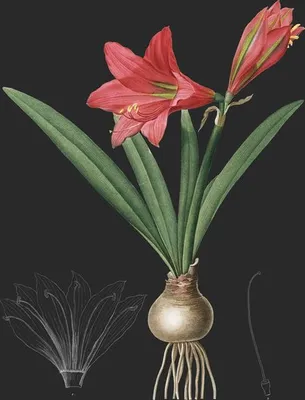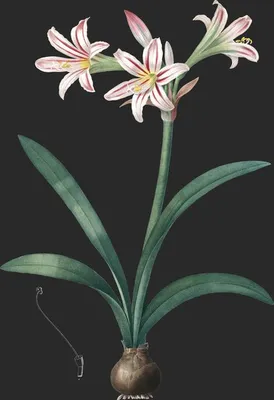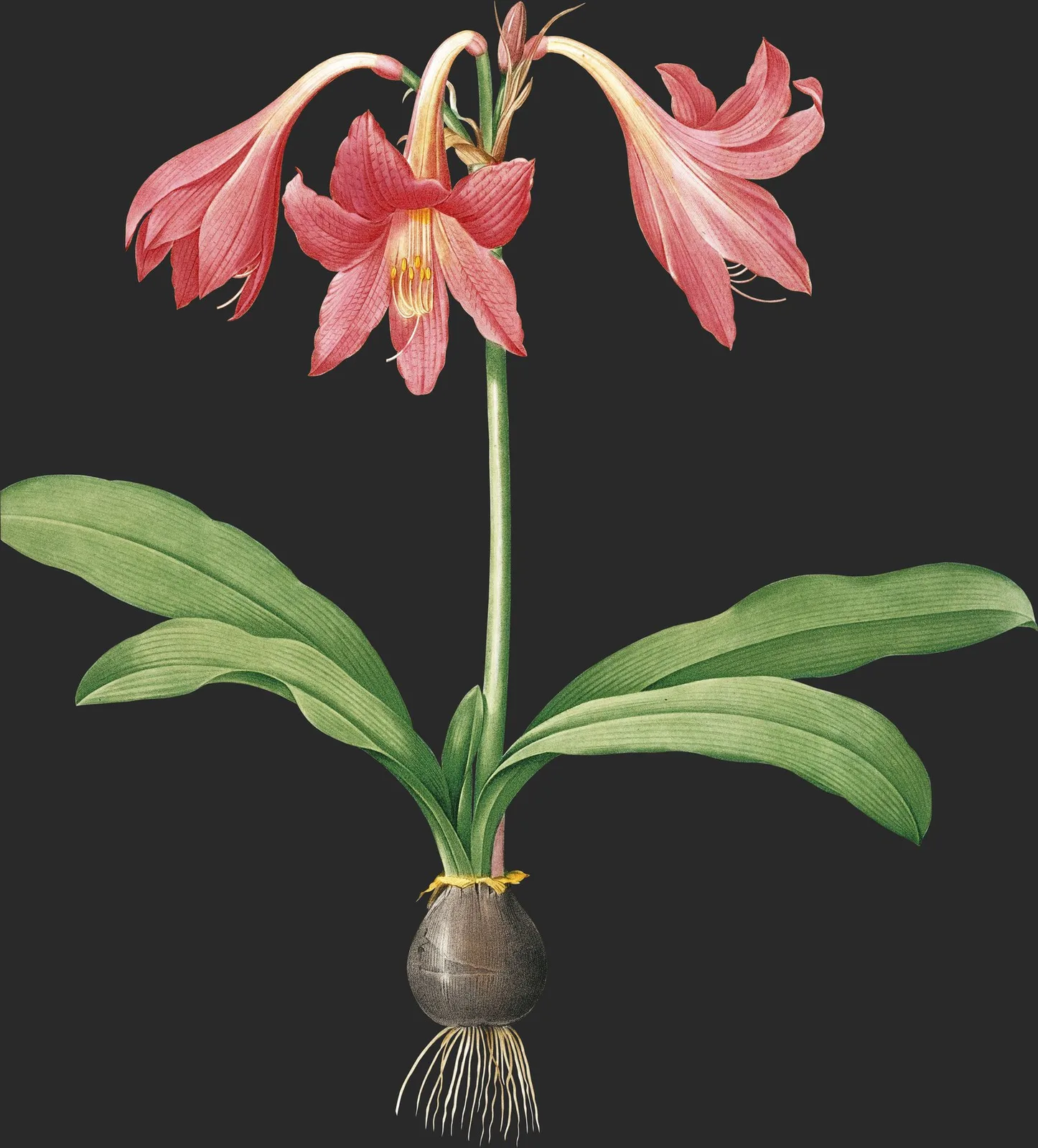
Amaryllis Reticulata
石蒜科
Amaryllis en Rézeau
About this plate
Description
Bulbe arrondie de la grosseur d’une prune de reine-claude, recouverte de tuniques lisses, noirâtres, bordée au sommet par les déchirures de ces tuniques, qui se replient et deviennent jaunes. Feuilles distiques, au nombre de quatre ou cinq, lancéolées en langue, très-vertes, longues de vingt à vingt-eing centimètres (sept à neuf pouces), larges de trois à quatre centimètres (quatorze a dix-huit lignes), retombantes et presque horizontales en s’écartant de la tige, ondulées légèrement sur les bords, tris-peu pliées en gouttière, excepté par leur base, terminées en une pointe au sommet; elles sont marquées de nervures longitudinales très-apparentes en dessus. La nervure moyenne, plus épaisse, n’est saillante que sur le revers des feuilles.
La hampe sort à côté des feuilles, est droite, glauque, comprimée, haute de deux décimètres (sept pouces et demi).
Une spathe multiflore & deux valves brunes, lancéolées, entoure le sommet de la hampe. Quatre fleurs sorties de cette spathe reposent sur des pédicules plus ou moins redressés, glauques, anguleux, longs de trois à quatre centime-tres (quatorze à dix-huit lignes).
Le périgone est infundibuliforme et pendant. Son tube, étroit et arqué par sa base, s’élargit par degrés vers son sommet pour produire les divisions du limbe avec lesquels il se confond.
Ce limbe est ample; ses découpures sont séparées jusqu’à trois décimètres de l’ovaire (quatorze lignes). Elles sont courbées en dehors, jaunátres en dedans, et linéaires en se soudant à l’entrée du tube; elles forment ensuite, par leur ensemble, un large pavillon, en devenant chacune ovale, et se colorant d’un beau rouge lilas. Ces découpures du limbe sont ondulées par les bords; leurs nervures transverses et longitudinales imitent des mailles. Les découpures tournées vers le dessus de la fleur se courbent en arrière; celles placées au dessous sinclinent dans le sens du tube. Il y a une petite pointe pubescente au sommet des trois découpures extérieures; les trois intérieures sont un tant soit peu plus étroites; la couleur des unes et des autres est plus vise en dedans qu’en dehors.
Les étamines sinelinent sur la paroi inférieure du tube, et ne dépassent point le périgone; leurs filets sont blancs, excepté A leur sommet, où ils se condent pour remonter, et se feignent de couleur lilas.
Les anthères sont versatiles, oblongues, d’un jaune pale dans le principe, et noircissent après avoir donné leur poussière.
Lovaire est ovoïde, à trois côtés et à trois courbures, blanc ou d’un violet pale; le style est filiforme, presque droit dans la direction des étamines, et porte un stigmate à trois lobes.
Histoire
L’Amaryllis en réseau est une liliacée naturelle au Brésil, d’où on l’a transplantee en Portugil, et ensaile en Angleterre vers les annees 1772 à 1777. Nous l’avons vue cultivée à Paris chez M. Noisette; elle était en fleur au mois de septembre dernier.
Fam. des Narcisses. Juss.—Hexandrie monogynie. Lin.
- Amaryllis reticulata. A. spathâ submultiflorâ; corollis nutantibus, basi tubulosis, limbo reticulatis; foliis oblongis. L’Hérit. sert, Angl. p. 19. t. 14. Sins. botan. mag. 657.
- Amaryllis reticulata. A. spathâ subbiflorâ; corollis basi tubulosis, nutantibus; fauce tubi glabrâ; scapo compresso; foliis oblongis, basi attenuatis. Ait. Kew. 1. p. 417. Willd. sp. pl. 2. p. 54. Enum. pl. 1. p. 354. Persoon, synops. 1. p. 353.
- Amaryllis reticulata. A. spathâ multiflorâ; corollis reticulatis, purpureis; foliis oblongis, reticulatis, basi attenuatis. Andrew. botan. reposit. tab. 179.
Twelve ways of seeing
One plate, read twelve times over: its name, its colour, the burin and the brush, the shape of the sheet, the season, the soil it came from, the book it belongs to, its language of flowers, the poem it answers to, the lore behind it, how to look, and what remains.
-
The Name
The plate is titled “Amaryllis Reticulata”, numbered Plate 424 (book page 424). Its binomial is Amaryllis reticulata: the genus places it among its kin, the epithet records a place, a shape or a person. The Chinese name 石蒜科 is a modern rendering of the Latin, not an old garden name — between a plant and its names there is always translation.
-
Form and Colour
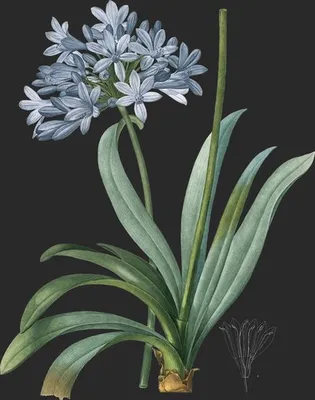
Bulbous plants store the year underground — bulb, corm or tuber — then send up a few thick leaves and a single scape, with six tepals in cup, funnel or star. Filed under green — a moss green. That colour comes mostly from leaf, calyx and stem; the flower occupies a small patch. A botanical plate establishes the plant before it points at the bloom. Three things fix the habit: leaf arrangement, tepal count, and how the flower is borne.
-
Line and Colour
The first half of the nineteenth century moved from copper to steel to lithography. Stipple could render the softest transition — Redouté's roses depend on it — while lithography suited broad, gentle washes. Look closely at the line and the colour: an unbroken line means engraving, colour crossing the outline by half a millimetre means hand-colouring. Craft leaves franker evidence than inscriptions.
-
Composition
Slightly taller than wide, the plant set a little above centre so the eye lands on the flower. (about 1.11 : 1). No details are appended: this is a plate for looking, not for keying out.
-
Season
Early spring to early summer, genus by genus: tulips and hyacinths first, gladiolus and amaryllis later. The year 1814 on the plate is the year of publication, not of flowering — the gathering came a year or two earlier.
-
Provenance
Three homelands: the Mediterranean, Central Asia and South Africa. The tulip came from Ottoman gardens and became a Dutch mania; South African bulbs filled European glasshouses after 1800. The volume was made in 1802-1816, when most of this knowledge came from living plants under glass rather than from the wild.
-
The Book
“The Liliaceae” was drawn by Pierre-Joseph Redouté and published 1802-1816. This plate is Plate 424, book page 424. The image is in the public domain; the hand-colouring on the paper is still one person's hand, two centuries ago.
-
Symbolism
The tulip was an imperial emblem in Istanbul and a speculative bubble in Amsterdam; the hyacinth sprang from a boy's blood in Greek myth. What bulbs share is concealment: next year kept underground. Flower language was added later; the flower knows nothing of it, and that innocence is part of its power.
-
Poetic Resonance
东风夜放花千树,更吹落、星如雨。
—— 宋·辛弃疾《青玉案·元夕》
East wind at night sets a thousand trees of flowers alight, then blows them down like rain of stars.
The poem gives the mood first and the picture supplies the form; set the line beside the plate and the green the corolla becomes its resting point.
-
Classical Lore
Li Bai's 'orchid wine, fragrant with yujin' is often misread as tulips; the Tang yujin was a turmeric-like root used to scent wine — same name, different plant. Chinese flower books ranked plants by character; European floras described them by form and name. This plate belongs to the second tradition, yet bears reading by the first. Books fill in what the picture omits, and also hide what it shows: look first, read after.
-
How to Look
Look at the base: tulips overlap in two whorls to make a cup, hyacinths pack small flowers into a spike, gladiolus sets its blooms in a single row facing one way. Stand back for the habit, step close for the meeting of line and colour.
-
Afterword
The flower of 1814 is dust, yet its image on paper has outlived every living cousin.