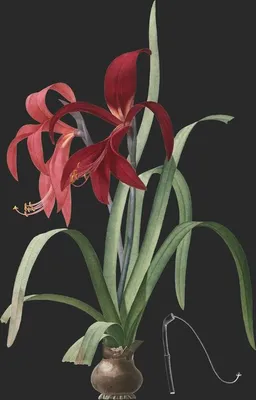
Hæmanthus Puniceus
Hémanthe a feuilles de Colchique
Hémanthe a feuilles de Colchique
About this plate
Description
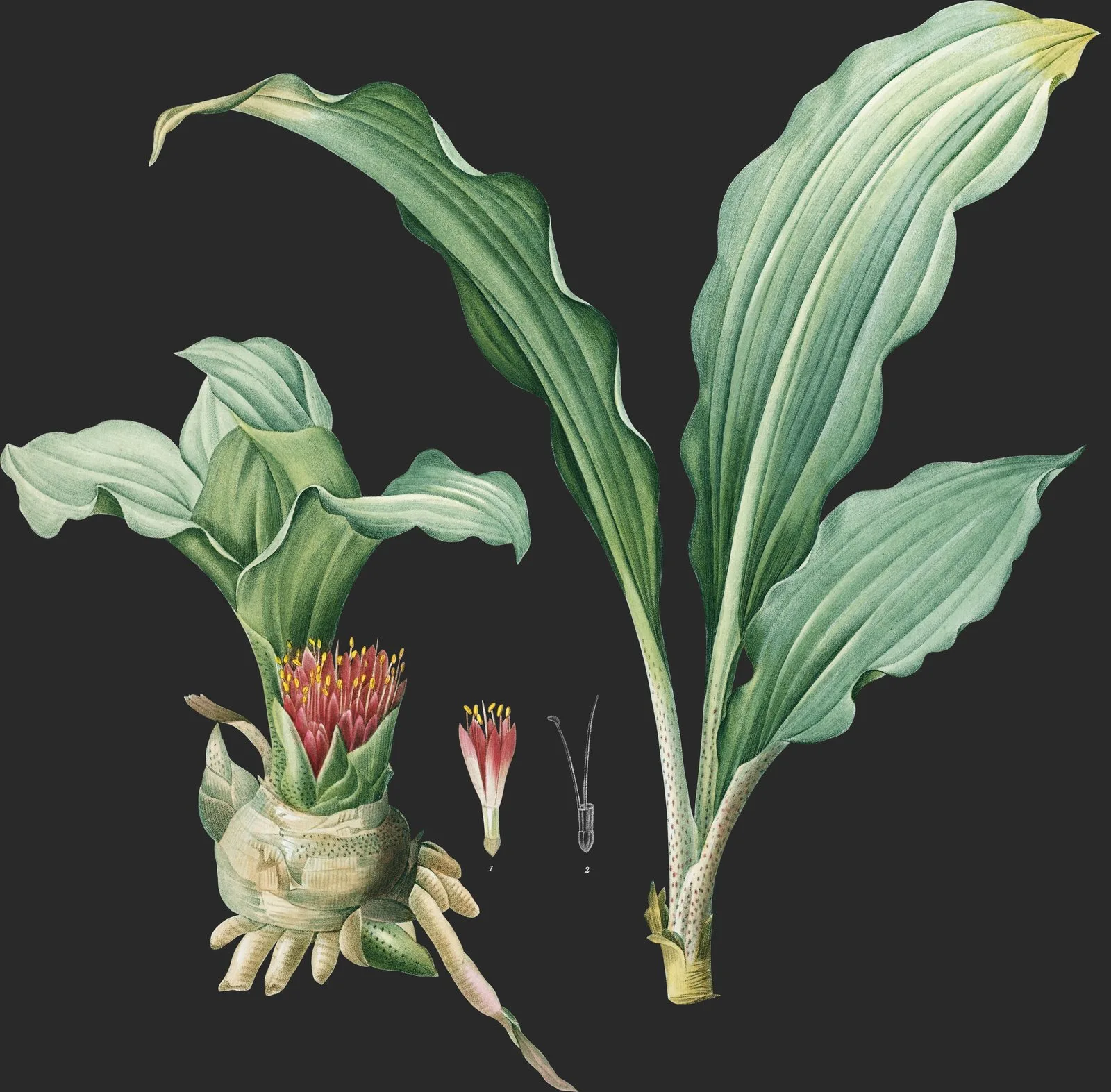
La bulbe de cette plante est arrondie, irrégulière, couverte de tuniques jau-nâtres, froncées circulairement. Elle émet un peu en dessous de son sommet des prolongements cylindriques, verts et charnus, qui se dirigent vers le bas en se réfléchissant sur sa convexité.
Les feuilles naissent du sommet de la bulbe et sont réunies en faisceau. Elles sont ovales, entières, glabres, fortement ondulées, engainantes à la base, obtuses, avec une petite pointe mousse formée par le prolongement de la nervure moyenne, qui est plus grosse que les autres. Les extérieures ont le limbe très-petit, ou presque nul, et sont marquées de petites taches pourpres très-nombreuses.
Les fleurs forment à côté du faisceau de feuilles un fascicule ou ombelle serrée, d’abord sessile sur la bulbe, puis portée sur une hampe de la grosseur du doigt, qui, s’allongeant peu à peu pendant la floraison, finit par atteindre la hauteur d’un ou deux décimètres. Elles sont nombreuses, presque sessiles au fond de la spathe, qui est formée de sept à huit folioles, lancéolées, droites, concaves, comprimées latéralement à leur sommet, vertes, avec des taches brunes.
Le périgone est d’un rouge pile, adhérent inférieurement à l’ovaire, et divisé, dans toute sa partie libre, en six lanières, droites, serrées les unes contre les autres, linéaires-lancéolées, un peu dilatées dans le haut, obtuses, concaves au sommet, qui est un peu en forme de capuchon et hérissé de poils courts.
Les filaments des étamines sont filiformes, épais, droits, de la même couleur que les divisions du périgone, à la base desquelles ils sont insérés, et qu’ils dépassent un peu. Ils supportent des anthères ovales-allongées, jaunes, redressées, à deus loges qui s’ouvrent latéralement.
L’ovaire est adhérent, d’un vert très-pale, irrégulièrement arrondi, et plus large dans le haut que dans le bas. Le style est droit, filiforme, d’abord plus court que les étamines, mais les dépassant ensuite, tordu sur lui-même en spirale, et terminé par un stigmate simple, blane, aigu.
Nous n’avons pas vu le fruit.
Histoire
L’Hémanthe à feuilles de colchique est originaire du Cap de Bonne-Espé-rance. C’est une des espèces de ce genre les plus anciennement introduites dans les jardins d’Europe. Elle demande à être abritée dans la serre chaude. Sa floraison commence au mois de mai, et dure près de deux mois.
Explication de la planche
La Plante entière de grandeur naturelle.
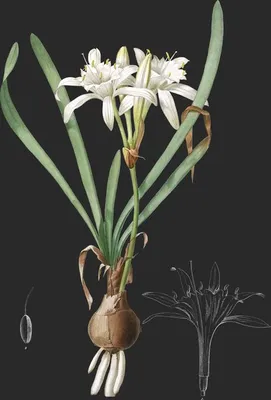
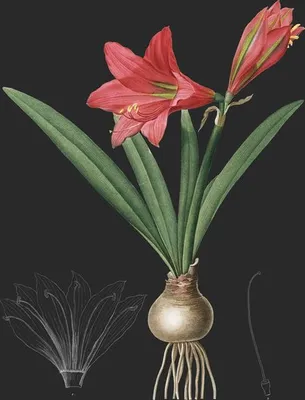
- Une fleur détachée.
- Une fleur dont le limbe a été enlevé de manière à montrer une étamine et le style.
Fam. des Narcisses. Juss.—Hexandrie monogynie. Lin.
- Hæmanthus puniceus. H. foliis oblongis ellipticis acutis retusis undulatis, umbellâ coaretatâ fastigiatâ, limbo staminibusque erectis. Ait. Kew. 1. p. 404. Willd. sp. pl. 2. p. 25. Hort. Berol. 1. 348. Pers. enchir. 1. p. 348.
- Hæmanthus puniceus. H. foliis petiolatis oblongis erectis undulatis glabris. Thunb. prodr. 59.
- Hæmanthus puniceus. H. foliis lanceolato-ovatis undulatis erectis. Hort. Cliff. 17. Hort. Ups. 88. Roy. Lugd-b. 43. Lin. sp. pl. 413 exclus. synon. Swertii, Moris. et Sebæ. Mill. dict. n. 3. Lam. dict. 3. p. 102.
- Hamanthus colchici foliis, perianthio herbaceo. Dill. Eltham. 167. t. 140. f. 2. Trew. Ehret. 44.
Twelve ways of seeing
- measured cast yellow-green
- square 0.98 : 1
- published 1811
- Plate 320
Not a catalogue entry but a way of looking: how to stand, what to notice, how the line was cut, when it flowers, where it came from, who made it — and then the poems and the classics that taught China to see the same flower. Read the twelve in order and the plate opens.
-
First Look
凡画山水,意在笔先。
—— 唐·王维《山水论》
In painting, the intention precedes the brush.
Nearly square, plant and detail each holding a corner. Then step in close: watch where colour meets line, and whether the line ever breaks. Third, find where the green is deepest: the whole tonal order is measured from that patch. The pose leans right: the upper half carries 9 points further right than the lower — a living thing, not a diagram.
-
Name and Thing
No reliable binomial survives, so the printed title must serve. The older system filed it under Amaryllidaceæ by overall affinity; Linnaeus, counting stamens only, placed it in Hexandria — two ways of asking what a plant is. Neither name nor binomial survives: the printed title must do.
-
Form and Colour
Measured on this plate: flower colour covers 3.2% of the sheet, foliage 11.9%, the cast yellow-green with a second note of red. No other plate shares exactly this measure. Bulbous plants store the year underground — bulb, corm or tuber — then send up a few thick leaves and a single scape, with six tepals in cup, funnel or star. Filed under green — a moss green, a colour that comes mostly from leaf and stem. Read the outline, then the colour layers, then the brush.
-
Composition
Nearly square, plant and details sharing the corners. (about 0.98 : 1) No details are appended: a plate for looking, not for keying out. The plant takes about 30% of the sheet, centred above centre — the easy measure most florists kept to. Cover the margins with your thumb and the plate suffocates; uncover them and the flower breathes again.
-
Line and Colour
The first half of the nineteenth century moved from copper to steel to lithography; stipple could render the softest transition. Decide first whether it was printed or painted; only then discuss whether it is beautiful.
-
Season
Early spring to early summer, genus by genus: tulips and hyacinths first, gladiolus and amaryllis later. The year 1811 on the plate is that of publication, not of flowering — the gathering came a year or two earlier. The plate records ten days of peak; the other three hundred are leaf, fruit and rest.
-
Provenance
Three homelands: the Mediterranean, Central Asia and South Africa. The tulip came from Ottoman gardens and became a Dutch mania; South African bulbs filled European glasshouses after 1800. The volume was made in 1802-1816, when most of this knowledge came from living plants under glass.
-
The Book and the Hand
“The Liliaceae” was drawn by Pierre-Joseph Redouté and published 1802-1816. This plate is Plate 320, book page 320. The image is public domain; the hand-colouring is still one person's hand.
-
Poetic Resonance
兰陵美酒郁金香,玉碗盛来琥珀光。
—— 唐·李白《客中行》
Fine wine of Lanling, fragrant with turmeric; poured in a jade bowl, it glows like amber.
The poem gives the mood first and the picture supplies the form; set the line beside the plate and the green the corolla becomes its resting point.
-
The Written Tradition
天地与我并生,而万物与我为一。
—— 《庄子·齐物论》
Heaven and earth were born with me, and the ten thousand things are one with me.
Li Bai's 'orchid wine, fragrant with yujin' is often misread as tulips; the Tang yujin was a turmeric-like root used to scent wine — same name, different plant. Keep the line; it will surface the next time you meet the same plant.
-
Symbolism
The tulip was an imperial emblem in Istanbul and a speculative bubble in Amsterdam; the hyacinth sprang from a boy's blood in Greek myth. What bulbs share is concealment: next year kept underground. In a flora it is a species first and a symbol second; the order is worth keeping.
-
What to Take Away
If you keep one line, keep Guo Xi's: from afar its momentum, up close its texture. A flora exists to be consulted; look long enough and you forget to consult — someone in 1811 gave a whole day to a single flower.