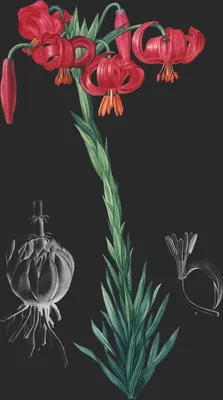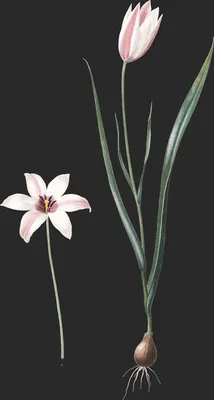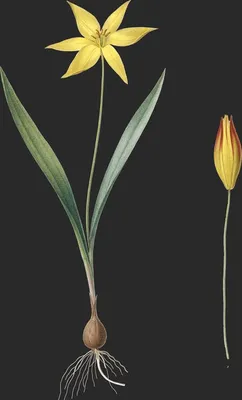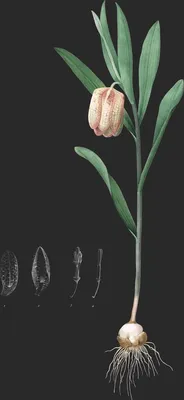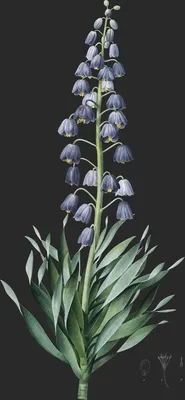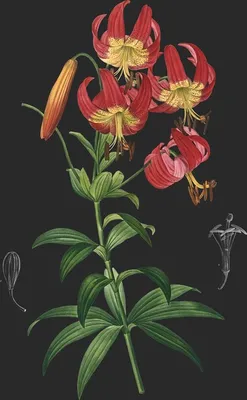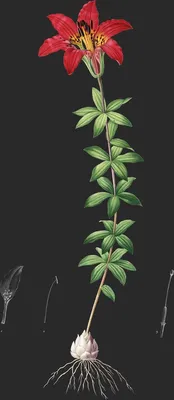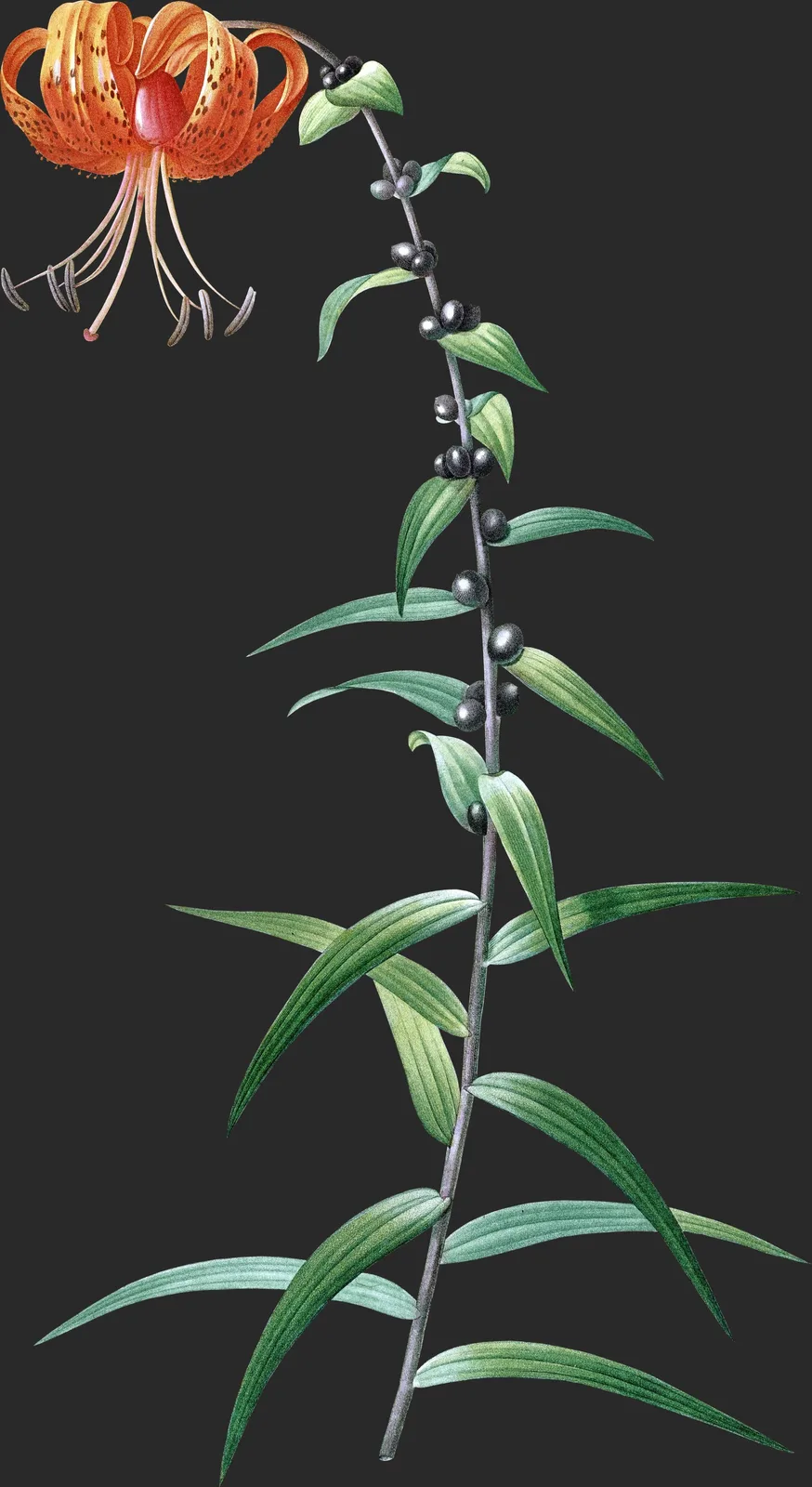
Lilium Tigrinum
十字园蛛
Lis de Chine
Ten ways of seeing
- measured cast amber
- upright 1.83 : 1
First Look
搜尽奇峰打草稿。
—— 清·石涛《苦瓜和尚画语录》
Exhaust the strange peaks, and then make the sketch.
The sheet is vertical: the eye climbs and settles in the upper half. Let the plant stand before you look for detail. Then step in close: watch where colour meets line, and whether the line ever breaks. Third, find where the green is deepest: the whole tonal order is measured from that patch. The pose leans left: the upper half carries 19 points further left than the lower — a living thing, not a diagram.
Name and Thing
The binomial is Lilium tigrinum: the first word is the genus it belongs among, the second the epithet that sets it apart. The genus name Lilium: Lilium comes from Greek leirion, the classical name for the white lily. The older system filed it under Liliaceæ by overall affinity; Linnaeus, counting stamens only, placed it in Hexandria — two ways of asking what a plant is. The Chinese name 十字园蛛 is a modern rendering of the Latin, not an old garden name.
Form and Colour
Measured on this plate: flower colour covers 3.5% of the sheet, foliage 6.6%, the cast amber with a second note of red. No other plate shares exactly this measure. A bulb of overlapping fleshy scales gives the lily its Chinese name, 'hundred-fold'; six tepals reflex as the flower opens, around six stamens with long, T-shaped anthers. a moss green. Read the outline, then the colour layers, then the brush.
Composition
The sheet is tall. No details are appended: a plate for looking, not for keying out. The plant covers only 15% of the sheet, centred near the centre; the emptiness is where the eye rests.
Line and Colour
The first half of the nineteenth century moved from copper to steel to lithography; stipple could render the softest transition. Decide first whether it was printed or painted; only then discuss whether it is beautiful. If you mean to copy it: take its skeleton, its margins and the order of its colours; the burin's hatching is the language of copper — suggest it with pencil density, do not imitate it stroke for stroke.
Poetic Resonance
方石斛栽香百合,小盆山养水黄杨。
—— 宋·陆游《龟堂杂兴十首 其五》
The poem gives the mood first and the picture supplies the form; set the line beside the plate and the green the corolla becomes its resting point.
Symbolism
In the West the white lily is Marian purity, held by the angel of the Annunciation; in China the name sounds like 'a hundred years in harmony', a wedding wish. Flower language was added later; the flower knows nothing of it, and that innocence is part of its power.
Season and Place
the flowers last only days, so artists drew them just as they opened. Temperate north — China, Japan, Europe. Long used in Chinese medicine, lilies were hunted in East Asia by nineteenth-century collectors and transformed European gardens. The year 1812 on the plate is that of publication, not of flowering — the gathering came a year or two earlier. The bud and the ripe fruit on one branch tell the season; the name in the title often tells the journey.
The Book and the Hand
“The Liliaceae” carries only Pierre-Joseph Redouté's name. The image is public domain; the hand-colouring is still one person's hand.
What to Take Away
Next time you stand before a flowering plant, give it three minutes: leaf arrangement, direction of the flower, the darkest patch. The flower of that year is dust, yet its image on paper has outlived every living cousin.
About this plate
Description
La tige de ce beau Lis est haute de plus d’un mètre, grèle, cylindrique, d’un brun noirátre, couverte de poils nombreux, longs et couchés, chargée de feuilles dans toute son étendue, à l’exception de sa base.
Les feuilles sont éparses, linéaires-lancéolées, rétrécies à leurs deux extré-mités, aigués, entières, glabres, d’un vert foncé et luisantes en dessus, plus pales en dessous. Les feuilles supérieures sont beaucoup plus petites, ovales-lancéolées. A laisselle des unes et des autres sont deux ou trois petites bulbes noires, luisantes, qui, étant mises en terre, donnent naissance à de nouvelles plantes. La plupart de ces bulbes tombent & l’époque de la floraison.
Dans les jeunes individus, et celui dont nous donnons ici la ligure était dans ce cas, la tige ne porte qu’une seule fleur; mais dans les individus Agés il y a sur la même tige un assez grand nombre de fleurs disposées en panicule terminal. Ces fleurs sont pendantes, dépourvues de bractées.
Le périgone est d’une belle couleur rouge, un peu orangée, parsemé à l’intérieur d’un grand nombre de petites taches ovales, pourpres, divisé jusqu’à sa base en six segments lancéolés, longs de huit ou neuf centimètres, obtus, bossus au sommet et tris-légèrement pubescents dans cet endroit, recourbés en dehors, de manière que leur sommet vient rejoindre le pédoncule près de son extrémité, comme dans le Lis martagon. L’intérieur de chacun de ces segments présente auprés de sa base deux petites crètes longitudinales, qui, se joignant par leur bord libre, forment le long de la nervure moyenne un canal triangulaire. Antour de ces crètes sont des filaments longs de quatre ou einq millimètres, les uns glabres, les autres barbus.
Les filaments des étamines sont filiformes, blanchätres ou d’un rouge très-pale, longs de six centimètres, droits et rapprochés les uns des autres dans leur moitié la plus proche de leur base, divergents dans le reste de leur étendue. Les anthères sont vacillantes, oblongues, d’une couleur pourpre foncé.
L’ovaire est vert, prismatique, long de quinze millimètres. Le style est égal en longueur aux étamines, plus épais que leurs filaments, un peu triangu-laire, arqué. Le stigmate est d’une couleur pourpre, de forme triangulaire et semblable, pour sa disposition, à ceux des autres Lis.
Histoire
Cette plante, l’une des plus remarquables du beau genre à laquelle elle appartient, est originaire du Japon, de la Chine et des pays voisins. On la introduite depuis quelques années dans les jardins d’Angleterre, et depuis deux ou trois ans seulemeut dans ceux de Paris. C’est daus celui de M. Boursaut qu’à fleuri l’individa dont nous donnons ici la figure.
Fam. des Lis. Juss.—Hexandrie monogynie. Lin.
- Lilium tigrinum. L. foliis sparsis lanceolatis in axilla bulbiferis, caule villoso corollis pendolis revolutis intas maculatis.
- Lilium tigrinum. L. foliis sparsis sessilibus quinquenerviis, superioribus cordato-ovatis, corollis revolutis intús papillosis. Ait. Kew. ed. alt. 2, p. 241.
- Lilium tigrinum. Gawl. in Curt. botan. mag. 1237.
- Lilium speciosum. L. foliis sparsis ovato-oblongis, floribus cernuis mox revolutis, caule ramoso. Andr. bot. rep. 586.
- Lilium Sinense Hortulan.
- Lilium pomponium. β. Loureir. fl. Coch. 207.
- Kentan vulgò oni juri. Kaempf. Amœn. exot. fasc. 5. p. 871.