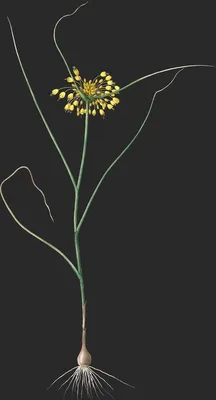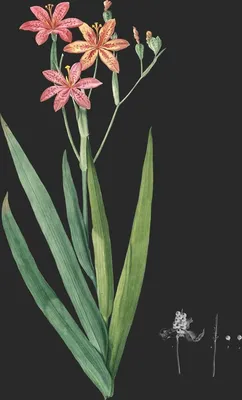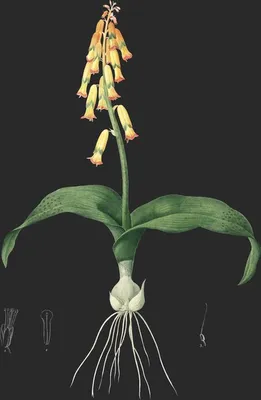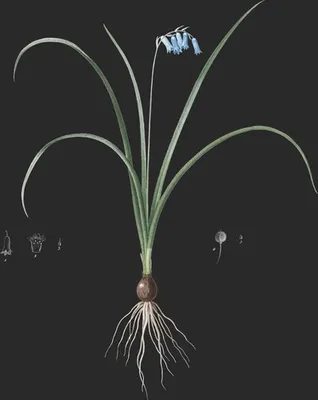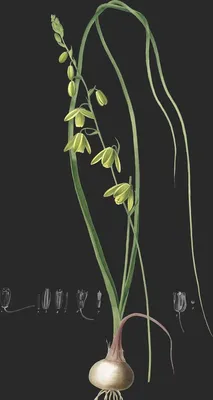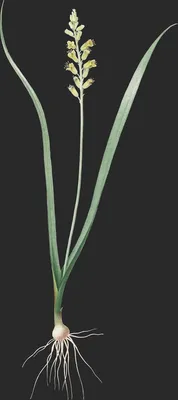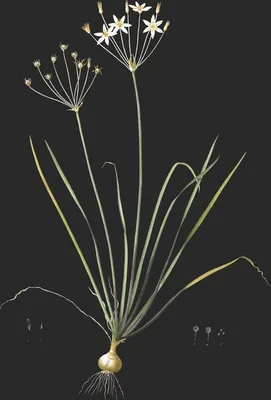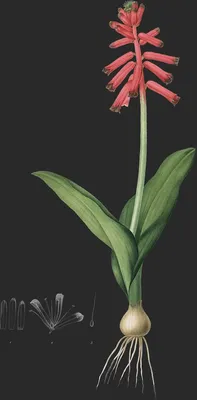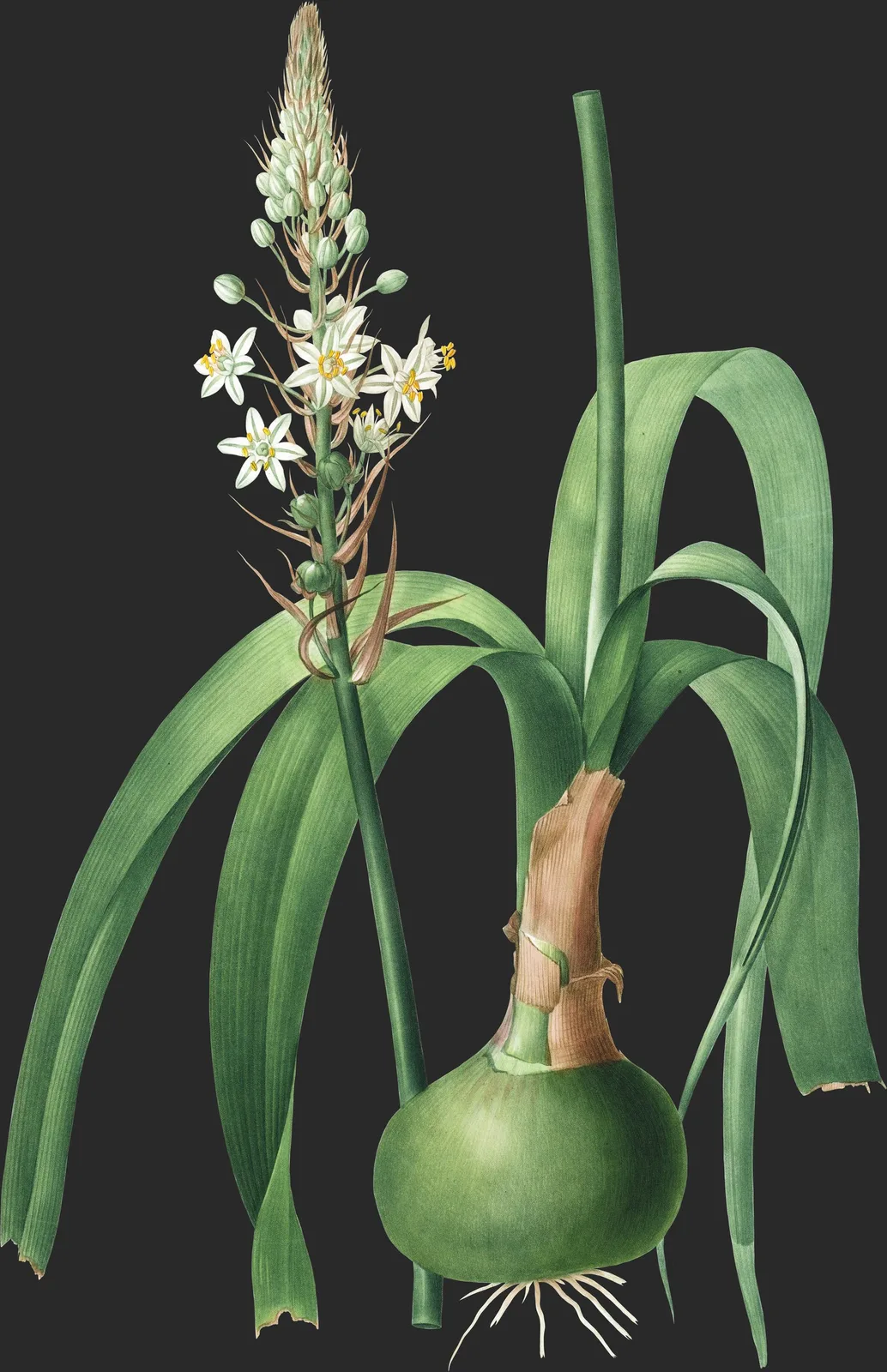
Ornithogalum Longibracteatum
Ornithogale a Longues Bractées
Ornithogale a Longues Bractées
Ten ways of seeing
- measured cast amber
- upright 1.55 : 1
First Look
搜尽奇峰打草稿。
—— 清·石涛《苦瓜和尚画语录》
Exhaust the strange peaks, and then make the sketch.
The sheet is vertical: the eye climbs and settles in the upper half. Let the plant stand before you look for detail. Then step in close: watch where colour meets line, and whether the line ever breaks. Third, find where the green is deepest: the whole tonal order is measured from that patch.
Name and Thing
No reliable binomial survives, so the printed title must serve. The older system filed it under Asphodelaceæ by overall affinity; Linnaeus, counting stamens only, placed it in Hexandria — two ways of asking what a plant is. Neither name nor binomial survives: the printed title must do.
Form and Colour
Measured on this plate: flower colour covers 3.2% of the sheet, foliage 23.8%, the cast amber with a second note of yellow-green. No other plate shares exactly this measure. Camellias are evergreen shrubs with thick, waxen, serrate leaves; the double flowers overlap like roof tiles and fall whole, petals still attached. a moss green. A single plant, laid out with nothing hidden.
Composition
The sheet is tall. No details are appended: a plate for looking, not for keying out. The plant takes about 31% of the sheet, centred below centre — the easy measure most florists kept to.
Line and Colour
The first half of the nineteenth century moved from copper to steel to lithography; stipple could render the softest transition. Decide first whether it was printed or painted; only then discuss whether it is beautiful. If you mean to copy it: take its skeleton, its margins and the order of its colours; the burin's hatching is the language of copper — suggest it with pencil density, do not imitate it stroke for stroke.
Poetic Resonance
山茶相对阿谁栽,细雨无人我独来。
—— 宋·苏轼《邵伯梵行寺山茶》
The poem gives the mood first and the picture supplies the form; set the line beside the plate and the green the corolla becomes its resting point.
Symbolism
In China the camellia is the friend that endures; in Europe it became Eastern beauty and unattainability, and after La Dame aux Camélias, a token of brief life. In a flora it is a species first and a symbol second; the order is worth keeping.
Season and Place
a single flower may last a fortnight. when it reached Europe in the nineteenth century it was hailed as 'the rose of the East'. The year 1804 on the plate is that of publication, not of flowering — the gathering came a year or two earlier. The bud and the ripe fruit on one branch tell the season; the name in the title often tells the journey.
The Book and the Hand
“The Liliaceae” carries only Pierre-Joseph Redouté's name. From drawing to plate the sheet passed through several hands — the engraver aimed at accuracy, the colourist at speed, and between them lies each plate's unevenness.
What to Take Away
Next time you stand before a flowering plant, give it three minutes: leaf arrangement, direction of the flower, the darkest patch. A flora exists to be consulted; look long enough and you forget to consult — someone in 1804 gave a whole day to a single flower.
About this plate
Description
Cette espèce est facile à reconnaitre, même avant l’époque de sa fleuraison, à l’énorme grosseur de sa bulbe, qui atteint le diamètre d’une pomme, et dont la moitié supérieure est habituellement hors de terre, au moins dans les individus cultivés en vase dans nos serres.
Ses feuilles sont radicales, embrassantes à leur base, courbées en dessus en forme de canal, longues de 5 à 6 décimètres, sur 4 à 5 centimètres de largeur, lancéolacées, pointues, étalées, glabres, et d’un vert assez foncé; du milieu de ces feuilles s’élève une hampe cylindrique, glabre, pleine, ferme, haute de près d’un mètre, terminée par une longue grappe de fleurs blanches qui commencent à s’épanouir par la base, dont la fleuraison dure plusieurs mois.
Ces fleurs sont portées chacune sur un pédicelle lisse, cylindrique, long de a à 3 centimètres; ce pédicelle sort de l’aisselle d’une bractée lancéolée, verte et foliacée dans le milieu de sa surface, blanche sur les bords, longue de 5 à 6 centimètres, c’est-à-dire, doubles de la longueur des pédicelles.
La corolle est à six pétales ou six lobes très-profonds, disposés sur deux rangs, ouverts, oblongs, obtus, de couleur blanche, traversés dans leur longueur par une large raie verte, qui est surtout visible au dehors.
Les étamines sont au nombre de six; leurs filets sont blanes, droits, épais, dilatés à leur base, surtout dans les trois étamines qui sont placées devant les trois pétales extérieurs; ce sont aussi ces trois étamines qui sont les premières à répandre leur pollen: les anthères sont oblongues, jaunâtres, versatiles, à deux loges.
L’ovaire est libre, vert, à trois angles obtus, à trois faces un peu concaves; le style est droit, triangulaire, blanc, égal en longueur aux filets des étamines, terminé par un stigmate obtus, à trois angles.
Le fruit est une capsule arrondie, triangulaire, à trois loges, à trois valves chargées chacune d’une cloison sur leur face interne, remplie d’un grand nombre de graines noires et anguleuses.
Histoire
Cette plante est originaire du Cap-de-Bonne-Espérance: elle est vivace et facile à cultiver; aussi est-elle très-répandue dans les jardins de botanique; elle fleurit presque tout l’hiver dans la serre tempérée.
Explication de la planche
La plante de grandeur naturelle, avec la hampe coupée en deux parties.
Fam. des Asphodèles. Juss.—Hexandrie monogynie. Lin.
- Ornithogalum longibracteatum. O, racemo longissimo, bracteis pedunculis ferè duplolongioribus, foliis lanceolato-ansiformibus. Murr. Syst. veg. 327. Jacq. hort. Vind. t. 29. Wild. Spec. 2. p. 120. Lam. Dict. 4. p. 614.
- Ornithogalum bracteatum. O. foliis ansiformibus acuminatis, bracteis floribus longioribus. Thunb. prod. 62.