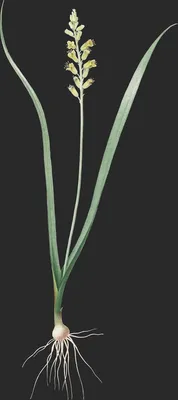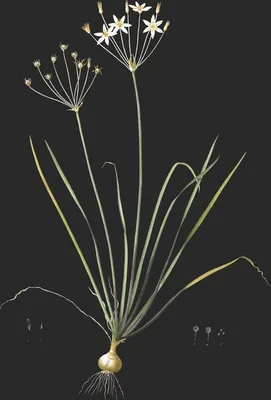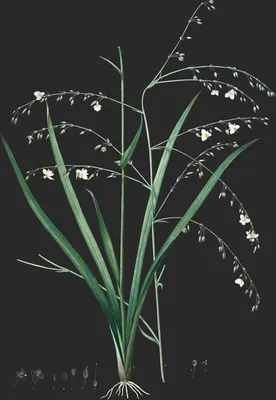
Lachenalia Tricolor
立金花属·Lachenalia Tricolor
Lachenale Tricolore
About this plate
Description
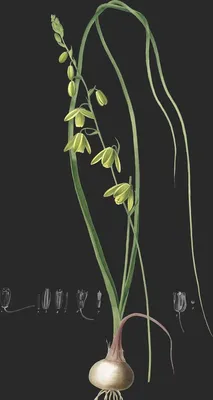
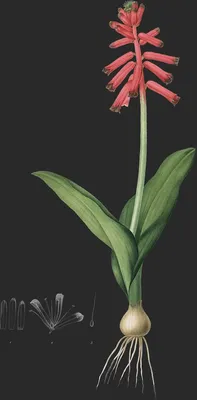
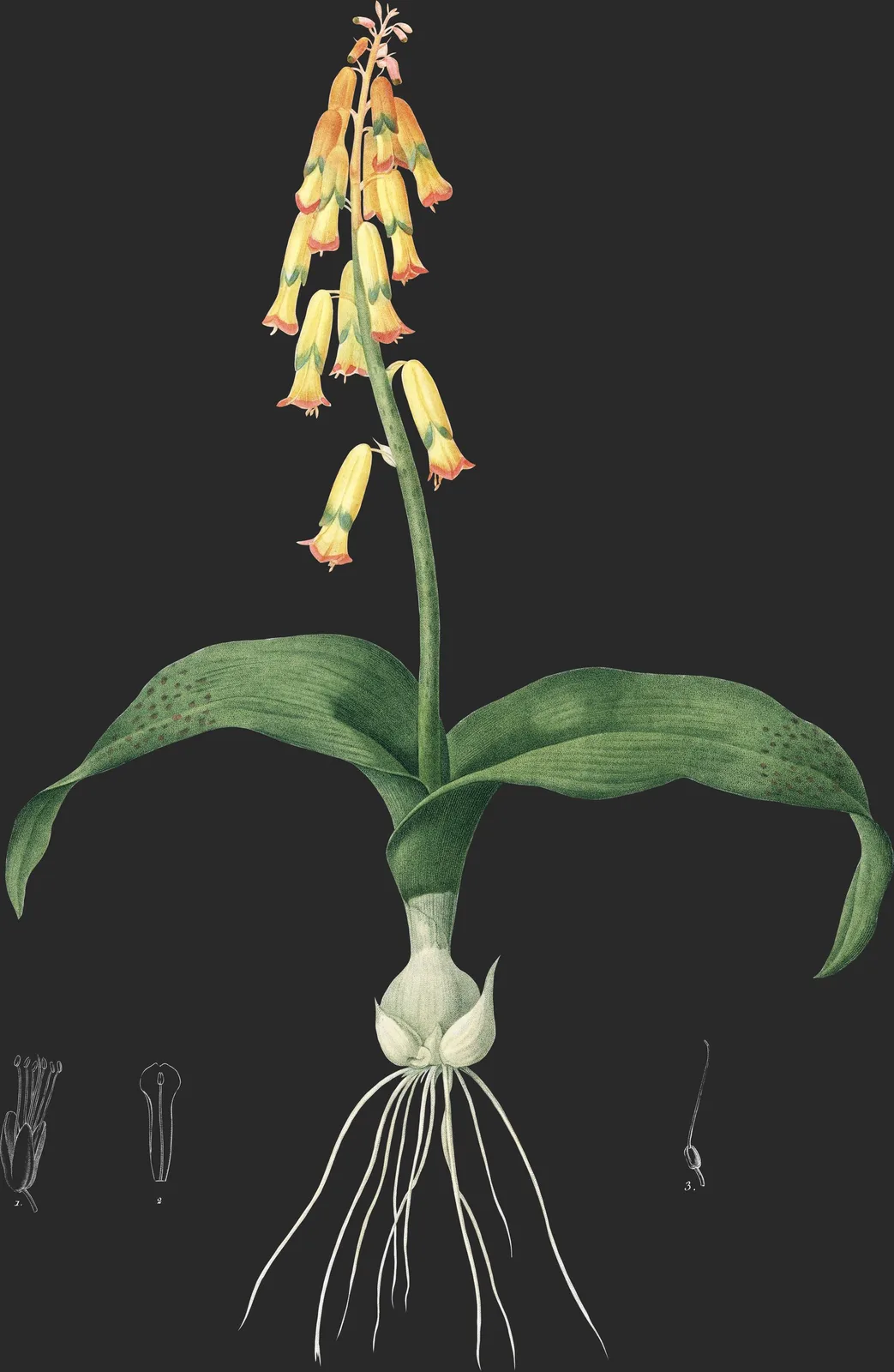
La Lachenale tricolore se reconnait facilement au premier coup-d’œil, à cause des taches brunes dont ses feuilles et sa hampe sont mouchetées.
La bulbe est arrondie, formée par la base des feuilles qui se dilate: elle émet des fibres épaisses, cylindriques, simples, blanchâtres et peu nombreuses. De cette racine sortent quatre à cinq feuilles étalées, lancéolées, pointues, glabres, mouchetées en dessus vers leur sommet de taches brunes, rondes, éparses; les feuilles atteignent 12–15 centimètres de longueur sur 4–5 de largeur: entre les feuilles s’élève une hampe cylindrique, glabre, verte, mouchetée de taches oblongues, haute d’un décimètre; elle porte une grappe simple, alongée, lâche, dont les fleurs sont disposées en ordre quinconce. Ces fleurs sont pendantes et portées sur un pédicelle horizontal, cylindrique, de couleur orangée, de 10–12 millimètres de longueur: une bractée lancéolée, colorée, se trouve à la base de chaque pédicelle, et atteint presque sa longueur.
La fleur est munie de six divisions ou pétales; les trois extérieures (qu’on pourrait regarder comme le calice, parce qu’elles sont un prolongement du pédicelle) sont oblongues, obtuses, concaves, épaisses, orangées dans le bas, calleuses et verdâtres au sommet, longues de 19–15 millimètres; les trois intérieures (qu’on peut regarder comme la corolle, car elles sont distinctes du pédicelle) sont plus minces et du double plus longues que les précédentes, oblongues, en spatule, concaves, surtout dans la partie infériente, obtuses, quelquefois échancrées on dentelées au sommet, jaunâtres dans le bas, d’un rouge pourpre au sommet.
Dans cette fleur, on trouve six étamines, dont trois sont insérées sur la base des divisions extérieures, et trois sur celle des divisions intérieures; les filets atteignent la longueur de ces dernières; ils portent des anthères assex petites, oblongues, roses avant la fécondation, puis d’une conleur violette.
L’ovaire est arrondi, verditre, a trois angles obtus, à trois faces marquées d’un sillon; il porte un style filiforme, pointu, jaune, égal à la longueur des étamines, terminé par un stigmate blane en tête.
Lovaire se change en une capsule à trois angles, à trois faces, à trois loges, qui renferme plasieurs graines globuleuses.
Histoire
La Lachenale tricolore habite au Cap-de-Bonne-Espérance. Elle est fort répandue dans les jardins de botanique, et même dans les jardins des amateurs: elle y fleurit à la fin du printemps.
On la tient dans la serre chaude.
Observations
Cette espèce diffère de la Lachenale rougeâtre, parce que le style ne dépasse point les étamines, que les feuilles sont lancéolées et les pétales intérieurs échancrés.
Explication de la planche
La Plante de grandeur naturelle.
- La fleur dont on a ôté les trois pétales intérieurs pour laisser voir les étamines.
- Un pétale intérieur avec l’étamine insérée à sa base.
- Le pistil.
Fam. des Asphodèles. Juss.—Hexandrie monogynie. Linn.
- Lachenalia tricolor. L. corollis cylindraceis pedunculatis pendolis, petalis interioribus longioribus emarginatis, bractois acutis, foliis lanceolatis. Wild. Spec. 179.
- Lachenalia tricolor. Ait. Kew. p. 461. Thunb. prod. 64.
- Phormium aloides. Lin. f. suppl. 205.
- A. foliis lineari-lanceolatis, petalis interioribus apice rubris. Ait.
- Lachenalia tricolor. Jacq. ic. rar. 1. t. 61.
- B. foliis oblongo-lanceolatis, corollis flavis basi rubentibus. Ait.
- Lachenalia tricolor. Curt. Mag. 1. 82.
- Lachenalia luteola. Jacq. Ic. 2. t. 395. Coll. 4. p. 148.*
Ten ways of seeing
- measured cast yellow-green
- upright 1.53 : 1
- published 1802
- Plate 2
Not a catalogue entry but a way of looking: how to stand, what to notice, how the line was cut — then, halfway, a line of Chinese poetry: how the ancients saw this same flower. After it, the flower's language, its season and homeland, its book; and at the end one line of classical prose — and a pair of eyes to take away.
-
First Look
论画以形似,见与儿童邻。
—— 宋·苏轼《书鄢陵王主簿所画折枝》
To judge painting by likeness alone is the view of a child.
The sheet is vertical: the eye climbs and settles in the upper half. Let the plant stand before you look for detail. Then step in close: watch where colour meets line, and whether the line ever breaks. Third, find where the green is deepest: the whole tonal order is measured from that patch. The pose leans left: the upper half carries 12 points further left than the lower — a living thing, not a diagram.
-
Name and Thing
The binomial is Lachenale tricolore: the first word is the genus it belongs among, the second the epithet that sets it apart. Two words carry a whole provenance. The older system filed it under Asphodelaceæ by overall affinity; Linnaeus, counting stamens only, placed it in Hexandria — two ways of asking what a plant is. No established Chinese name exists, so it is cited by its binomial alone.
-
Form and Colour
Measured on this plate: flower colour covers 2.9% of the sheet, foliage 6.7%, the cast yellow-green with a second note of amber. No other plate shares exactly this measure. A bulb of overlapping fleshy scales gives the lily its Chinese name, 'hundred-fold'; six tepals reflex as the flower opens, around six stamens with long, T-shaped anthers. Filed under green — a moss green, a colour that comes mostly from leaf and stem. Three things fix the habit: leaf arrangement, tepal count, and how the flower is borne.
-
Composition
Tall and narrow, the plant rising in one movement with generous margins — the upright format of most floras. (about 1.53 : 1) No details are appended: a plate for looking, not for keying out. The plant covers only 12% of the sheet, centred near the centre; the emptiness is where the eye rests. Old plates set the plant slightly off centre, with unequal margins — that small imbalance is what keeps it alive.
-
Line and Colour
The first half of the nineteenth century moved from copper to steel to lithography; stipple could render the softest transition. Decide first whether it was printed or painted; only then discuss whether it is beautiful. If you mean to copy it: take its skeleton, its margins and the order of its colours; the burin's hatching is the language of copper — suggest it with pencil density, do not imitate it stroke for stroke.
-
Poetic Resonance
更乞两丛香百合,老翁七十尚童心。
—— 宋·陆游《窗前作小土山蓻兰及玉簪最后得香百合并种之戏作》
The poem gives the mood first and the picture supplies the form; set the line beside the plate and the green the corolla becomes its resting point.
-
Symbolism
In the West the white lily is Marian purity, held by the angel of the Annunciation; in China the name sounds like 'a hundred years in harmony', a wedding wish. In a flora it is a species first and a symbol second; the order is worth keeping.
-
Season and Place
the flowers last only days, so artists drew them just as they opened. Temperate north — China, Japan, Europe. Long used in Chinese medicine, lilies were hunted in East Asia by nineteenth-century collectors and transformed European gardens. The year 1802 on the plate is that of publication, not of flowering — the gathering came a year or two earlier. The volume was made in 1802-1816, when most of this knowledge came from living plants under glass.
-
The Book and the Hand
“The Liliaceae” was drawn by Pierre-Joseph Redouté and published 1802-1816. This plate is Plate 2, book page 2. The image is public domain; the hand-colouring is still one person's hand.
-
The Written Tradition
生川谷。《吴普》曰:百合一名重迈,一名中庭,生冠朐及荆山。(艺文类聚引云:一名重匡)《名医》曰:一名重箱,一名摩罗,一名中逢花,一名强瞿,生荆州,二月八月,采根,暴干。
—— 神农本草经·百合第一百七十
The Bencao Gangmu describes the bulb as garlic-like, edible and medicinal; Song writers already noted that the leaves vary while the flowers stay white. You need not parse every word: take the line, and the flower acquires a second face.
What to Take Away
Next time you stand before a flowering plant, give it three minutes: leaf arrangement, direction of the flower, the darkest patch. The flower of that year is dust, yet its image on paper has outlived every living cousin.