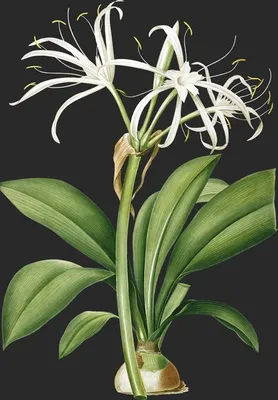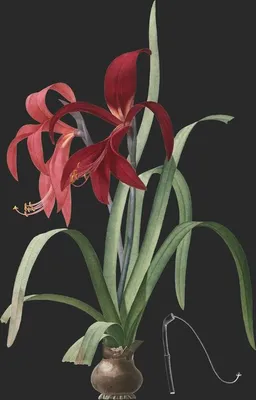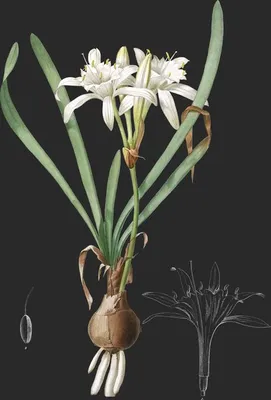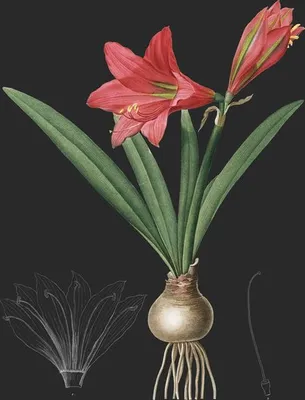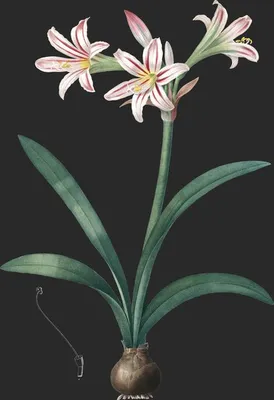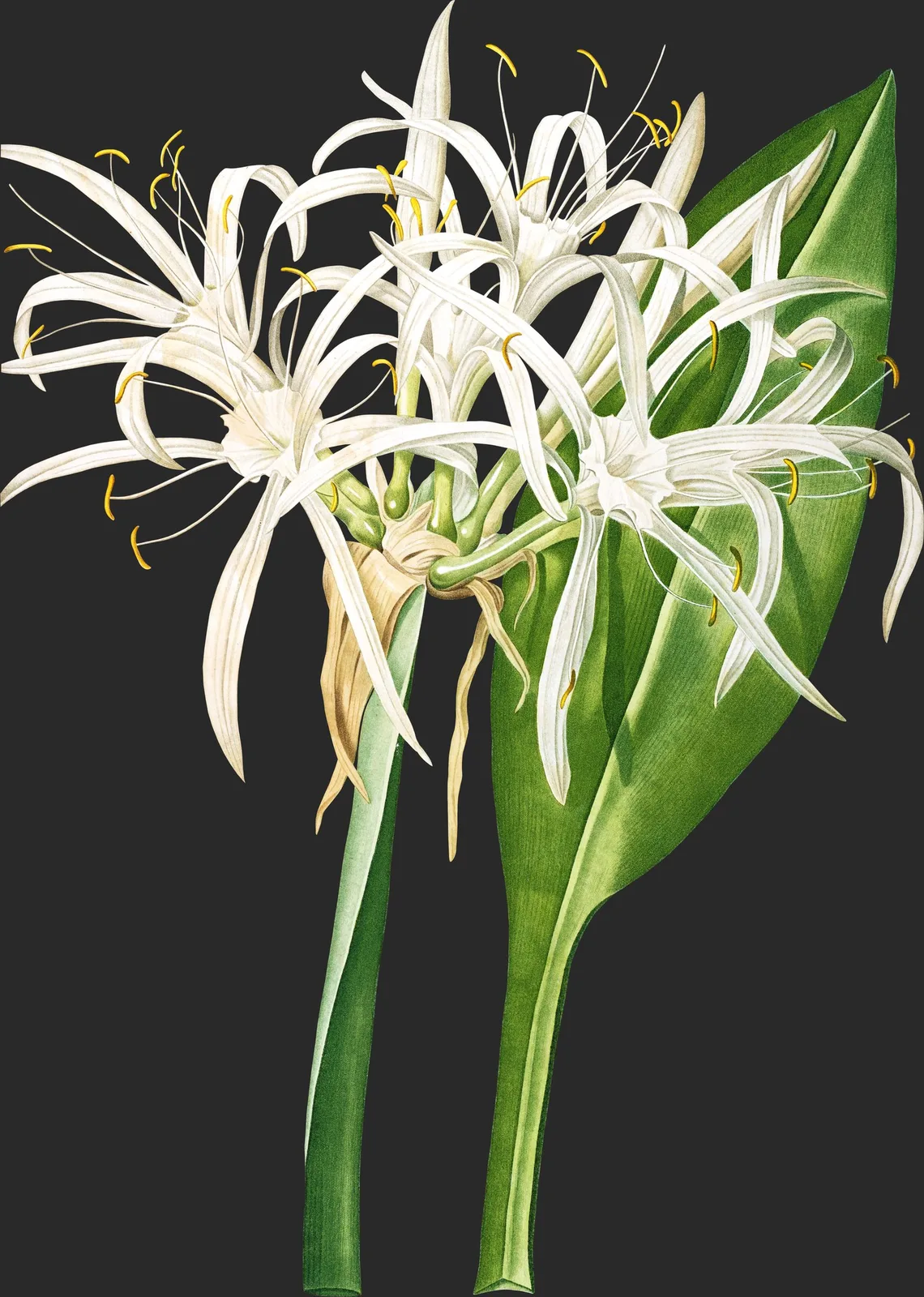
Pancratium Speciosum
全能花属·Pancratium Speciosum
Pancrace a Belles Fleurs
Ten ways of seeing
- measured cast yellow-green
- upright 1.40 : 1
First Look
论画以形似,见与儿童邻。
—— 宋·苏轼《书鄢陵王主簿所画折枝》
To judge painting by likeness alone is the view of a child.
The sheet is vertical: the eye climbs and settles in the upper half. Let the plant stand before you look for detail. Then step in close: watch where colour meets line, and whether the line ever breaks. Third, find where the green is deepest: the whole tonal order is measured from that patch.
Name and Thing
The binomial is Pancratium speciosum: the first word is the genus it belongs among, the second the epithet that sets it apart. Two words carry a whole provenance. The older system filed it under Amaryllidaceæ by overall affinity; Linnaeus, counting stamens only, placed it in Hexandria — two ways of asking what a plant is. No established Chinese name exists, so it is cited by its binomial alone.
Form and Colour
Measured on this plate: flower colour covers 3.6% of the sheet, foliage 13.5%, the cast yellow-green with a second note of amber. No other plate shares exactly this measure. Bulbous plants store the year underground — bulb, corm or tuber — then send up a few thick leaves and a single scape, with six tepals in cup, funnel or star. a moss green. Read the outline, then the colour layers, then the brush.
Composition
The sheet is tall. No details are appended: a plate for looking, not for keying out. The plant takes about 36% of the sheet, centred a little right of centre — the easy measure most florists kept to.
Line and Colour
The first half of the nineteenth century moved from copper to steel to lithography; stipple could render the softest transition. Decide first whether it was printed or painted; only then discuss whether it is beautiful. If you mean to copy it: take its skeleton, its margins and the order of its colours; the burin's hatching is the language of copper — suggest it with pencil density, do not imitate it stroke for stroke.
Poetic Resonance
兰陵美酒郁金香,玉碗盛来琥珀光。
—— 唐·李白《客中行》
Fine wine of Lanling, fragrant with turmeric; poured in a jade bowl, it glows like amber.
The poem gives the mood first and the picture supplies the form; set the line beside the plate and the green the corolla becomes its resting point.
Symbolism
The tulip was an imperial emblem in Istanbul and a speculative bubble in Amsterdam; the hyacinth sprang from a boy's blood in Greek myth. What bulbs share is concealment: next year kept underground. Flower language was added later; the flower knows nothing of it, and that innocence is part of its power.
Season and Place
Early spring to early summer, genus by genus: tulips and hyacinths first, gladiolus and amaryllis later. South African bulbs filled European glasshouses after 1800. The year 1812 on the plate is that of publication, not of flowering — the gathering came a year or two earlier. The bud and the ripe fruit on one branch tell the season; the name in the title often tells the journey.
The Book and the Hand
“The Liliaceae” carries only Pierre-Joseph Redouté's name. From drawing to plate the sheet passed through several hands — the engraver aimed at accuracy, the colourist at speed, and between them lies each plate's unevenness.
What to Take Away
Carry three rules away: whole before detail; line before colour; picture before book. The flower of that year is dust, yet its image on paper has outlived every living cousin.
About this plate
Description
La bulbe de ce beau Pancrace est ovale, couverte de tuniques vertes. Les feuilles sont assez nombreuses, ovales-lancéolées, aiguës, d’un vert un peu foncé, glabres, demi-étalées, rétrécies inférieurement en un pétiole étroit et épais. Leur longueur, y compris celle du pétiole, est de six décimètres environ. La hampe est haute de cinq décimètres environ, droite, roide, verte, glabre, extrêmement comprimée, surtout dans le haut, à deux tranchans aigus.
Les fleurs sont nombreuses, portées sur des pédicelles épais, longs d’un cen-timètre. La spathe est à deux valves, ovales lancéolées, longues de dix ou donze centimètres, demi foliacées, blanchâtres, se renversant de bonne heure en dehors; des bractées linéaires presque aussi longues séparent les fleurs.
Le tube du périgone est vert, anguleux, non strie, long de neuf à dix centi-mètres, en y comprenant l’ovaire. Le limbe est d’un très-beau blane, divisé jusqu’an tabe en six lanières linéaires-lancéolées, longues de douze centime-tres, larges de dix à douze millimètres, étalées et un peu recourbées en dehors. Trois de ces lanières sont un pen obtuses; les trois autres sont aigues et portent en dedans, auprès de leur sommet, une petite pointe ou sorte de crochet dirigée en arrière.
Les étamines sont un peu plus courtes que le périgone. Leurs filaments sont en forme d’alène, blancs dans le bas, verdatres dans le haut, égaux entre eux, joints inférieurement par un nectaire en forme de cloche à douze dents, dont six accompagnent les filaments des étamines, et les six autres se terminent en pointe. Quelquefois ces dernières sont divisées plus ou moins profondément. Les anthères sont vacillantes, linéaires, jaunes, longues de deus centimètres, insérées un peu au dessous de leur partie moyenne.
L’ovaire est ovale, à trois angles obtas. Le style est filiforme, égal en longueur aux divisions du périgone, blanc dans le bas, verdâtre dans le haut, fléchi à sa sortie du tube, et déjeté vers la partie supérieure de la fleur.
Histoire
Le Pancrace à belles fleurs est cultivé depuis une vingtaine d’années dans les jardins de botanique; mais on ignore d’où il est originaire. Notre description et notre dessin ont été faits d’après un individu cultivé dans les serres du jardin de la Malmaison, où il était en fleur au mois de mai.
Observations
Nous avons décrit sous le nom de Pancratium speciosum, dans le cours de cet ouvrage, une plante que nous avons reconnu depuis appartenir à une autre espèce. Mais quelle est cette espèce? c’est ce que nous ne pouvons décider positivement, n’ayant pas eu occasion de revoir notre plante depuis longtemps. Nous croyons cependant qu’elle est nouvelle, sa tige, cylindrique dans le haut, ne permettant pas de la réunir au Pancratium declinatum, dont elle semblerait se rapprocher à d’autres égards.
Fam. des Narcisses. Juss.—Hexandrie monogynie. Lin.
- Paneratium speciosum. P. foliorum petiolis angustis, corolla tabo triangulo rare striato, laciniis tabo longioribus patenti-recurvatis linearibus, alternis concavioribus, coronæ sinubus ligulâ bilidâ. Salisb. in act. Soc. Lin. Lond. 2. p. 3. t. 12.
- Pancratiam speciosum. P. spathâ multillorâ, folis ellipticis, nectarii dentibus sex staminibus, intermediis simplicibus acutis. Willd. sp. pl. 2. p. 44. Ait. hort. Kew. ed. alt. 2. p. 219. exclus. syn. Bor. mag. et Liliac.