Tulipa Sylvestris
Tulipa Sylvestris
Tulipe Sauvage
About this plate
Description
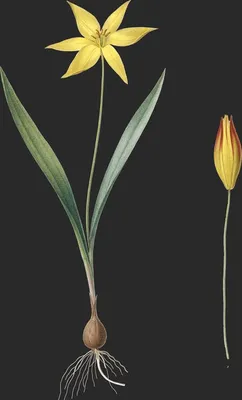
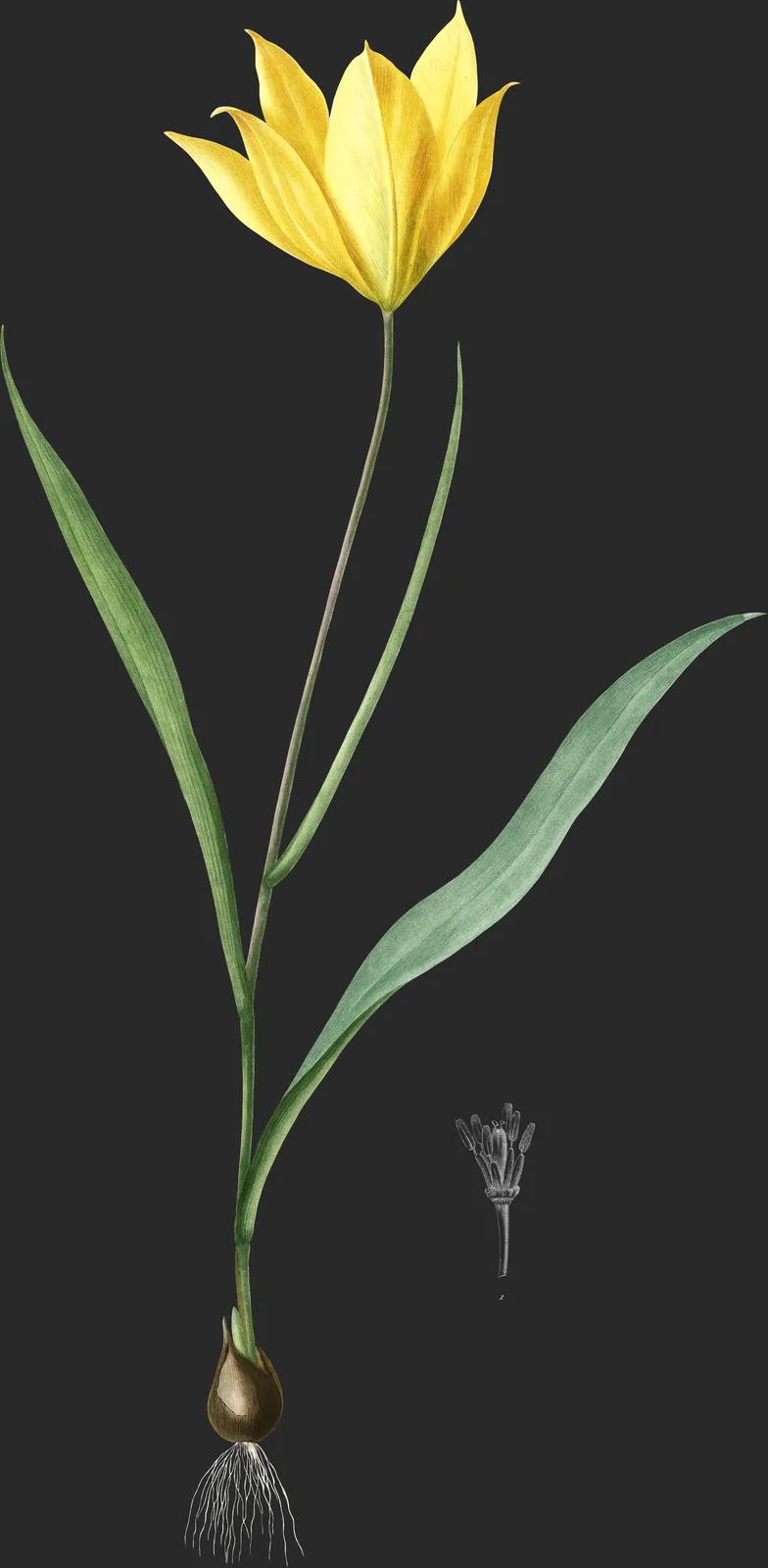
La Tulipe sauvage se distingue facilement de toutes les espèces de ce beau genre, à sa tige chargée d’une seule fleur jaune, dont les lanières sont légèrement barbues à leur extrémité.
Sa racine est une bulbe arrondie, blanche, de la grosseur d’une pomme d’api; sa tige est droite, cylindrique, glabre, longue de a à 3 décimètres, nue dans sa partie supérieure, garnie dans le bas de deux à trois fenilles: celles-ci sont étalées, un peu engainantes à leur base, oblongues, légèrement concaves, glabres, couvertes de poussière glauque; elles atteignent la longueur de la tige, et leur extrémité, qui est calleuse, offre une légère pubescence lorsqu’on la voit à la loupe.
La fleur est jaune, inodore, nue, penchée avant son épanouissement, ensuite droite, solitaire au sommet de la tige. Son périgone est à six pièces ovales-oblongues, rétrécies aux deux extrémités, pointues, calleuses et pubescentes au sommet; les trois extérieures sont un peu épaisses, verdâtres à la surface exté-rieure, souvent roulées en dehors; les trois intérieures sont plus minces, plus larges, plus jaunes, moins ouvertes et garnies vers leur base de quelques cils mous et blanchâtres.
Les étamines sont placées devant chacune des pièces du périgone; leurs filaments sont jaunes, en forme d’alene, un peu velus à leur base; les trois qui sont placés devant les lamières intérieures de la fleur sont les plus longues et dépassent presque la longueur de l’ovaire; les anthères sont jaunes, com-primées, oblongues, obtuses, terminées par une trés-petite pointe, a deux loges pleines d’un pollen jaune.
Lovaire est vert, glabre, épais, en forme de prisme triangulaire, trois fois plus court, épais, sessile, garni de petites papilles visibles à la loupe. Il se change en une capsule ovoide-triangulaire, a trois loges, à trois valves chargées d’une cloison sur leur face interne, à plusieura graines disposées sur deux rangs dans chaque loge, planes et de couleur noire.
Histoire
La Tulipe sauvage croit naturellement dans la plus grande partie de l’Europe, et notamment dans presque toute la France; on la trouve dans les prés, au bord des haies. Elle fleurit au printemps. ♃.
Sa racine est vomitive, d’après l’autorité de Haller, mais elle est hors d’usage en médecine.
On trouve quelquefois des individus de cette plante qui, au lieu de six, ont huit pièces au périgone, huit étamines et quatre loges à l’ovaire.
Observations
La variété B des auteurs qui a la fleur odorante, plus petite que celle-ci, parait constituer une espèce distinete qui a déjà été indiquée par Link sous le nom de Tulipa australis. Dillère-t-elle de notre Tulipa celsiana?
La Talipa clasiana est indigène des champs aux environs de Madrid, comme je l’apprends par un échantillon qui m’en a été envoyé par M. Lagasca. Cava-nilles la désignait dans ses leçons sous le nom de Tulipa præcox, faisant allusion a la phrase de l’Ecluse, Tulipa persica præcox.
Fam. des Liliacées. Juss.—Hexandrie monogynie. Lin.
- Tulipa sylvestris. T. caule unifloro glabro, flore subnutante, petalis lanceolato-acuminatis apice barbatis, staminibus basi hirsutis. Flor. franç. syn. n. 1903.
- Tulipa sylvestris. T. caule unifloro glabro, flore subnutante, petalis acutis apice barbatis, foliis lanceolatis. Willd. Spec. 2. p. 96.
- Tulipa sylvestris. T. flore subnutante, folis lanceolatis. Lin. Spec. 438. Flor. suec. 2. n. 284. Hall. helv. n. 1236. Scop. carn. n. 407. Gou. illustr. 25. Pall. itin. 3. p. 562. Hoffm. germ. 118. Œd. Fl. dan. t. 375. Roth. germ. I. 158. II. 397. Lam. Fl. fr. 3. p. 299. engl. bot. t. 63. Desf. atl. 1. p. 294.
- Tulipa sylvestris. T. flore solitario subnutante, foliis lanceolatis, stigmate obtuso triquetro, staminibus basi hirsutis. Smith. Fl. brit. t. 1. p. 361.
- Tulipa minor lutea gallica. C. Bauh. pin. 63. Tourn. inst. 376. Moris. hist. s. 4. r. 17. f. 9.
Twelve ways of seeing
- measured cast yellow-green
- upright 2.04 : 1
- published 1805
- Plate 165
Not a catalogue entry but a way of looking: how to stand, what to notice, how the line was cut, when it flowers, where it came from, who made it — and then the poems and the classics that taught China to see the same flower. Read the twelve in order and the plate opens.
-
First Look
夫象物必在于形似,形似须全其骨气。
—— 唐·张彦远《历代名画记》
Likeness is the threshold; bone-and-breath is the point.
The sheet is vertical: the eye climbs and settles in the upper half. Let the plant stand before you look for detail. Then step in close: watch where colour meets line, and whether the line ever breaks. Third, find where the yellow is deepest: the whole tonal order is measured from that patch.
-
Name and Thing
The binomial is Tulipe sauvage: the first word is the genus it belongs among, the second the epithet that sets it apart. Two words carry a whole provenance. The older system filed it under Liliaceæ by overall affinity; Linnaeus, counting stamens only, placed it in Hexandria — two ways of asking what a plant is. No established Chinese name exists, so it is cited by its binomial alone.
-
Form and Colour
Measured on this plate: flower colour covers 4.7% of the sheet, foliage 3.1%, the cast yellow-green. No other plate shares exactly this measure. A bulb of overlapping fleshy scales gives the lily its Chinese name, 'hundred-fold'; six tepals reflex as the flower opens, around six stamens with long, T-shaped anthers. Filed under yellow — a honey-yellow, built in washes from a pale ground. A single plant, laid out with nothing hidden.
-
Composition
Tall and narrow, the plant rising in one movement with generous margins — the upright format of most floras. (about 2.04 : 1) No details are appended: a plate for looking, not for keying out. The plant covers only 11% of the sheet, centred above centre; the emptiness is where the eye rests. Cover the margins with your thumb and the plate suffocates; uncover them and the flower breathes again.
-
Line and Colour
The first half of the nineteenth century moved from copper to steel to lithography; stipple could render the softest transition. Craft leaves franker evidence than inscriptions.
-
Season
Early to high summer, June and July; the flowers last only days, so artists drew them just as they opened. The year 1805 on the plate is that of publication, not of flowering — the gathering came a year or two earlier. The plate records ten days of peak; the other three hundred are leaf, fruit and rest.
-
Provenance
Temperate north — China, Japan, Europe. Long used in Chinese medicine, lilies were hunted in East Asia by nineteenth-century collectors and transformed European gardens. In the same volume the kin are shelved together; set several plates side by side.
-
The Book and the Hand
“The Liliaceae” was drawn by Pierre-Joseph Redouté and published 1802-1816. This plate is Plate 165, book page 165. The image is public domain; the hand-colouring is still one person's hand.
-
Poetic Resonance
方石斛栽香百合,小盆山养水黄杨。
—— 宋·陆游《龟堂杂兴十首 其五》
The poem gives the mood first and the picture supplies the form; set the line beside the plate and the yellow the corolla becomes its resting point.
-
The Written Tradition
气之动物,物之感人,故摇荡性情,形诸舞咏。
—— 南朝梁·钟嵘《诗品序》
The vital breath moves things, things move men, and the stirred heart takes shape in song.
The Bencao Gangmu describes the bulb as garlic-like, edible and medicinal; Song writers already noted that the leaves vary while the flowers stay white. The difference is not of quality but of question: Europe asks what it is, China asks whom it resembles.
-
Symbolism
In the West the white lily is Marian purity, held by the angel of the Annunciation; in China the name sounds like 'a hundred years in harmony', a wedding wish. This plate leans yellow, which in flower language adds one more degree of feeling. Meanings change their tune: the same flower can say opposite things within a century.
-
What to Take Away
If you keep one line, keep Guo Xi's: from afar its momentum, up close its texture. A flora exists to be consulted; look long enough and you forget to consult — someone in 1805 gave a whole day to a single flower.