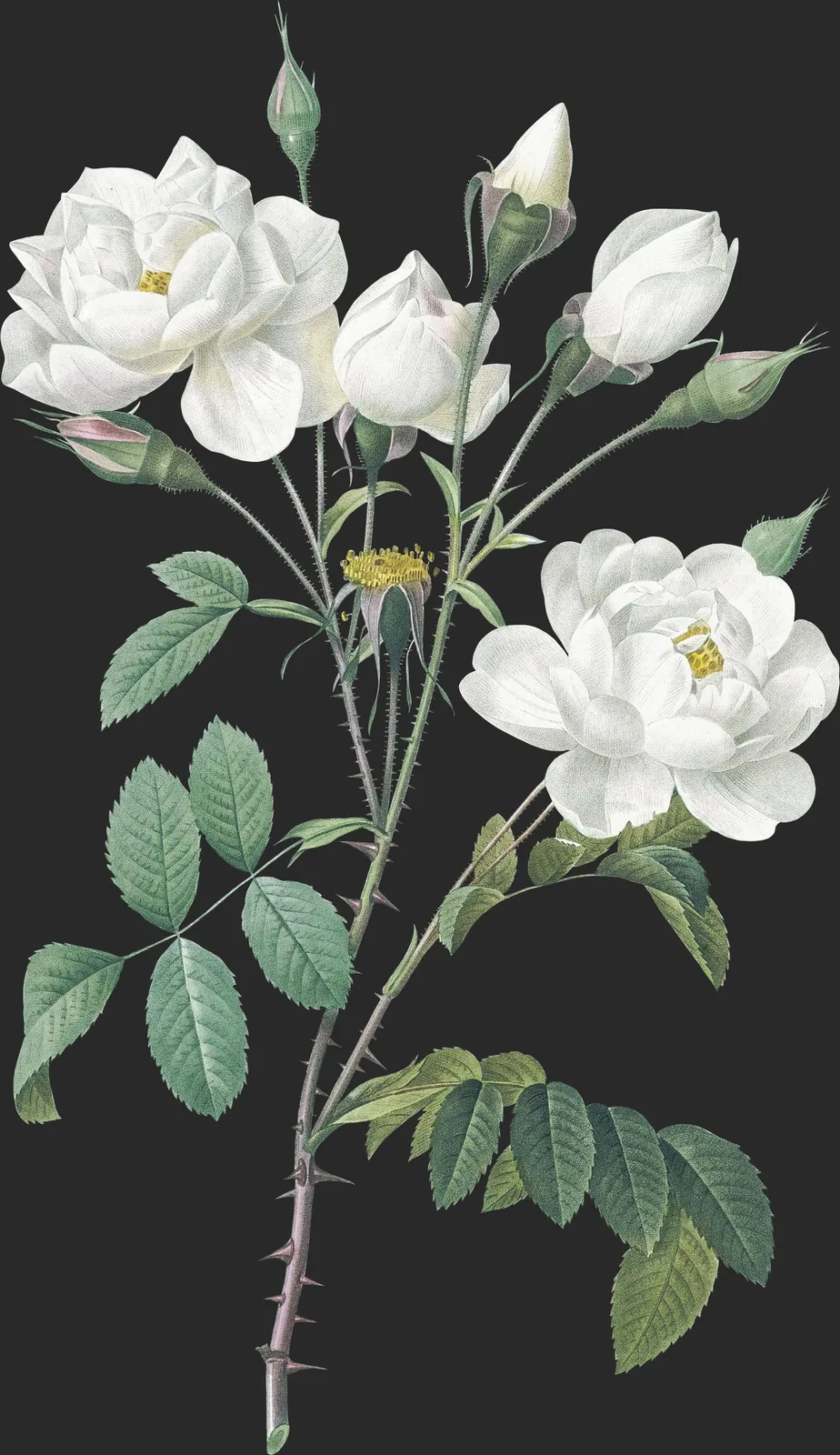
Rosa Campanulata var Flore Albo
Le Rosier Campanulé
Le Rosier Campanulé
About this plate
Description
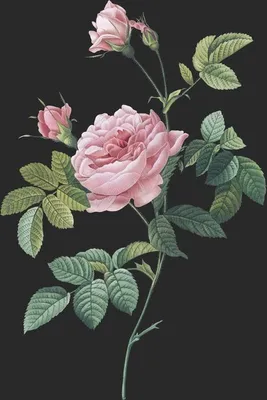
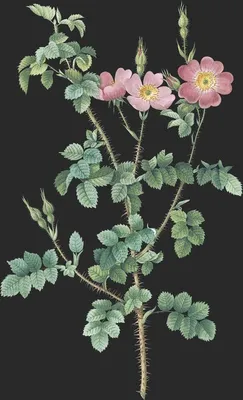
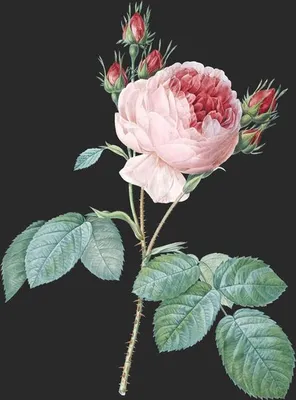
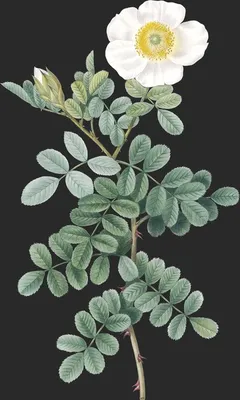
Il s’élève en buisson à la hauteur de deux pieds, ou environ. Ses rameaux sont armés d’aiguillons presque droits sur les branches florifères, et un peu courbés sur la tige principale. Ses feuilles se composent de sept et souvent de neuf folioles d’un vert glauque en-dessus, plus pâle en-dessous, glabres, ovales et simplement dentées. Elles sont portées par des pétioles légèrement velus, garnis de très-petits aiguillous jaunâtres, ayant à leur base des stipules étroites, bifides et pointues au sommet. Les fleurs sont tantôt solitaires, tantôt disposées par deux ou trois à l’extrémité des rameaux. Les pédoncules qui les supportent sont longs, couverts d’un grand nombre de poils roides et glanduleux. Le tube du calice, évasé au sommet et pointu à la base, offre à-peu-près la forme d’une campanule: il est glabre à sa partie supérieure, et couvert, inférieurement, de poils pareils à ceux du pédoncule. de Les divisions du limbe, parfois entières, parfois munies de quelques pinnules, sont garnies, à l’intérieur, d’un duvet épais et blanchâtre, et munies de glandes sessiles sur leur bordure extérieure. La corolle, un peu odorante, présente cinq à six rangs de pétales blancs, ceux du centre un peu teints en rose, irrégulièrement échancrés au sommet, presque jaunes vers l’onglet, larges de dix à douze lignes. Etamines nombreuses.
Observations
Ce Rosier diffère de celui de Francfort par ses fleurs blanches, et ses rameaux florifères aiguillonnés; le Rosa rapa de M. Bosc s’en éloigne par ses feuilles luisantes; le turbinata inermis, par ses folioles entièrement glabres; et le Rosenbergiana, par ses rameaux hérissés d’un très-grand nombre d’aiguillons. Toutefois, la forme des tubes des calices, l’avortement d’une grande partie de ses fleurs, et d’autres caractères, le rangent naturellement dans le groupe des turbinatæ.
Il paraît constant que notre arbrisseau a été obtenu de semis, par M. Cugnot, jardinier, barrière de Sèvres, à Paris: mais nous devons dire que nous l’avons trouvé greffé dans beaucoup de jardins, notamment dans ceux de MM. Cels et Noisette; de M. Vibert, à Chenevières-sur-Marne; de M. Le Dru, maire de Fontenay-aux-Roses; de M. Catel, membre de l’Institut; de M. le docteur Cartier, et chez d’autres amateurs. C’est une jolie variété, et la seule du groupe des turbinatæ que nous ayons encore rencontrée à fleurs blanches.
Ten ways of seeing
- measured cast yellow-green
- upright 1.73 : 1
- published 1821
- Plate 102
First Look
竖划三寸,当千仞之高;横墨数尺,体百里之迥。
—— 南朝宋·宗炳《画山水序》
A vertical stroke of three inches stands for a cliff of a thousand fathoms; a few feet of ink holds a hundred li.
The sheet is vertical: the eye climbs and settles in the upper half. Let the plant stand before you look for detail. Then step in close: watch where colour meets line, and whether the line ever breaks. Third, find where the green is deepest: the whole tonal order is measured from that patch.
Name and Thing
The binomial is Rosa campanulata: the first word is the genus it belongs among, the second the epithet that sets it apart. Here the epithet campanulata means “bell-shaped” — the name records the feature the namer noticed first. No established Chinese name exists, so it is cited by its binomial alone.
Form and Colour
Measured on this plate: flower colour is sparing, 0.5% of the sheet against 6.3% of foliage, the cast tending yellow-green — as with pale or white blooms, outline and tone do the talking. Roses are shrubs or scramblers with pinnate leaves of three to seven serrated leaflets; the double flowers open in crumpled, inward-curling layers around a small knot of yellow stamens. Filed under green — a moss green, a colour that comes mostly from leaf and stem. A single plant, laid out with nothing hidden.
Composition
Tall and narrow, the plant rising in one movement with generous margins — the upright format of most floras. (about 1.73 : 1) No details are appended: a plate for looking, not for keying out. The plant takes about 36% of the sheet, centred near the centre — the easy measure most florists kept to. Blank paper is not unfinished work: it is where the eye rests.
Line and Colour
The first half of the nineteenth century moved from copper to steel to lithography; stipple could render the softest transition. There is evidence on the back too: the plate mark pressed into the paper, the slight relief of the pigment, lines worn shallow in a later printing. If you mean to copy it: take its skeleton, its margins and the order of its colours; the burin's hatching is the language of copper — suggest it with pencil density, do not imitate it stroke for stroke.
Poetic Resonance
蔷薇泣幽素,翠带花钱小。
—— 唐·李商隐《房中曲》
The poem gives the mood first and the picture supplies the form; set the line beside the plate and the green the corolla becomes its resting point.
Symbolism
In Europe the rose means love and secrecy ('sub rosa'); in Chinese verse the rambling rose leans and clings — lingering attachment rather than ardour. Meanings change their tune: the same flower can say opposite things within a century.
Season and Place
Late spring into early summer, peaking in May — the first flush of the garden year. the ever-blooming modern rose is a nineteenth-century crossing of European and Chinese stock. The year 1821 on the plate is that of publication, not of flowering — the gathering came a year or two earlier. The volume was made in 1817-1824, when most of this knowledge came from living plants under glass.
The Book and the Hand
“Les Roses” was drawn by Pierre-Joseph Redouté and published 1817-1824. This plate is Plate 102, book page 102. The image is public domain; the hand-colouring is still one person's hand.
What to Take Away
Appreciation is not knowledge but habit — one more look each time. The flower of that year is dust, yet its image on paper has outlived every living cousin.