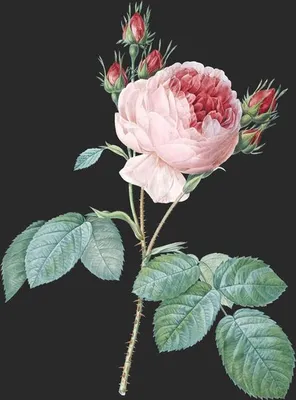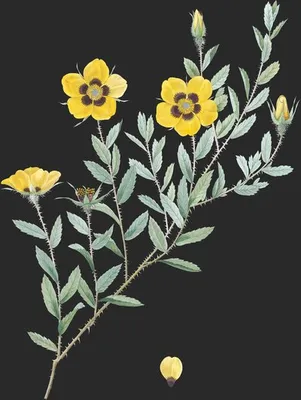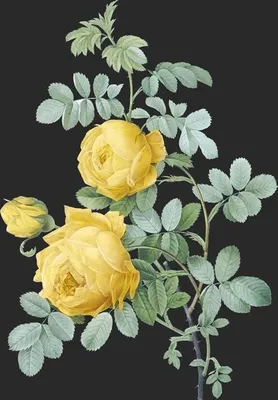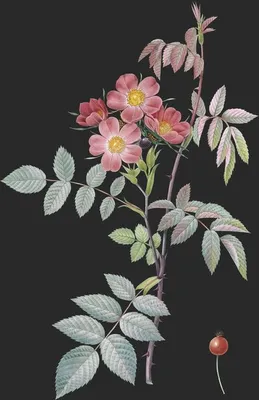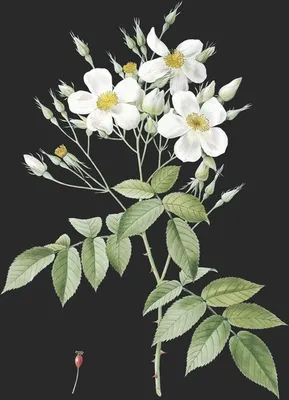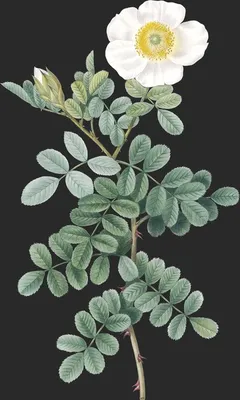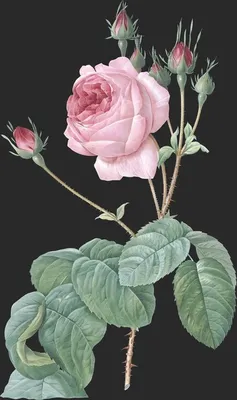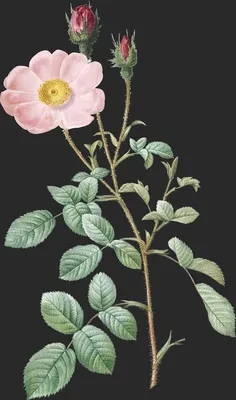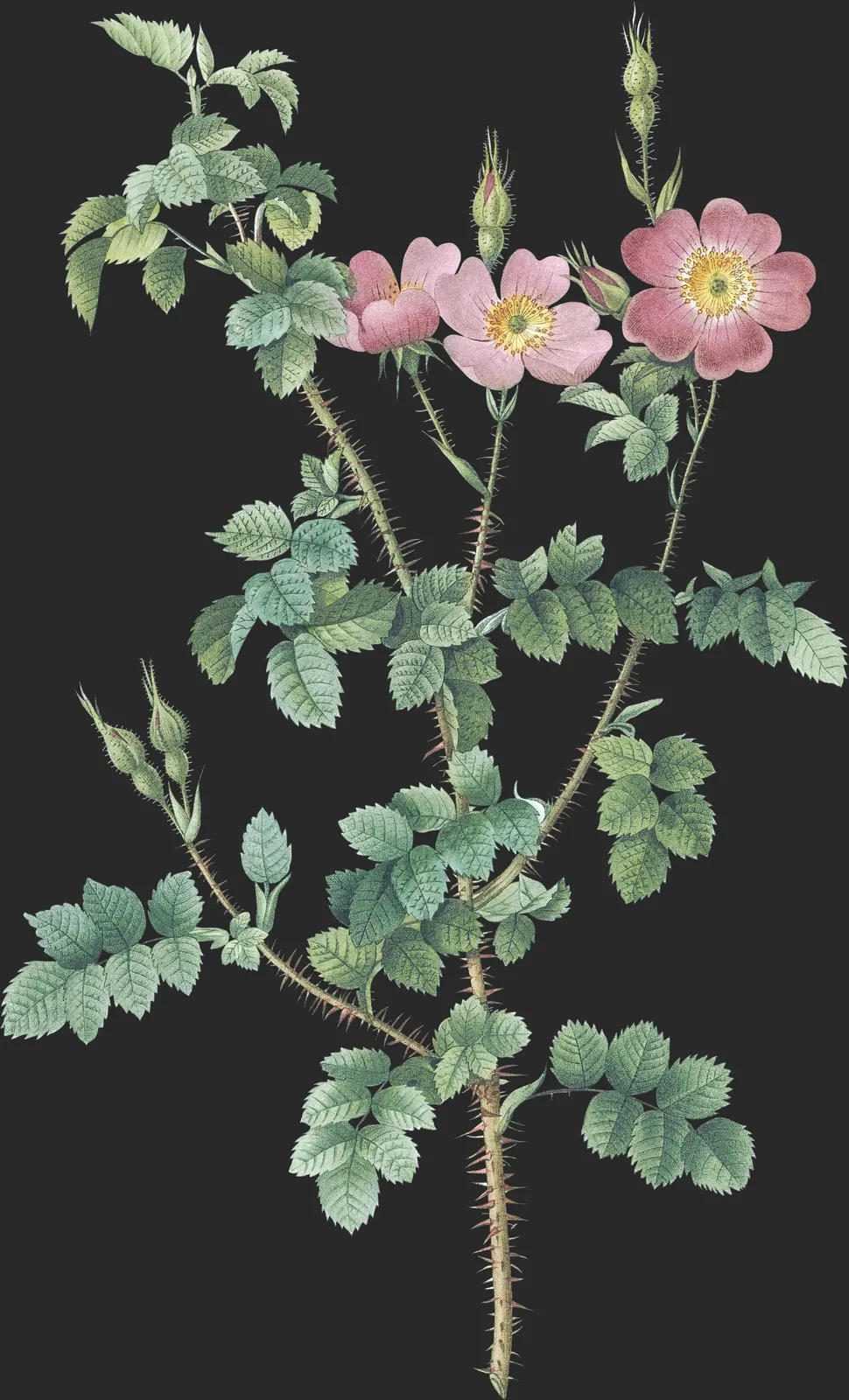
Rosa Rubiginosa var Aculeatissima
Le Rosier Rouillé
Le Rosier Rouillé
Ten ways of seeing
- measured cast red
- upright 1.65 : 1
First Look
六法者何?一、气韵生动是也;二、骨法用笔是也;三、应物象形是也;四、随类赋彩是也;五、经营位置是也;六、传移模写是也。
—— 南齐·谢赫《古画品录》
The six laws: spirit resonance alive; bone-method in the brush; matching form; colour by kind; planning the placing; copying the masters.
The sheet is vertical: the eye climbs and settles in the upper half. Let the plant stand before you look for detail. Then step in close: watch where colour meets line, and whether the line ever breaks. Third, find where the green is deepest: the whole tonal order is measured from that patch.
Name and Thing
The binomial is Rosa rubiginosa: the first word is the genus it belongs among, the second the epithet that sets it apart. The genus name Rosa: Rosa is simply the Latin for rose, from Greek rhodon. No established Chinese name exists, so it is cited by its binomial alone.
Form and Colour
Measured on this plate: flower colour covers 3.2% of the sheet, foliage 7.5%, the cast red with a second note of yellow-green. No other plate shares exactly this measure. Roses are shrubs or scramblers with pinnate leaves of three to seven serrated leaflets; the double flowers open in crumpled, inward-curling layers around a small knot of yellow stamens. a moss green. Read the outline, then the colour layers, then the brush.
Composition
The sheet is tall. No details are appended: a plate for looking, not for keying out. The plant takes about 28% of the sheet, centred near the centre — the easy measure most florists kept to.
Line and Colour
The first half of the nineteenth century moved from copper to steel to lithography; stipple could render the softest transition. Craft leaves franker evidence than inscriptions. If you mean to copy it: take its skeleton, its margins and the order of its colours; the burin's hatching is the language of copper — suggest it with pencil density, do not imitate it stroke for stroke.
Poetic Resonance
苍翠浓阴满院,莺对语,蝶交飞,戏蔷薇。
—— 《定西番·苍翠浓阴满院》
The poem gives the mood first and the picture supplies the form; set the line beside the plate and the green the corolla becomes its resting point.
Symbolism
In Europe the rose means love and secrecy ('sub rosa'); in Chinese verse the rambling rose leans and clings — lingering attachment rather than ardour. In a flora it is a species first and a symbol second; the order is worth keeping.
Season and Place
Late spring into early summer, peaking in May — the first flush of the garden year. Widespread in the temperate north. Chinese gardeners knew roses since the Han. The year 1821 on the plate is that of publication, not of flowering — the gathering came a year or two earlier. The bud and the ripe fruit on one branch tell the season; the name in the title often tells the journey.
The Book and the Hand
“Les Roses” carries only Pierre-Joseph Redouté's name. From drawing to plate the sheet passed through several hands — the engraver aimed at accuracy, the colourist at speed, and between them lies each plate's unevenness.
What to Take Away
If you keep one line, keep Guo Xi's: from afar its momentum, up close its texture. The flower of that year is dust, yet its image on paper has outlived every living cousin.
About this plate
Description
Cet arbrisseau s’élève en un buisson touffu à la hauteur de quatre pieds, au plus. Ses branches sont hérissées d’un grand nombre d’aiguillons inégaux, fermes, rapprochés entre eux, la plupart presque droits. Les feuilles se composent de sept, rarement de neuf folioles, un peu visqueuses, ovales-arron-dies, légèrement pubescentes en-dessus, à dentelure double et glanduleuse: elles sont portées par un pétiole pubescent, chargé de glandes, garni de quelques petits aiguillons crochus, ayant à sa base des stipules entières, à bords glanduleux. Les fleurs, assez petites, sont disposées par deux ou trois à l’extrémité des rameaux; il est assez rare de les trouver solitaires. Le pédoncule ainsi que le tube ovoïde du calice sont hérissés de poils roides surmontés de glandes. Les divisions du limbe sont. pinnatifides et spatulées au sommet. Corolle de cinq pétales d’un rose-pâle, un peu jaunes vers l’onglet. Styles velus, et très-courts.
Observations
Ce Rosier n’est recherché que par ceux qui forment des collections; car son aspect n’est pas agréable, et il ferait peu d’effet dans les jardins d’ornement. Du Pont l’a obtenu de semence et communiqué aux curieux vers l’année 1810. Il a de grands rapports avec le R. Rubiginosa triflora, de M. le professeur Rau, dont il ne diffère que par les nombreux aiguillons qui couvrent ses tiges. Il se plaît à l’exposition du midi, et donne des fleurs pendant plus d’un mois, sur-tout si on l’abandonne à lui-même, et si l’on évite de le tailler.
- R. germinibus subovatis pedunculisque hispidis; foliolis subrotun-dis, supra subpubescentibus, subtus margineque glandulosis; caule aculeis incequalibus confertissimis subrectis; floribus 2–3 subcorymbosis. (N.)
- R. Rubiginosa aculeatissima. Du P. Gym. Rosarum, in Thy. R. Candolleana, p. 13, sp. 2, var. 4. Thy. Prod. de la Mon. du genre Rosier, p. 110, groupe 20, var. δ.1
- Prodrome de la Monographie des espèces et variétés du genre Rosier, divisées selon leur ordre naturel, avec la synonymie, les noms vulgaires, un tableau synoptique, et deux planches gravées en couleur. Ouvrage utile aux botanistes-cultivateurs, pour l’arrangement méthodique de ces arbrisseaux dans les grandes collections, et aux pépiniéristes pour répondre aux demandes qui leur seraient faites. Par Claude-Antoine Thory, 1 vol. in-12. Paris, de l’imprimerie de Firmin Didot, chez P. Dufart.
 Previous plate
Rosa Campanulata var Flore Albo
 Next plate
Rosa Pimpinellifolia var Flore Albo Submultiplici