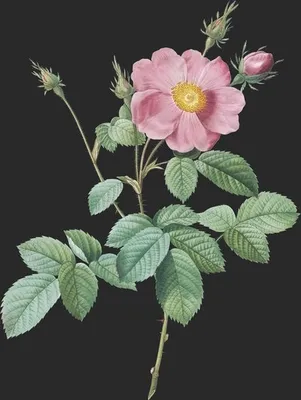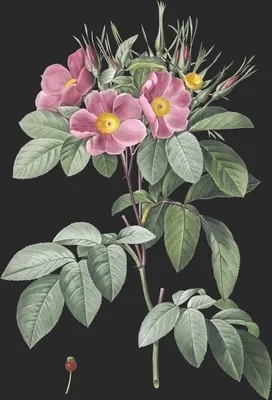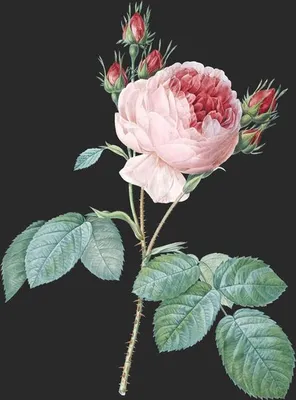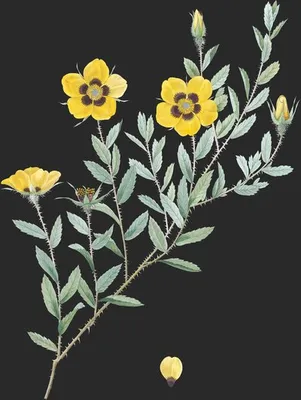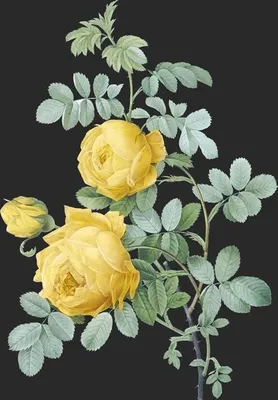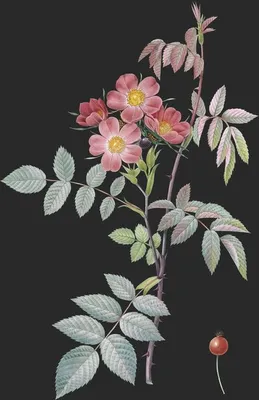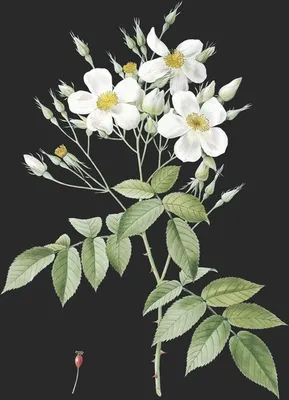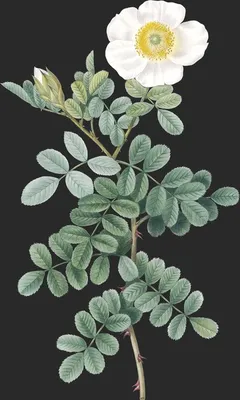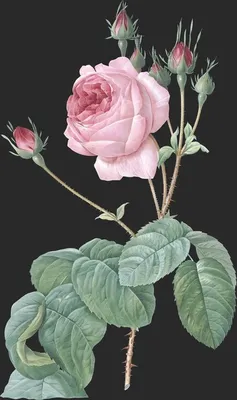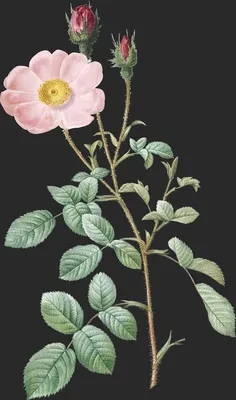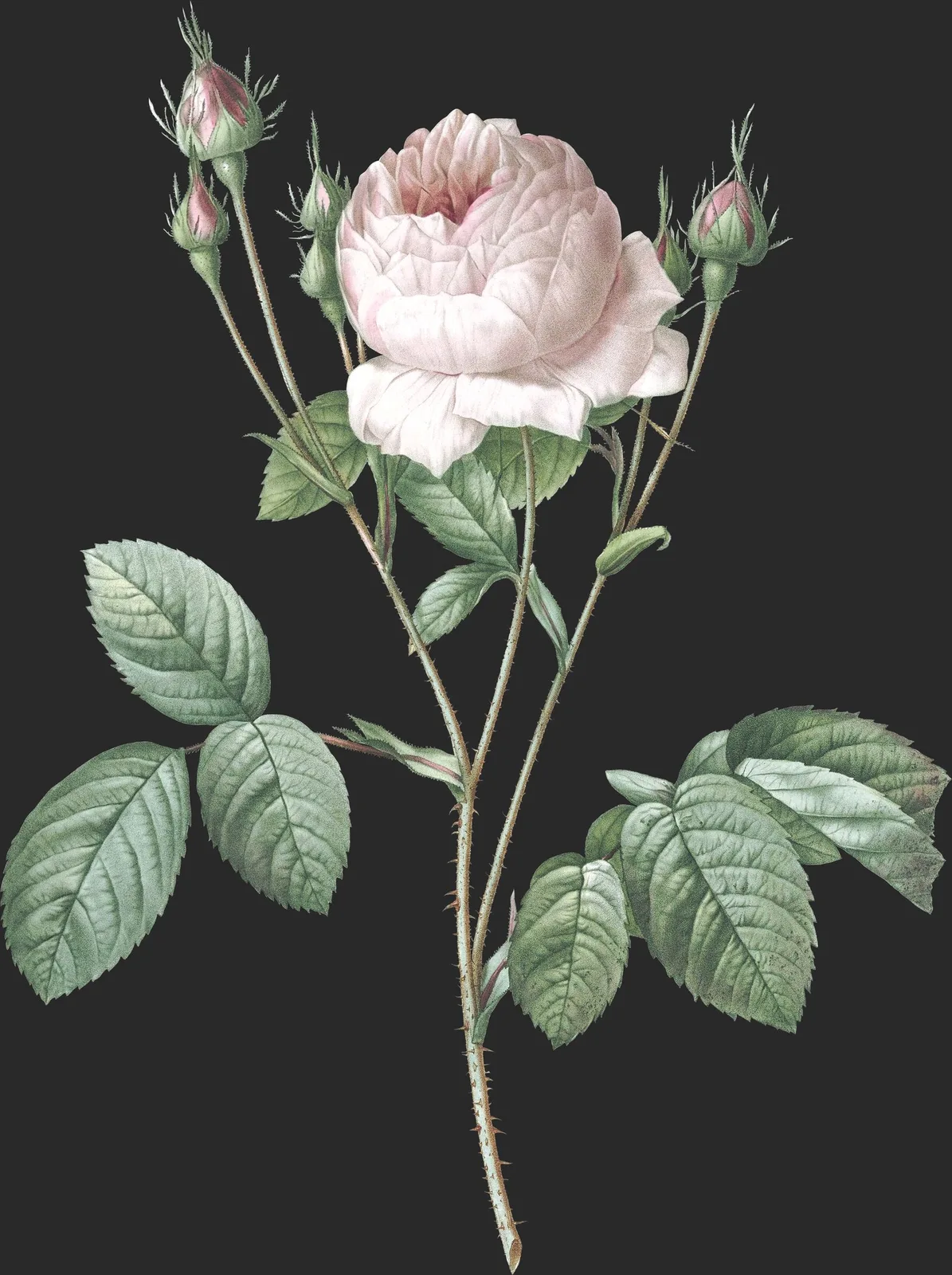
Rosa Centifolia var Carnea
Rosa Centifolia var Carnea
Le Rosier Vilmorin
About this plate
Description
Ce Rosier a été propagé, il y a quinze ou seize ans, par M. Vilmorin. C’est lui qui, le premier, a fait connaître cette belle variété, à laquelle on a donné son nom. Les amateurs de tous les pays se sont empressés de confirmer par leurs suffrages la dédicace de la plante dont nous présentons la figure, heureux de pouvoir offrir ce témoignage de leur reconnaissance à lhomme habile qui, long-temps avant qu’on connût la pépinière de M. Du Pont, avait déja réuni dans ses jardins la collection entière des Rosiers, et contribua ainsi à répandre le goût de la culture de ces arbustes.
Cette variété, due au hasard, est l’une de celles qu’on ne peut perpéluer qu’au moyen de la greffe. Par le procédé de la marcotte, on obtient des frans de pied: dans cet état le Rosier Vilmorin s’élève à deux pieds, ou environ; il forme des buissons couverts de fleurs presque pleines, quelquefois solitaires, plus souvent disposées par deux ou par trois à l’extrémité des rameaux, d’une dimension moyenne, odorantes, enfin Aune couleur de chair transparente et très-agréable à l’œil.
C’est cette dernière modification qui la distingue du Rosier a cent feuilles commun. Notre variété est plus ou moins hérissée d’aiguillons et de poils roides et glanduleux sur les tiges, selon son âge, et le climat dans lequel elle végète; les folioles sont d’un verd-clair, tomenteuses en-dessous, et supportées par un pétiole commun, glanduleux, rude au toucher. La couleur des pétales de cette variété la rapproche de la Bifera carnea du Botaniste cultivateur; mais la forme du tube du calice, ainsi que les folioles presque rondes et simplement dentées de ce dernier Rosier l’éloignent suffisamment du Vilmorin.
Observations
Cette Rose rentre facilement en couleur, c’est-à-dire qu’elle est plus disposée que toute autre de son espèce à reprendre ses nuances primitives: il en résulte que, souvent, on trouve sur le même pied des fleurs carnées avec des fleurs roses, et quelquefois des pétales à moitié roses, et à moitié blancs, phénomène qu’on observe surtout sur les sujets vigoureux, car les individus faibles présentent plus constamment la variété dans toute sa pureté. Il arrive aussi que le Rosier se mé tamorphose entièrement en fleurs parfaitement roses qui ne sont autres que des cent feuilles ordinaires, mais un peu moins volumineuses: dans cet état, quelques pépiniéristes donnent à larbuste le nom de Rosier Vilmorin à fleurs roses. On doit conclure de ces remarques que cette variété, pour être conservée, a besoin d’être renouvelée par la greffe, et qu’on la perdrait infailliblement si on l’abandonnait à elle-même. Les marcottes reprennent difficilement.
- R. Centifolia Carnea. Nouv. Duham. vol. 7, p. 35. var. 7.
- R. (à cent feuilles) Vilmorin. Bot. cult. ed. alt. № 21, var. 8. Mord. De Lau. Bon Jardinier, 1813, p. 775.
Twelve ways of seeing
- measured cast red
- upright 1.34 : 1
- published 1817
- Plate 27
Not a catalogue entry but a way of looking: how to stand, what to notice, how the line was cut, when it flowers, where it came from, who made it — and then the poems and the classics that taught China to see the same flower. Read the twelve in order and the plate opens.
-
First Look
搜尽奇峰打草稿。
—— 清·石涛《苦瓜和尚画语录》
Exhaust the strange peaks, and then make the sketch.
The sheet is vertical: the eye climbs and settles in the upper half. Let the plant stand before you look for detail. Then step in close: watch where colour meets line, and whether the line ever breaks. Third, find where the green is deepest: the whole tonal order is measured from that patch.
-
Name and Thing
The binomial is Rosa centifolia: the first word is the genus it belongs among, the second the epithet that sets it apart. Here the epithet centifolia means “hundred-leaved” — the name records the feature the namer noticed first. No established Chinese name exists, so it is cited by its binomial alone.
-
Form and Colour
Measured on this plate: flower colour covers 1.4% of the sheet, foliage 3.6%, the cast red with a second note of amber. No other plate shares exactly this measure. Roses are shrubs or scramblers with pinnate leaves of three to seven serrated leaflets; the double flowers open in crumpled, inward-curling layers around a small knot of yellow stamens. Filed under green — a moss green, a colour that comes mostly from leaf and stem. A single plant, laid out with nothing hidden.
-
Composition
Tall and narrow, the plant rising in one movement with generous margins — the upright format of most floras. (about 1.34 : 1) No details are appended: a plate for looking, not for keying out. The plant takes about 29% of the sheet, centred near the centre — the easy measure most florists kept to. Old plates set the plant slightly off centre, with unequal margins — that small imbalance is what keeps it alive.
-
Line and Colour
The first half of the nineteenth century moved from copper to steel to lithography; stipple could render the softest transition. There is evidence on the back too: the plate mark pressed into the paper, the slight relief of the pigment, lines worn shallow in a later printing.
-
Season
Late spring into early summer, peaking in May — the first flush of the garden year. The year 1817 on the plate is that of publication, not of flowering — the gathering came a year or two earlier. Note the season. Phenology is the most practical tool of appreciation.
-
Provenance
Widespread in the temperate north. Chinese gardeners knew roses since the Han; the ever-blooming modern rose is a nineteenth-century crossing of European and Chinese stock. The localities on the plate are those of a century ago; plants travel and places change their names.
-
The Book and the Hand
“Les Roses” was drawn by Pierre-Joseph Redouté and published 1817-1824. This plate is Plate 27, book page 27. The image is public domain; the hand-colouring is still one person's hand.
-
Poetic Resonance
水晶帘动微风起,满架蔷薇一院香。
—— 唐·高骈《山亭夏日》
The crystal blind stirs as a breeze rises; a trellis of roses perfumes the whole courtyard.
The poem gives the mood first and the picture supplies the form; set the line beside the plate and the green the corolla becomes its resting point.
-
The Written Tradition
人无癖不可与交,以其无深情也。
—— 明·张岱《陶庵梦忆》
Never make a friend of a man without an obsession: he has no deep feeling.
Tradition places roses in the Han imperial park; Song and Ming manuals named the double forms 'Baoxiang' and 'Ten Sisters', and Qing compendia separated rose, rugosa and monthly rose. Keep the line; it will surface the next time you meet the same plant.
-
Symbolism
In Europe the rose means love and secrecy ('sub rosa'); in Chinese verse the rambling rose leans and clings — lingering attachment rather than ardour. Meanings change their tune: the same flower can say opposite things within a century.
-
What to Take Away
Carry three rules away: whole before detail; line before colour; picture before book. The flower of that year is dust, yet its image on paper has outlived every living cousin.