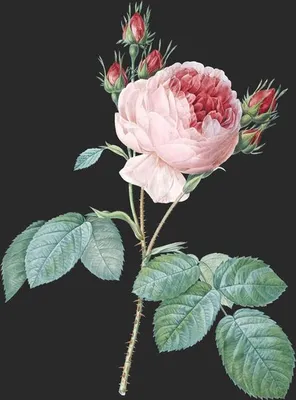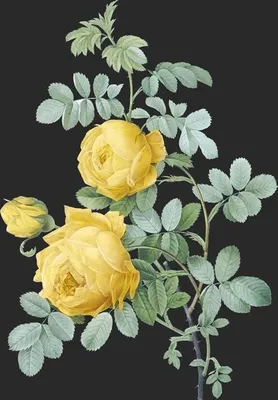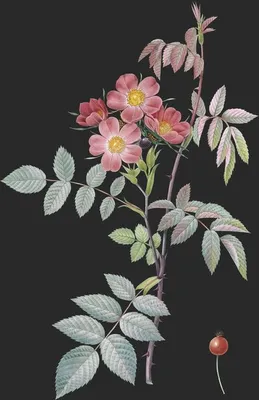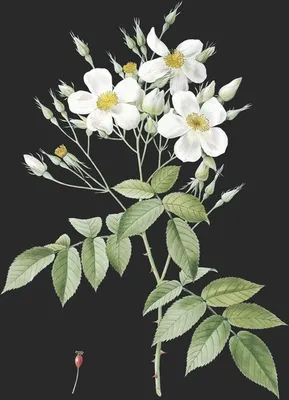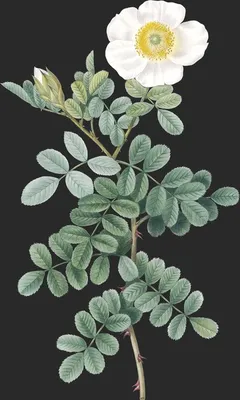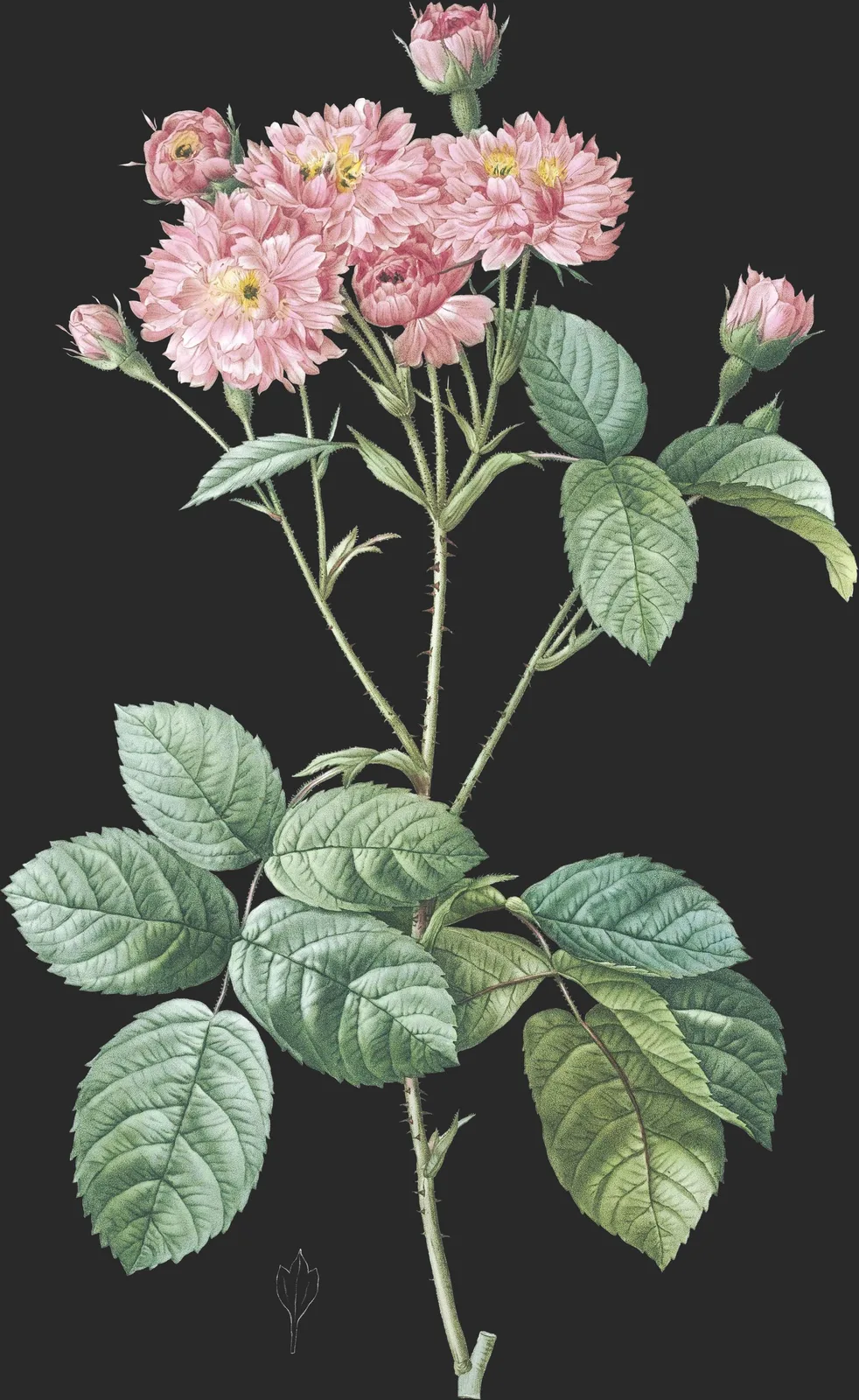
Rosa Centifolia var Caryophyllea
Le Rosier-Œillet
Le Rosier-Œillet
About this plate
Description
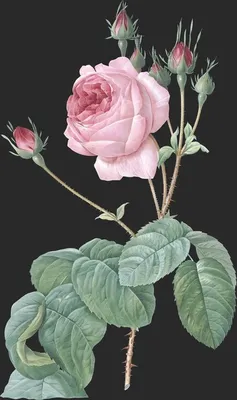
Cette variété du Rosier à cent feuilles est encore l’une de celles que l’on ne peut multiplier que par le procédé de la greffe ou celui de la marcotte. Le Rosier-œillet, cultivé à la manière des francs-de-pied s’élève, en un buisson peu touffu, à la hauteur de deux pieds, ou environ. Ses tiges, divergentes el vertes, sont armées d’un assez grand nombre d’aiguillons, les uns très-petits, et les autres longs, rougeâtres, un peu recourbés, sur-tout ceux qui naissent près des stipules. Les feuilles se composent de trois à cinq folioles ovales-pointues, d’un verd-gai en-dessus, plus pâles et tomenteuses en-dessous, munies en leurs bords d’un léger duvet entremêlé de quelques poils glanduleux: elles sont supportées par un pétiole velu, souvent garni de glandes un peu visqueuses, ayant à sa base des stipules allongées, pointues, à bordure découpée aussi velue et glanduleuse. Les fleurs terminales, disposées au nombre de trois, quelquefois de six à l’extrémité des rameaux, sont soutenues par des pédoncules hérissés, pour ainsi dire, d’un grand nombre de petits aiguillons inégaux. Les pédicelles sont munis d’aiguillons encore plus petits, entremêlés de poils roides et glanduleux. Chaque pédicelle partiel, excepté celui du milieu, est muni de bractées ovales-pointues. Le tube du calice, ovoïde, un peu rétréci au sommet, est, en partie, couvert de glandes sessiles et visqueuses. Les divisions du limbe, trois pinnatifides et deux simples, sont tomenteuses intérieurement et couvertes de pareilles glandes à l’extérieur et sur leurs bords. La corolle, assez petite, est composée de cinq à six rangs de pétales, roulés, chiffonnés dans l’intérieur, de couleur de rose-tendre fouettée de quelques taches d’un blanc-jaunâtre, irrégulièrement échancrés au sommet, terminés en un onglet allongé et blanc. Les styles sont longs et velus: le fruit est absolument semblable à celui du Rosier à cent feuilles.
Observations
Cette variété, dont la fleur présente l’aspect d’un œillet, est due au hasard: elle tire son origine d’une Rose à cent feuilles qui a dégénéré dans un jardin, à Mantes-sur-Seine, en 1800. C’est M. Du PoNT qui l’a conservée et propagée sous le nom de Rosa Caryophyllata. Elle reprend facilement ses formes primitives, et, pour la conserver, il faut la renouveler. Greffé sur le Rosier des Haies, ou sur des rejetons vigoureux du Rosier blanc, le Rosier-œillet produit de magnifiques têtes et beaucoup de fleurs; c’est ainsi qu’on le trouve presque toujours dans les pépinières, car il est assez rare franc-de-pied. Il demande l’exposition du levant.
- R. Centifolia caryophyllea petalis minoribus, longe unguiculatis, apice crenato-dissectis. Poiret, Ency. 6, p. 276.
- R. Unguiculata. Mord. De Launay, Bon Jard.
- R. Centifolia unguiculata. Desf. Cat. 175. Deleuze, Hist. des arbres et arbrisseaux de Desfontaines, 2, P. 163.
Twelve ways of seeing
- measured cast red
- upright 1.63 : 1
- published 1817
- Plate 44
Not a catalogue entry but a way of looking: how to stand, what to notice, how the line was cut, when it flowers, where it came from, who made it — and then the poems and the classics that taught China to see the same flower. Read the twelve in order and the plate opens.
-
First Look
凡画山水,意在笔先。
—— 唐·王维《山水论》
In painting, the intention precedes the brush.
The sheet is vertical: the eye climbs and settles in the upper half. Let the plant stand before you look for detail. Then step in close: watch where colour meets line, and whether the line ever breaks. Third, find where the green is deepest: the whole tonal order is measured from that patch. The pose leans right: the upper half carries 9 points further right than the lower — a living thing, not a diagram.
-
Name and Thing
The binomial is Rosa centifolia: the first word is the genus it belongs among, the second the epithet that sets it apart. Here the epithet centifolia means “hundred-leaved” — the name records the feature the namer noticed first. No established Chinese name exists, so it is cited by its binomial alone.
-
Form and Colour
Measured on this plate: flower colour covers 4.2% of the sheet, foliage 9.9%, the cast red. No other plate shares exactly this measure. Roses are shrubs or scramblers with pinnate leaves of three to seven serrated leaflets; the double flowers open in crumpled, inward-curling layers around a small knot of yellow stamens. Filed under green — a moss green, a colour that comes mostly from leaf and stem. Three things fix the habit: leaf arrangement, tepal count, and how the flower is borne.
-
Composition
Tall and narrow, the plant rising in one movement with generous margins — the upright format of most floras. (about 1.63 : 1) No details are appended: a plate for looking, not for keying out. The plant takes about 37% of the sheet, centred near the centre — the easy measure most florists kept to. Old plates set the plant slightly off centre, with unequal margins — that small imbalance is what keeps it alive.
-
Line and Colour
The first half of the nineteenth century moved from copper to steel to lithography; stipple could render the softest transition. Take a loupe to three places: petal edge, leaf vein, caption. An unbroken line means engraving; colour crossing the outline means a hand.
-
Season
Late spring into early summer, peaking in May — the first flush of the garden year. The year 1817 on the plate is that of publication, not of flowering — the gathering came a year or two earlier. Note the season. Phenology is the most practical tool of appreciation.
-
Provenance
Widespread in the temperate north. Chinese gardeners knew roses since the Han; the ever-blooming modern rose is a nineteenth-century crossing of European and Chinese stock. The localities on the plate are those of a century ago; plants travel and places change their names.
-
The Book and the Hand
“Les Roses” was drawn by Pierre-Joseph Redouté and published 1817-1824. This plate is Plate 44, book page 44. The image is public domain; the hand-colouring is still one person's hand.
-
Poetic Resonance
记取明年,蔷薇谢后。
—— 宋·贺铸《绿头鸭・多丽》
The poem gives the mood first and the picture supplies the form; set the line beside the plate and the green the corolla becomes its resting point.
-
The Written Tradition
插花不可太繁,亦不可太瘦。多不过二种三种,高低疏密,如画苑布置方妙。
—— 明·袁宏道《瓶史·宜称》
Flowers should be set neither too crowded nor too sparse — two or three kinds at most, tall and low, dense and open, arranged as a painter would compose.
Tradition places roses in the Han imperial park; Song and Ming manuals named the double forms 'Baoxiang' and 'Ten Sisters', and Qing compendia separated rose, rugosa and monthly rose. Keep the line; it will surface the next time you meet the same plant.
-
Symbolism
In Europe the rose means love and secrecy ('sub rosa'); in Chinese verse the rambling rose leans and clings — lingering attachment rather than ardour. Flower language was added later; the flower knows nothing of it, and that innocence is part of its power.
-
What to Take Away
Appreciation is not knowledge but habit — one more look each time. A flora exists to be consulted; look long enough and you forget to consult — someone in 1817 gave a whole day to a single flower.