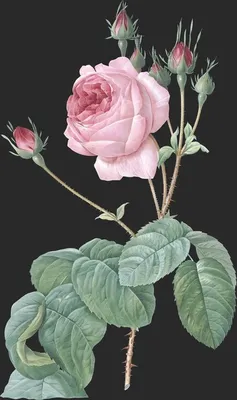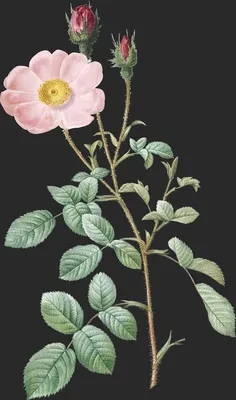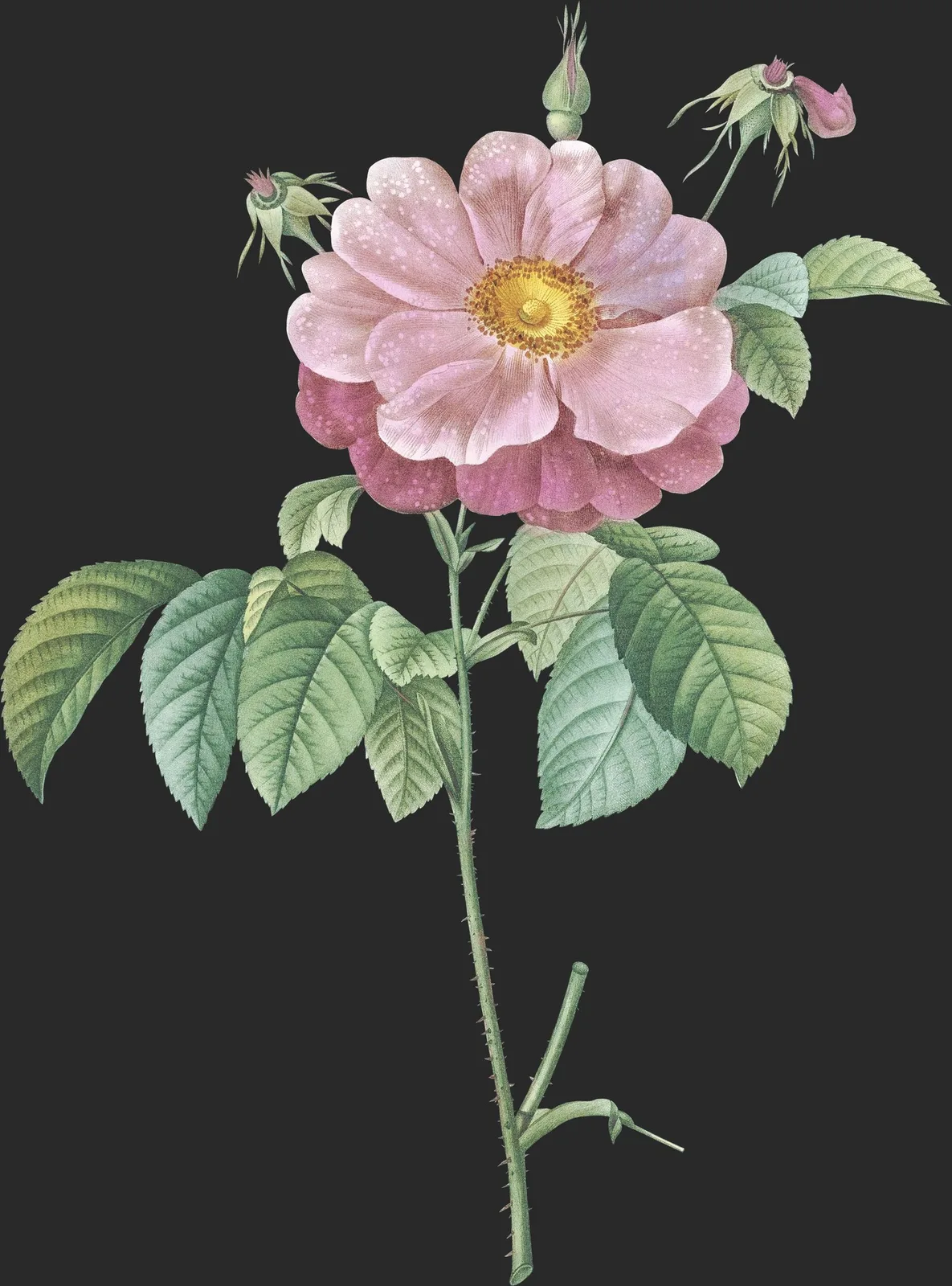
Rosa Gallica var Flore Marmoreo
狗牙蔷薇
Le Rosier de Provins
About this plate
Description
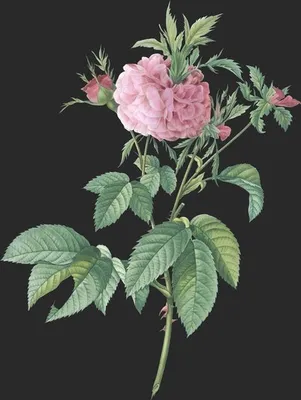
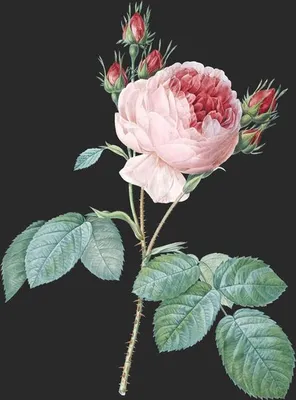
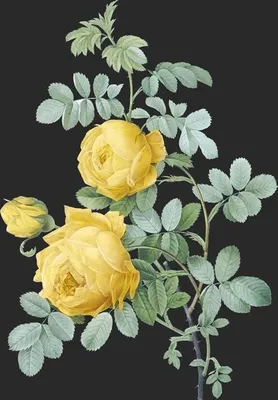
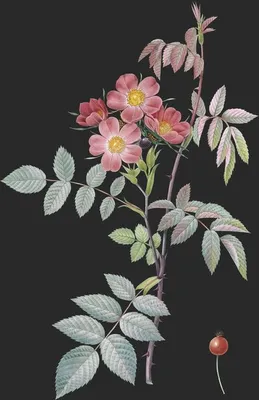
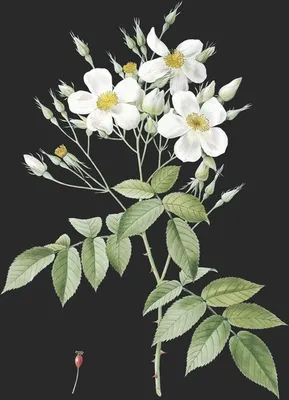
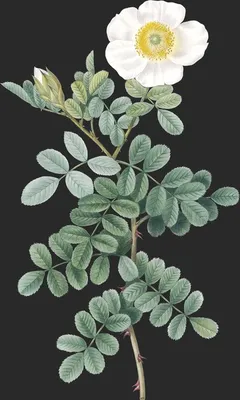
C’est un Rosier qui s’élève en buisson à la hauteur de trois ou quatre pieds. Ses branches sont armées de petits aiguillons courts, inégaux, presque droits, très-rapprochés, principalement sur les rameaux florifères. Les feuilles se composent de cinq ou de sept folioles, la plupart ovales-arrondies à la base et au sommet, vertes en-dessus, plus pâles en-dessous: elles sont portées par un pétiole légèrement tomenteux, muni de plusieurs petits aiguillons recourbés, ayant à la base deux stipules assez larges, bifides et pointues au sommet. Les fleurs, presque inodores, larges de trois pouces, et souvent plus, sont disposées plusieurs ensemble à l’extrémité des rameaux. Le tube ovoïde du calice est souvent glabre; parfois, aussi, il est muni de quelques poils roides et glanduleux: le pédoncule qui le supporte est entièrement couvert de poils très-courts, entremêlés de glandes sessiles. Les divisions du limbe sont pinnatifides. Corolle de deux à trois rangs de pétales d’un rose pâle, recouvert de taches d’un rose un peu plus foncé, qui représentent assez bien une espèce de marbrure. Étamines nombreuses; stigmates courts, réunis en une tête sessile demi-globuleuse.
Observations
Il n’est pas rare de rencontrer le Rosier à pétales marbrés dans le produit des semences des fruits du R. Gallica, avec des taches de différentes formes et couleurs. M. le docteur Loiseleur-des-Longchamps en a publié une très-belle sous-variété sous le nom de Rose pentade (R. Gallica meleagris) que nous n’avons pas citée en synonyme, parce que sa Rose diffère de la nôtre par les points constamment blancs et très-fins qui recouvrent les pétales.
Notre Rosier fait un très-bel effet greffé sur églantier: il est recherché, non seulement à cause des panachures dont nous avons parlé, mais encore parce que sa fleur ne présente qu’un petit, nombre de pétales, circonstance heureuse qui permet d’admirer ce jeu de la nature dans tous ses détails: on sait d’ailleurs que les amateurs préferent, en général, les Rosiers de Provins à fleurs simples ou semi-doubles, à ceux qui donnent des fleurs très-pleines.
- R. germinibus globosis; floribus magnis marmoreis; pedunculo hispido; caule petiolisque hispido-aculeatis; foliolis subovatis, subtusvillosis. And. Roses, cum Tab.
- R. Gallica marbled. Ait. Kew. ed. alt. var. γ. Miss Law. Tab. 57.
- R. Gallica marmorea, flore modice pleno, lucide purpureo, ca-lycibus pinnatis, germine pyriformi. Roess. Beschrei. der Rosen, part. 2, p. 56. Non R. marmorea Id. l. c. p. 6, № 2. An R. marmorea, Id. Roses, № 26?
- Rose marbrée. Hortul.
- Marbled Rose. Id.
- Die Marmorirte Franzrose. Id.
Twelve ways of seeing
- measured cast red
- upright 1.35 : 1
- published 1824
- Plate 138
Not a catalogue entry but a way of looking: how to stand, what to notice, how the line was cut, when it flowers, where it came from, who made it — and then the poems and the classics that taught China to see the same flower. Read the twelve in order and the plate opens.
-
First Look
江馆清秋,晨起看竹,烟光日影露气,皆浮动于疏枝密叶之间。
—— 清·郑板桥《题画竹》
On an autumn morning at the river lodge I looked at the bamboo: mist, sunlight, dew, all drifting among the sparse and dense leaves.
The sheet is vertical: the eye climbs and settles in the upper half. Let the plant stand before you look for detail. Then step in close: watch where colour meets line, and whether the line ever breaks. Third, find where the green is deepest: the whole tonal order is measured from that patch. The pose leans right: the upper half carries 10 points further right than the lower — a living thing, not a diagram.
-
Name and Thing
The binomial is Rosa gallica: the first word is the genus it belongs among, the second the epithet that sets it apart. Here the epithet gallica means “of Gaul” — the name records the feature the namer noticed first. The Chinese name 狗牙蔷薇 is a modern rendering of the Latin, not an old garden name.
-
Form and Colour
Measured on this plate: flower colour covers 4.8% of the sheet, foliage 7.6%, the cast red with a second note of crimson. No other plate shares exactly this measure. Roses are shrubs or scramblers with pinnate leaves of three to seven serrated leaflets; the double flowers open in crumpled, inward-curling layers around a small knot of yellow stamens. Filed under green — a moss green, a colour that comes mostly from leaf and stem. Read the outline, then the colour layers, then the brush.
-
Composition
Tall and narrow, the plant rising in one movement with generous margins — the upright format of most floras. (about 1.35 : 1) No details are appended: a plate for looking, not for keying out. The plant takes about 28% of the sheet, centred above centre — the easy measure most florists kept to. Blank paper is not unfinished work: it is where the eye rests.
-
Line and Colour
The first half of the nineteenth century moved from copper to steel to lithography; stipple could render the softest transition. Decide first whether it was printed or painted; only then discuss whether it is beautiful.
-
Season
Late spring into early summer, peaking in May — the first flush of the garden year. The year 1824 on the plate is that of publication, not of flowering — the gathering came a year or two earlier. The best time to read such a plate is its flowering season: three minutes under the tree explains what no text can.
-
Provenance
Widespread in the temperate north. Chinese gardeners knew roses since the Han; the ever-blooming modern rose is a nineteenth-century crossing of European and Chinese stock. The volume was made in 1817-1824, when most of this knowledge came from living plants under glass.
-
The Book and the Hand
“Les Roses” was drawn by Pierre-Joseph Redouté and published 1817-1824. This plate is Plate 138, book page 138. The image is public domain; the hand-colouring is still one person's hand.
-
Poetic Resonance
低头久立向蔷薇,爱似零陵香惹衣。
—— 唐·薛涛《春郊游眺寄孙处士二首》
The poem gives the mood first and the picture supplies the form; set the line beside the plate and the green the corolla becomes its resting point.
-
The Written Tradition
插花不可太繁,亦不可太瘦。多不过二种三种,高低疏密,如画苑布置方妙。
—— 明·袁宏道《瓶史·宜称》
Flowers should be set neither too crowded nor too sparse — two or three kinds at most, tall and low, dense and open, arranged as a painter would compose.
Tradition places roses in the Han imperial park; Song and Ming manuals named the double forms 'Baoxiang' and 'Ten Sisters', and Qing compendia separated rose, rugosa and monthly rose. You need not parse every word: take the line, and the flower acquires a second face.
-
Symbolism
In Europe the rose means love and secrecy ('sub rosa'); in Chinese verse the rambling rose leans and clings — lingering attachment rather than ardour. Meanings change their tune: the same flower can say opposite things within a century.
-
What to Take Away
Carry three rules away: whole before detail; line before colour; picture before book. A flora exists to be consulted; look long enough and you forget to consult — someone in 1824 gave a whole day to a single flower.