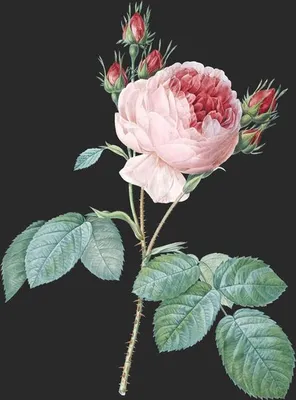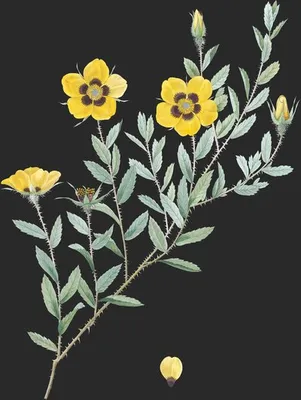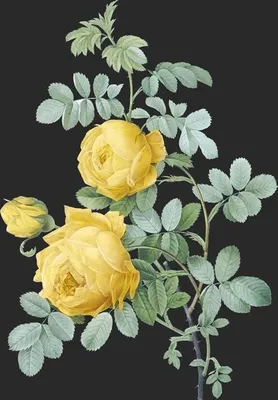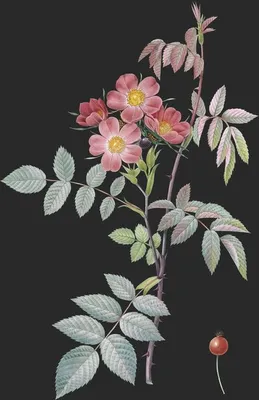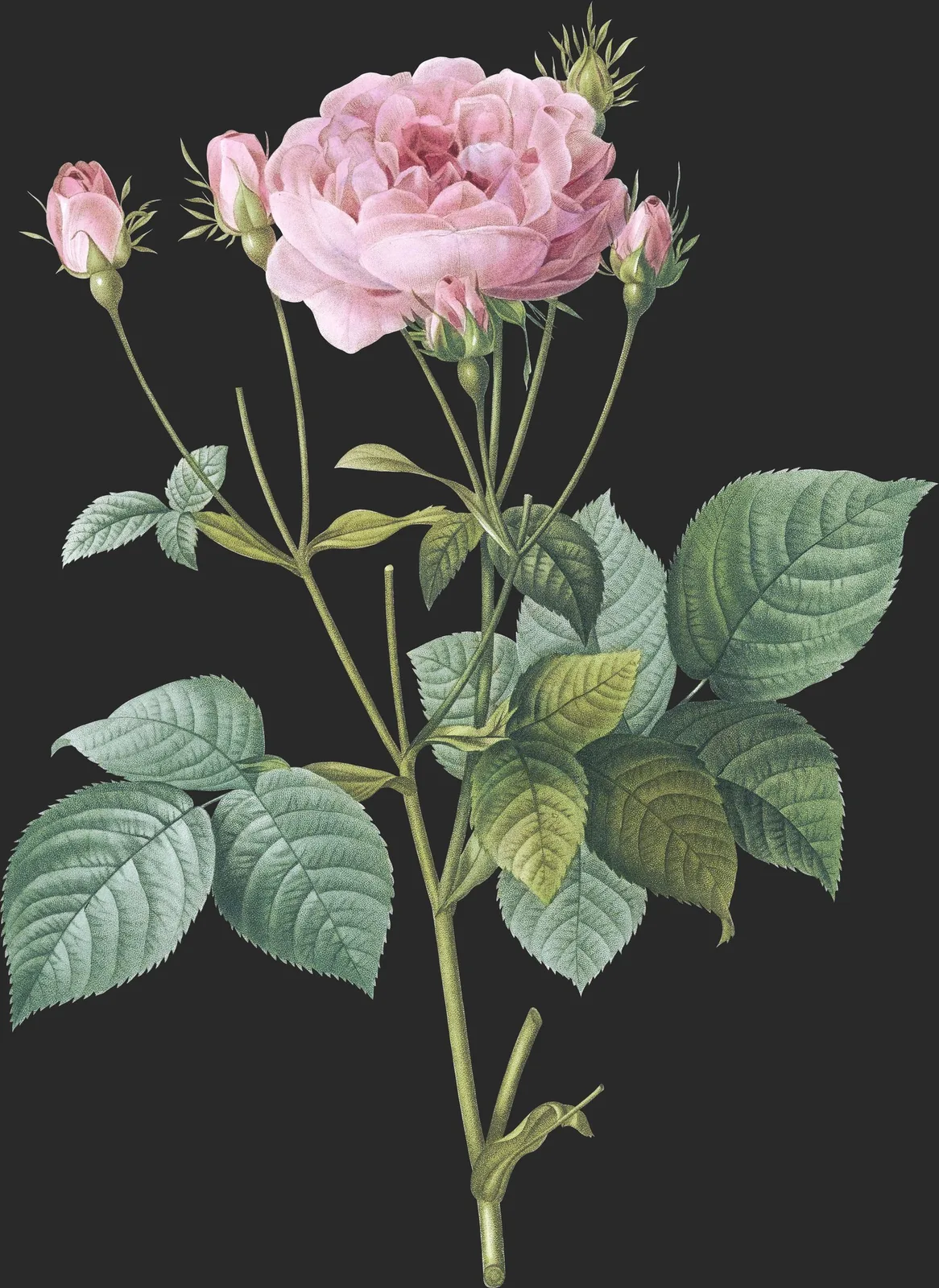
Rosa Gallica var Granati
狗牙蔷薇
Le Rosier de France
Ten ways of seeing
- measured cast yellow-green
- upright 1.37 : 1
First Look
凡画山水,意在笔先。
—— 唐·王维《山水论》
In painting, the intention precedes the brush.
The sheet is vertical: the eye climbs and settles in the upper half. Let the plant stand before you look for detail. Then step in close: watch where colour meets line, and whether the line ever breaks. Third, find where the green is deepest: the whole tonal order is measured from that patch.
Name and Thing
The binomial is Rosa gallica: the first word is the genus it belongs among, the second the epithet that sets it apart. Here the epithet gallica means “of Gaul” — the name records the feature the namer noticed first. The Chinese name 狗牙蔷薇 is a modern rendering of the Latin, not an old garden name.
Form and Colour
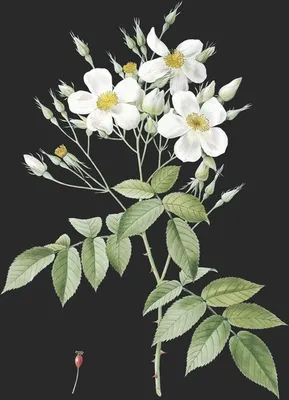
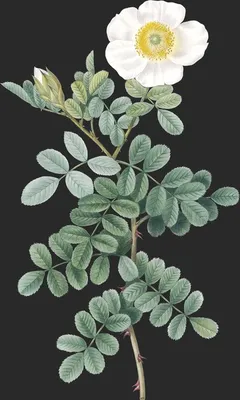
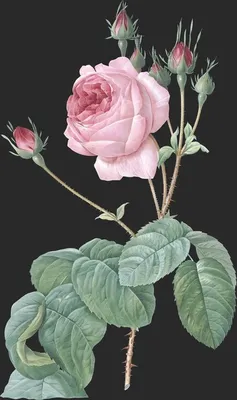
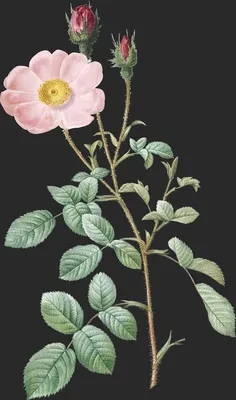
Measured on this plate: flower colour covers 6.0% of the sheet, foliage 7.3%, the cast yellow-green with a second note of red. No other plate shares exactly this measure. Roses are shrubs or scramblers with pinnate leaves of three to seven serrated leaflets; the double flowers open in crumpled, inward-curling layers around a small knot of yellow stamens. a moss green. Read the outline, then the colour layers, then the brush.
Composition
The sheet is tall. No details are appended: a plate for looking, not for keying out. The plant takes about 33% of the sheet, centred near the centre — the easy measure most florists kept to.
Line and Colour
The first half of the nineteenth century moved from copper to steel to lithography; stipple could render the softest transition. Take a loupe to three places: petal edge, leaf vein, caption. An unbroken line means engraving; colour crossing the outline means a hand. If you mean to copy it: take its skeleton, its margins and the order of its colours; the burin's hatching is the language of copper — suggest it with pencil density, do not imitate it stroke for stroke.
Poetic Resonance
想雪香酥暖,粉娇翠软,风流乐事,慰惬情怀。
—— 宋·无名氏《沁园春》
The poem gives the mood first and the picture supplies the form; set the line beside the plate and the green the corolla becomes its resting point.
Symbolism
In Europe the rose means love and secrecy ('sub rosa'); in Chinese verse the rambling rose leans and clings — lingering attachment rather than ardour. Flower language was added later; the flower knows nothing of it, and that innocence is part of its power.
Season and Place
Late spring into early summer, peaking in May — the first flush of the garden year. the ever-blooming modern rose is a nineteenth-century crossing of European and Chinese stock. The year 1821 on the plate is that of publication, not of flowering — the gathering came a year or two earlier. The bud and the ripe fruit on one branch tell the season; the name in the title often tells the journey.
The Book and the Hand
“Les Roses” carries only Pierre-Joseph Redouté's name. The image is public domain; the hand-colouring is still one person's hand.
What to Take Away
Carry three rules away: whole before detail; line before colour; picture before book. Two centuries on, the plant may still flower in some garden; the one on this sheet stopped in the season of 1821.
About this plate
Description
Cest la figure du fruit de cet arbrisseau qui a une ressemblance éloignée avec le fruit du grenadier (punica granatus), qui lui a fait donner, dans la pépinière de M. Villemorin, le nom sous lequel nous le présentons. Il s’élève, en un buisson peu touffu, à la hauteur de deux pieds et demi, ou environ. Ses rameaux sont armés d’aiguillons nombreux, iné-gaux, les uns droits, les autres recourbés. Les feuilles se composent de cing, rarement de sept folioles, grandes, d’un vert-pâle en-dessus, tomenteuses en-dessous et sur leur bordure, doublement et finement dentées, toutefois un peu moins épaisses et ridées que celles des autres variétés du R. Gallica. Elles sont portées par un pétiole velu, muni de plusieurs petits aiguillons, ayant, à sa base, deux stipules assez grandes, bifides, denticulées en leur bord. Les fleurs, presque inodores, sont disposées par trois ou quatre à l’extrémité des rameaux. Les pédoncules, ainsi que les tubes. arrondis du calice, sont garnis de petits poils glanduleux. Les divisions du limbe, allongées, quelquefois foliacées, trois pinnatifides et deux simples, sont aussi glanduleuses à l’extérieur, et velues intérieu-rement. Corolle de quatre à cinq rangs de pétales, d’un rose un peu pâle, à-peu-près analogue à celui des pétales de la Rose à cent feuilles commune. Styles un peu allongés et presque réunis en faisceau.
Observations
Cette belle variation du Rosier de France, très-remarquable par la couleur de ses pétales et sur-tout par la forme de ses fruits, a été obtenue de semence par M. Villemorin, il y a déja plusieurs années. On la trouve dans quelques jardins d’amateurs; mais elle n’est pas très-répandue. Sa culture est la même que celle que l’on donne à tous les individus du groupe des Gallicæ. Elle veut être taillée un peu court. L’arbrisseau donne ses fleurs à la fin de juin.
 Previous plate
Rosa Pimpinellifolia Major var Flore Variegato
 Next plate
Rosa Sepium var Flore Submultiplici