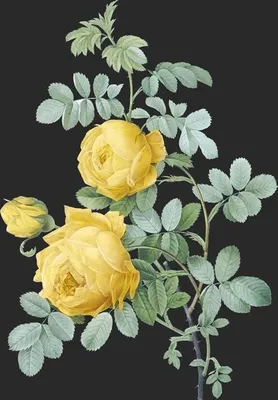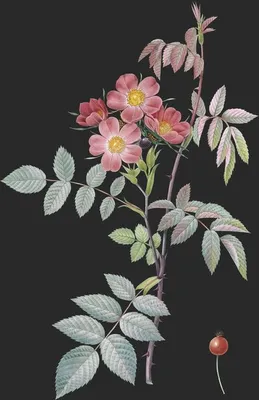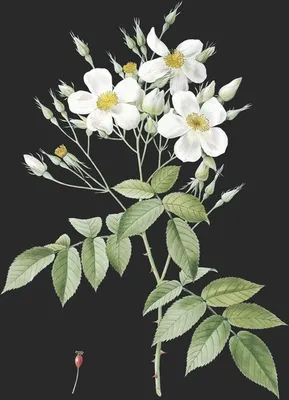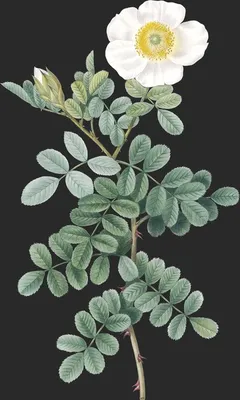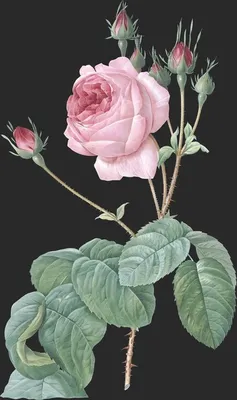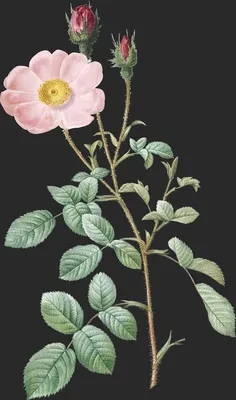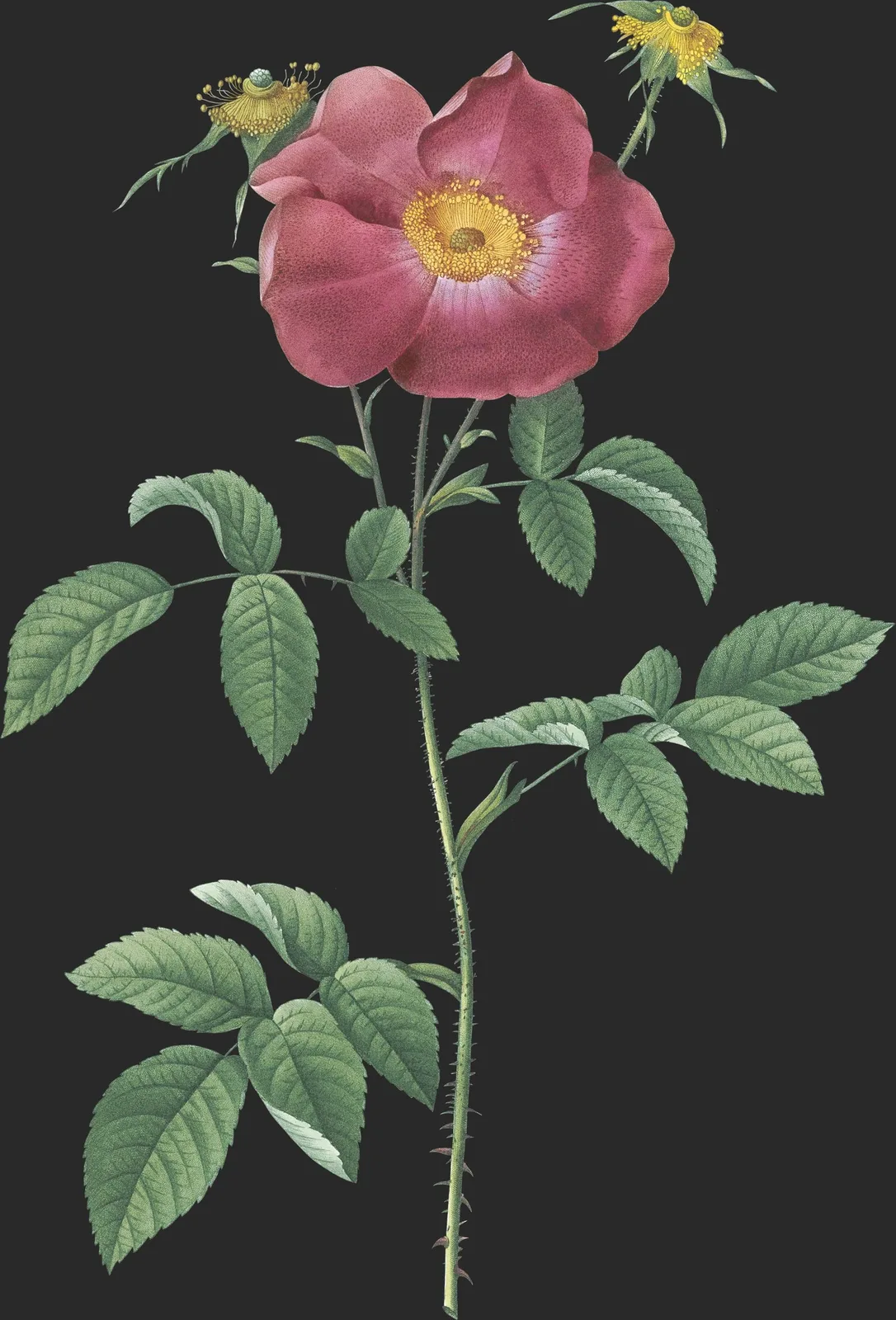
Rosa Gallica var Stapeliæ Flora
狗牙蔷薇
Le Rosier de Provins
About this plate
Description
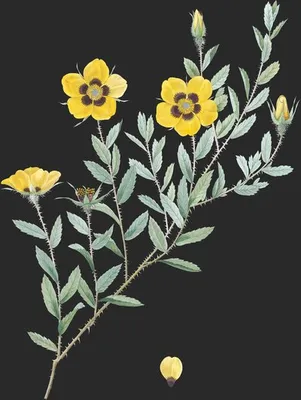
Cet arbrisseau s’élève en buisson à la hauteur de deux pieds et demi, ou environ. Ses branches sont munies, à leur partie supérieure, de poils spinuliformes, courts, entremêlés de glandes: leur partie inférieure est armée de quelques aiguillons courts, inégaux, les uns droits, les autres un peu recourbés. Les cinq folioles dont les feuilles se composent, sont assez. petites, glabres en-dessus, tomenteuses en-dessous, glanduleuses et ciliées en leur bord. Le pétiole qui les supporte, légèrement velu, un peu aiguillonné, est muni, à la base, de stipules bifides et pointues au sommet, denticulées en leur bord. Les fleurs, rarement solitaires, sont presque toujours réunies par trois à l’extrémité des rameaux. Le tube du calice est glabre: il est porté par un pédoncule garni de poils roides et glandu-leux. Les divisions du limbe, trois pinnatifides et deux simples, sont cotonneuses intérieurement et couvertes, à l’extérieur, de petites glandes sessiles. Corolle de cinq pétales, grands, un peu concaves, d’un pourpre assez foncé, recouverts en partie d’un grand nombre de petites taches d’un jaune fauve, rougeâtres, ou d’autres couleurs disposées en ligne longitudinale. Étamines très-nombreuses. Styles réunis en une tête convexe au centre de la fleur. Fruit presque rond, d’abord rougeâtre, enfin noir à la maturité.
Observations
Le nom que nous avons imposé à ce Rosier dérive des taches qui recouvrent les pétales des fleurs, lesquelles rappellent celles que l’on remarque sur certaines variétés du genre Stapelia, (Willd. 1, 1277), en faisant observer cependant que, dans ces dernières plantes, les taches sont disposées en lignes trans-versales. Quoique la ressemblance ne soit pas précisément spé-ciale, nous avons cru pouvoir tirer le nom de notre variété de cette particularité dans la fleur, le Rosier ne présentant rien d’assez marquant pour le faire distinguer autrement de l’espèce primitive.
- R. germinibus subovatis pedunculisque glanduloso-hispidis; foliolis ovalibus duplicato-dentatis; petiolis glandulosis aculeatis; caule acu-leis inequalibus sparsis.
- *Corolla speciosa maculis lineisque fusco-purpureis undulato-variegata. (N.)
Ten ways of seeing
- measured cast red
- upright 1.47 : 1
- published 1824
- Plate 141
Not a catalogue entry but a way of looking: how to stand, what to notice, how the line was cut — then, halfway, a line of Chinese poetry: how the ancients saw this same flower. After it, the flower's language, its season and homeland, its book; and at the end one line of classical prose — and a pair of eyes to take away.
-
First Look
六法者何?一、气韵生动是也;二、骨法用笔是也;三、应物象形是也;四、随类赋彩是也;五、经营位置是也;六、传移模写是也。
—— 南齐·谢赫《古画品录》
The six laws: spirit resonance alive; bone-method in the brush; matching form; colour by kind; planning the placing; copying the masters.
The sheet is vertical: the eye climbs and settles in the upper half. Let the plant stand before you look for detail. Then step in close: watch where colour meets line, and whether the line ever breaks. Third, find where the green is deepest: the whole tonal order is measured from that patch. The pose leans right: the upper half carries 8 points further right than the lower — a living thing, not a diagram.
-
Name and Thing
The binomial is Rosa gallica: the first word is the genus it belongs among, the second the epithet that sets it apart. Here the epithet gallica means “of Gaul” — the name records the feature the namer noticed first. The Chinese name 狗牙蔷薇 is a modern rendering of the Latin, not an old garden name.
-
Form and Colour
Measured on this plate: flower colour covers 9.6% of the sheet, foliage 10.6%, the cast red. No other plate shares exactly this measure. Roses are shrubs or scramblers with pinnate leaves of three to seven serrated leaflets; the double flowers open in crumpled, inward-curling layers around a small knot of yellow stamens. Filed under green — a moss green, a colour that comes mostly from leaf and stem. Three things fix the habit: leaf arrangement, tepal count, and how the flower is borne.
-
Composition
Tall and narrow, the plant rising in one movement with generous margins — the upright format of most floras. (about 1.47 : 1) No details are appended: a plate for looking, not for keying out. The plant covers only 28% of the sheet, centred above centre; the emptiness is where the eye rests. Old plates set the plant slightly off centre, with unequal margins — that small imbalance is what keeps it alive.
-
Line and Colour
The first half of the nineteenth century moved from copper to steel to lithography; stipple could render the softest transition. Decide first whether it was printed or painted; only then discuss whether it is beautiful. If you mean to copy it: take its skeleton, its margins and the order of its colours; the burin's hatching is the language of copper — suggest it with pencil density, do not imitate it stroke for stroke.
-
Poetic Resonance
记取明年,蔷薇谢后。
—— 宋·贺铸《绿头鸭・多丽》
The poem gives the mood first and the picture supplies the form; set the line beside the plate and the green the corolla becomes its resting point.
-
Symbolism
In Europe the rose means love and secrecy ('sub rosa'); in Chinese verse the rambling rose leans and clings — lingering attachment rather than ardour. In a flora it is a species first and a symbol second; the order is worth keeping.
-
Season and Place
Late spring into early summer, peaking in May — the first flush of the garden year. the ever-blooming modern rose is a nineteenth-century crossing of European and Chinese stock. The year 1824 on the plate is that of publication, not of flowering — the gathering came a year or two earlier. The bud and the ripe fruit on one branch tell the season; the name in the title often tells the journey.
-
The Book and the Hand
“Les Roses” was drawn by Pierre-Joseph Redouté and published 1817-1824. This plate is Plate 141, book page 141. The image is public domain; the hand-colouring is still one person's hand.
-
The Written Tradition
插花不可太繁,亦不可太瘦。多不过二种三种,高低疏密,如画苑布置方妙。
—— 明·袁宏道《瓶史·宜称》
Flowers should be set neither too crowded nor too sparse — two or three kinds at most, tall and low, dense and open, arranged as a painter would compose.
Tradition places roses in the Han imperial park; Song and Ming manuals named the double forms 'Baoxiang' and 'Ten Sisters', and Qing compendia separated rose, rugosa and monthly rose. You need not parse every word: take the line, and the flower acquires a second face.
What to Take Away
Appreciation is not knowledge but habit — one more look each time. A flora exists to be consulted; look long enough and you forget to consult — someone in 1824 gave a whole day to a single flower.