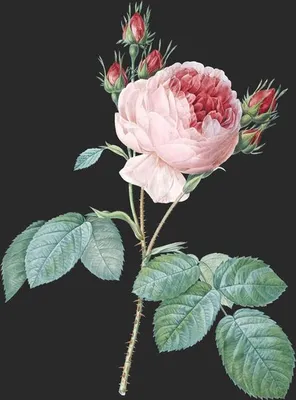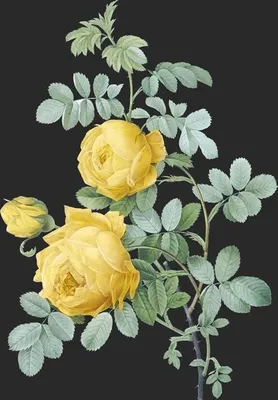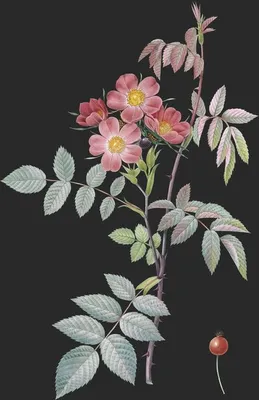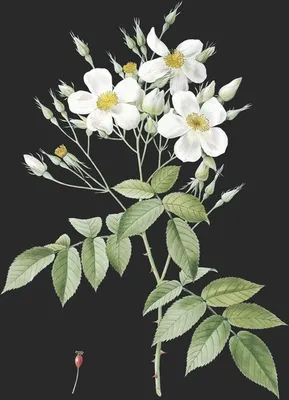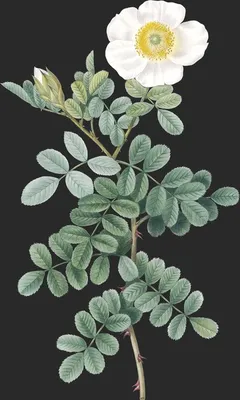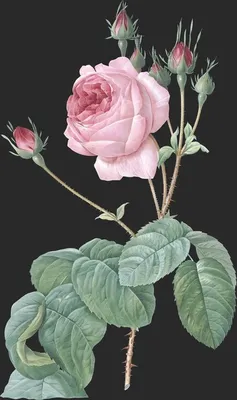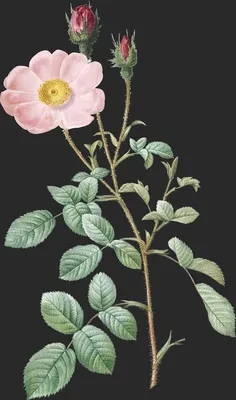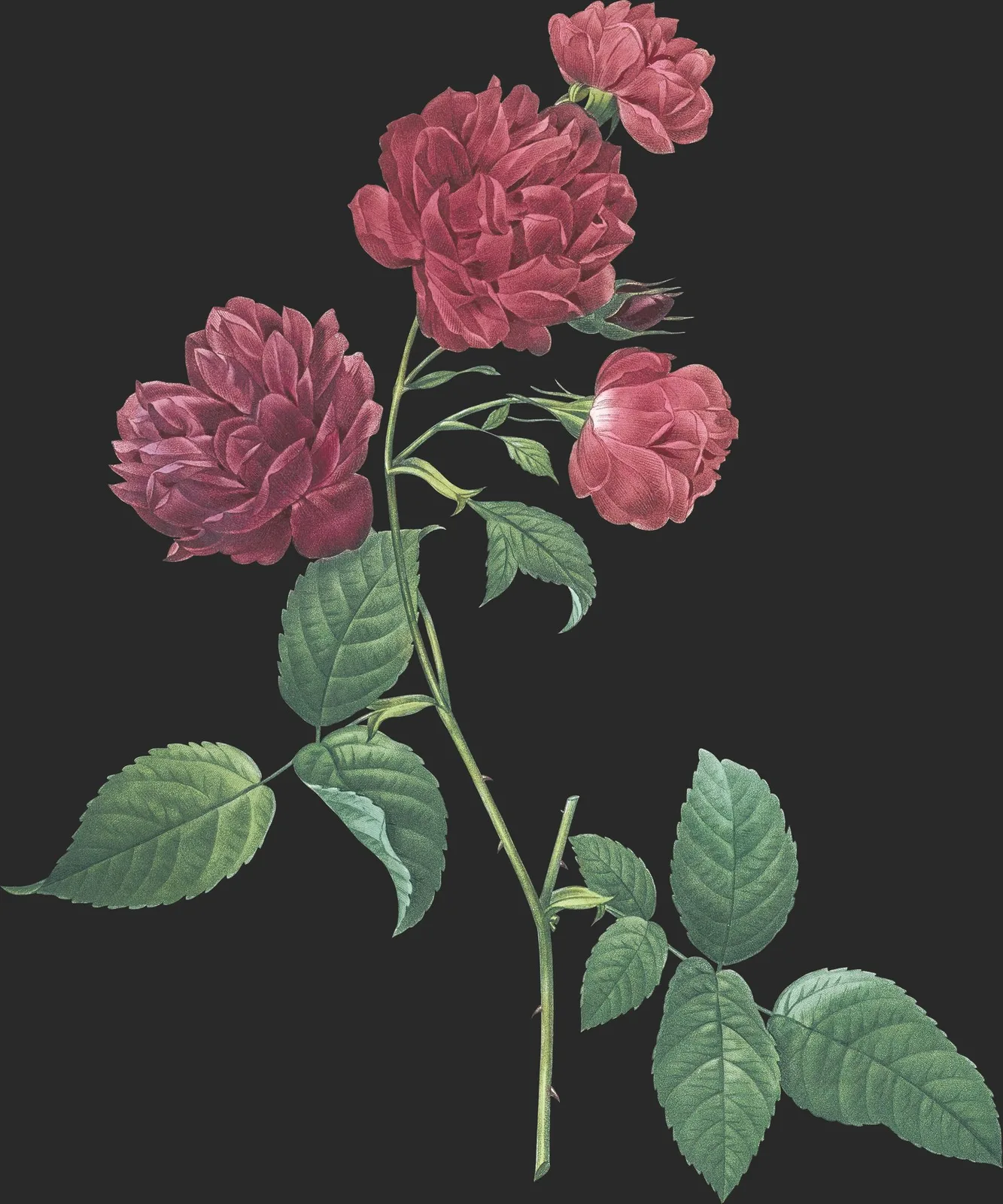
Rosa Indica Caryophillea
Le Bengale-Œillet
Le Bengale-Œillet
Ten ways of seeing
- measured cast red
- slightly upright 1.20 : 1
First Look
竖划三寸,当千仞之高;横墨数尺,体百里之迥。
—— 南朝宋·宗炳《画山水序》
A vertical stroke of three inches stands for a cliff of a thousand fathoms; a few feet of ink holds a hundred li.
Slightly taller than wide; the eye lands above centre. Then step in close: watch where colour meets line, and whether the line ever breaks. Third, find where the magenta is deepest: the whole tonal order is measured from that patch. The pose leans left: the upper half carries 10 points further left than the lower — a living thing, not a diagram.
Name and Thing
Only the genus Rosa is given; species-level names came later. No established Chinese name exists, so it is cited by its binomial alone.
Form and Colour
Measured on this plate: flower colour covers 11.7% of the sheet, foliage 9.7%, the cast red. No other plate shares exactly this measure. Roses are shrubs or scramblers with pinnate leaves of three to seven serrated leaflets; the double flowers open in crumpled, inward-curling layers around a small knot of yellow stamens. Filed under magenta — a crimson-magenta, built in washes from a pale ground. Read the outline, then the colour layers, then the brush.
Composition
The sheet is slightly tall. No details are appended: a plate for looking, not for keying out. The plant covers only 27% of the sheet, centred near the centre; the emptiness is where the eye rests.
Line and Colour
The first half of the nineteenth century moved from copper to steel to lithography; stipple could render the softest transition. Decide first whether it was printed or painted; only then discuss whether it is beautiful. If you mean to copy it: take its skeleton, its margins and the order of its colours; the burin's hatching is the language of copper — suggest it with pencil density, do not imitate it stroke for stroke.
Poetic Resonance
行时载酒寻芳,湖湾堤曲,放浪红尘脚。
—— 宋·黄人杰《念奴娇》
The poem gives the mood first and the picture supplies the form; set the line beside the plate and the magenta the corolla becomes its resting point.
Symbolism
In Europe the rose means love and secrecy ('sub rosa'); in Chinese verse the rambling rose leans and clings — lingering attachment rather than ardour. This plate leans magenta, which in flower language adds one more degree of feeling. Meanings change their tune: the same flower can say opposite things within a century.
Season and Place
Late spring into early summer, peaking in May — the first flush of the garden year. the ever-blooming modern rose is a nineteenth-century crossing of European and Chinese stock. The year 1824 on the plate is that of publication, not of flowering — the gathering came a year or two earlier. Read the locality and the flowering season both with a discount: one is hearsay, the other a ten-day peak.
The Book and the Hand
“Les Roses” carries only Pierre-Joseph Redouté's name. From drawing to plate the sheet passed through several hands — the engraver aimed at accuracy, the colourist at speed, and between them lies each plate's unevenness.
What to Take Away
Appreciation is not knowledge but habit — one more look each time. Two centuries on, the plant may still flower in some garden; the one on this sheet stopped in the season of 1824.
About this plate
Description
C’est un arbrisseau très-élégant, qui s’élève à la hauteur de quinze à vingt pouces au plus. Les rameaux florifères sont, assez généralement, dépourvus d’aiguillons: les rameaux adultes en présentent quelques-uns, assez petits et recourbés. Les feuilles se composent de cinq folioles glabres, vertes en-dessus, plus pâles en-dessous, l’impaire très-aigue, à dentelure crénelée, chaque dent surmontée d’une petite glande. Elles sont portées par un pétiole glanduleux muni, en-dessous, de quelques petits aiguillons rougeâtres et crochus: à sa base sont deux stipules bifides et pointues au sommet, denticulées en leur bord. Les fleurs, légèrement odorantes, presque aussi doubles que celles du R. des Indes-Cent-feuilles, naissent par trois à l’extrémité des rameaux où elles se réunissent en une espèce d’ombelle. Le tube du calice est ovoïde, glabre, et marqué de quelques cannelures longitudinales. Le pédoncule commun est glabre, mais les pédicelles sont hispides-glanduleux. A la base de chaque pédicelle se trouvent des stipules longues et étroites. Les divisions du limbe sont simples, pointues au sommet, à bordure garnie de petites glandes sessiles. Corolle de huit à dix rangs de pétales, d’un beau rose assez foncé, quelques-uns traversés par une ligne blanche qui règne depuis l’onglet jusqu’au som-met. Ces pétales, irrégulièrement échancrés, se gaufrent et se chiffonnent dans leur longueur, de sorte que la fleur, en état de parfait développement, ressemble assez bien à un œillet. Le fruit est ovoide un peu arrondi, et glabre.
Observations
C’est M. Redouté qui a obtenu cette variété de la semence des graines du Bengale ordinaire. Elle se distingue très-bien de toutes les autres par le bel incarnat de ses couleurs et par la forme assez singulière de ses pétales. Cette dernière circonstance l’a fait nommer Bengale-œillet, parce qu’en effet elle a une ressemblance marquée avec la fleur de cette plante. Sa culture est la même que celle que l’on donne à tous les Rosiers de ce groupe. On doit lélever en pot et le rentrer l’hiver dans l’orangerie.
R. germinibus ovatis, glabris; pedicellis hispido-glandulosis; cyma trifida. (N.)